



SKT partners with Xilinx to build AI-intensive data center
 Published2018.08.16 15:00
Building hardware to keep pace with AI development
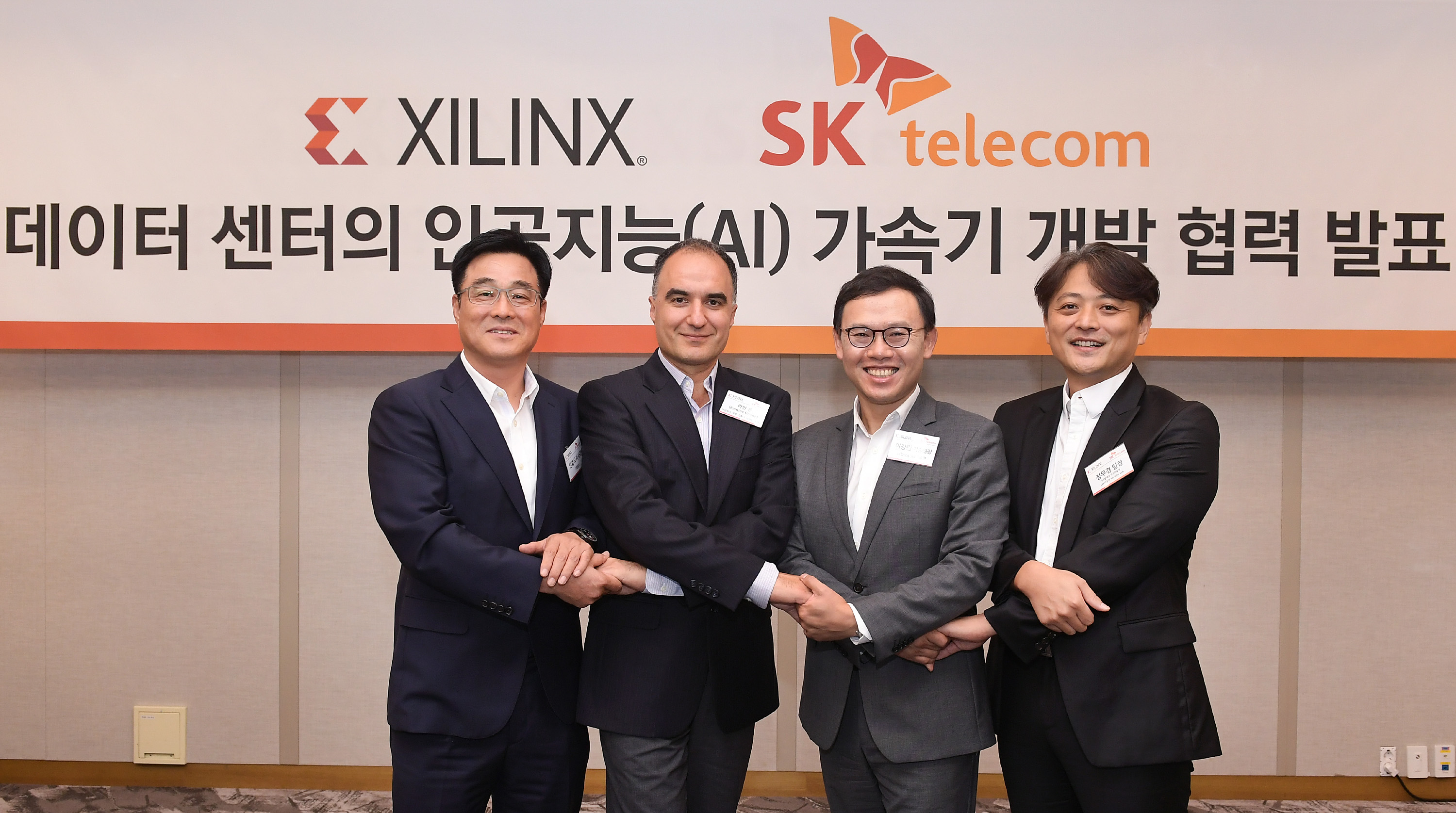
From left: Xilinx CEO Ahn Heung-sik, Xilinx Vice President Ramin Ron, SKT Technology Director Lee Kang-won, and SKT Team Leader Jeong Mu-gyeong.
SK Telecom has deployed Xilinx FPGAs as artificial intelligence (AI) accelerators in its data centers.
AI is like the "electricity" of the Fourth Industrial Revolution. Even now, AI is being applied across a wide range of fields, complementing the limitations of existing methods and creating new value. However, unlike the rapid advancements in AI algorithms and machine learning models, the advancement of AI computing platforms, or hardware, is reaching its limits. For example, for every one improvement in hardware, AI can improve eight times.
ASICs (Application Specific Integrated Circuits), widely used in the industry, are custom-built semiconductors designed and manufactured by semiconductor manufacturers for specific user needs, making it extremely difficult to respond immediately to the rapid pace of AI development. Consequently, Field Programmable Gate Arrays (FPGAs), semiconductors with programmable logic elements and programmable internal circuits, are emerging as an alternative. This is because they enable rapid hardware programming on-site. FPGAs accelerate CPUs and GPUs in data center servers. Intel's acquisition of Altera was also aimed at accelerating CPUs for existing X86 servers.
On August 16th, Xilinx and SK Telecom held a press conference in Gangnam and jointly announced that Xilinx Kintex UltraScale FPGAs are currently deployed in SK Telecom's data centers to accelerate NUGU, SK Telecom's voice recognition platform. This marks the first commercial deployment of FPGA accelerators in the AI domain for a large-scale data center in Korea. Xilinx's FPGA accelerators are currently successfully running automatic speech recognition (ASR) applications.
FPGA accelerators lower the total cost of ownership (TCO) of ASR application servers by adding Xilinx FPGA add-in cards to existing CPU-only servers. ASR servers can easily and simply accelerate multiple voice service channels by installing Xilinx FPGA cards in empty slots. A single FPGA card delivers over five times the performance of a single server, resulting in significant cost savings.
SK Telecom's data center's FPGA accelerators have been installed since June of this year. Since then, FPGA accelerators have achieved up to five times higher performance than GPUs in ASR applications, with power efficiency improved by 16 times. Furthermore, DSP efficiency has increased by 95% across all work cycles.
“I’ve watched this industry grow and develop over the past few years, and I’m proud to be leading the way in developing AI accelerators,” said Kangwon Lee, head of SK Telecom’s Software Technology Research Center. “By designing a solution based on the Xilinx KCU1500 board and SK Telecom’s own bitstream image, we have developed a cost-effective and high-performance application,” he said.
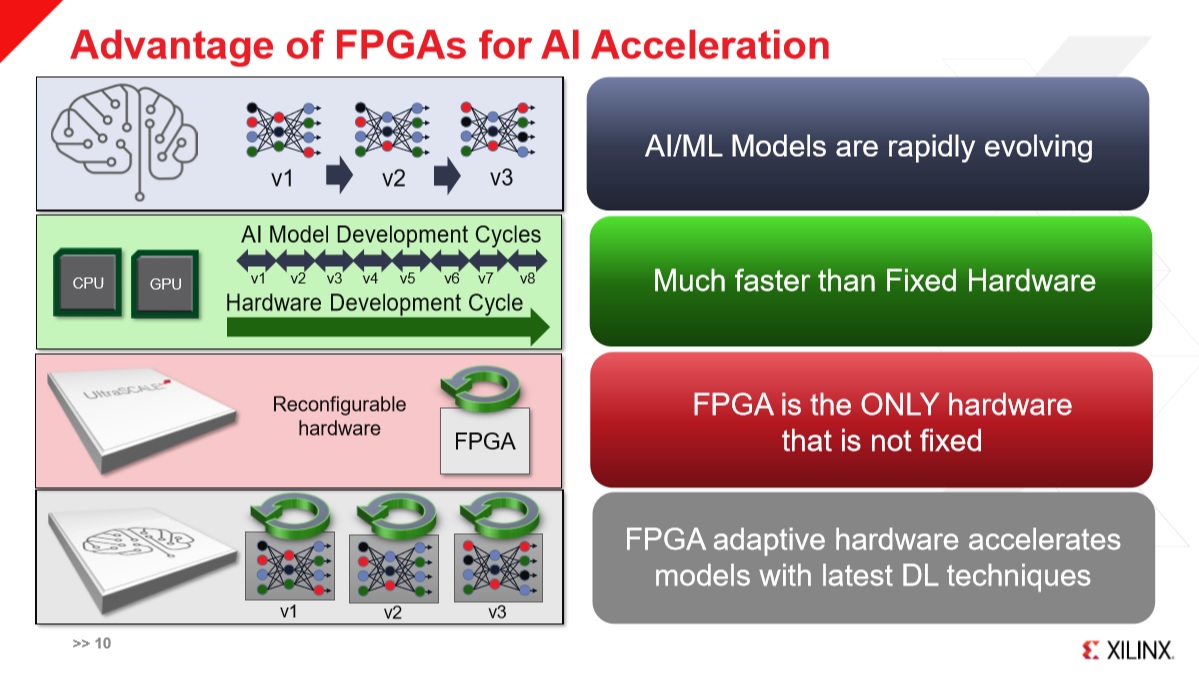
The adaptability of Xilinx FPGAs enables rapid deployment of custom hardware accelerators for the rapidly evolving fields of AI and deep learning. FPGAs also offer higher performance and lower latency at lower power consumption compared to CPUs and GPUs. SK Telecom joins a growing list of leading commercial data center companies deploying FPGAs for computing acceleration, including Baidu, Tencent, Alibaba, AWS, Huawei, and Nimbix.
“We are excited to be the first in Korea to supply Xilinx FPGAs to SK Telecom’s AI data center,” said Manish Muthal, vice president of data center marketing at Xilinx. “Our Kintex UltraScale KCU1500 FPGAs demonstrate Xilinx’s competitive edge in this application. Xilinx will continue to focus our technology capabilities and innovation on data center acceleration.”
SK Telecom and Xilinx will continue their collaboration beyond ASR. They will enhance natural language processing and image recognition capabilities to create NUGU, which can identify users, answer questions, and communicate with them. Furthermore, T-View, a cloud video security service, plans to lower false alarms to less than 5% through AI-powered video analysis aided by FPGA accelerators, thereby enhancing its market competitiveness. We are also strengthening solutions such as 'HD maps' for autonomous vehicle services to be launched in the future.
Meanwhile, Xilinx plans to complete development of the Adaptive Compute Acceleration Platform (ACAP), which can overcome the limitations of FPGAs, by the end of the year. ACAP is a highly integrated, multi-core, heterogeneous computing platform that can be modified at the hardware level to adapt to the massive workload demands of diverse applications. Software developers can develop target systems based on ACAP using tools such as C/C++, OpenCL, and Python. FPGA tools can also be used to program at the RTL level. The first ACAP product family, codenamed "Everest," is currently being developed using TSMC's 7nm process technology.
Comments
Related news
Data centers compete on speed, power efficiency, and adaptive acceleration technologies.
Xilinx's trajectory, which can be considered the ancestor of traditional FPGAs, is noteworthy. Xilinx's FPGA business, which began as an emulator for semiconductor ASICs, has challenged the market as a platform with adaptive acceleration as its strength, threatening the CPU and GPU markets previously dominated by established players. Applications requiring fast processing, such as AI, machine learning, and big data processing, require fast server-level processing and efficient computing resource utilization. For these reasons, FPGAs have been widely used in servers within data centers to assist in CPU and GPU acceleration, and Intel's acquisition of Altera is also being utilized in the direction of CPU acceleration for existing X86 servers.
2018.04.25by 명세환 기자
Xilinx to Provide Technology to Daimler AG to Power AI-Based Automotive Applications
Xilinx and Daimler AG announced that they will collaborate on the development of in-car systems for artificial intelligence (AI) processing in automotive applications.
2018.06.27by 명세환 기자
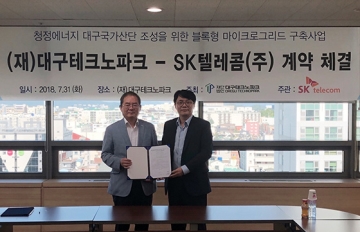
SKT to Establish Microgrid at Daegu National Industrial Complex
SK Telecom has been selected as the prime contractor for the second phase microgrid construction project at the Daegu National Industrial Complex, and plans to apply energy management solutions to approximately 40 companies by year-end with a total investment of 12.7 billion won.
2018.08.01by 이수민 기자

[e4ds Tech Day 2026 ⑨] Sim Sang-gyu, Autocrypt CTO: "In the Physical AI Era, Automotive Security Must Extend Beyond the Vehicle"
At e4ds Tech Day 2026, Sim Sang-gyu, CTO of Autocrypt, explained automotive cybersecurity strategies in the era of Physical AI and SDV (Software-Defined Vehicle). Automobiles are evolving as part of an ecosystem connected to AI, cloud, chargers, IoT, and robots, and he emphasized that the scope of security must expand beyond the vehicle interior to the entire connected environment. In particular, AI model tampering, adversarial attacks, OTA updates, and EV charger hacking were identified as major threats. He explained that response measures require zero trust, AI model integrity protection, intrusion detection, Security by Design and Default, and full lifecycle security management, and that proactive security system establishment beyond regulatory compliance is critical for securing future mobility competitiveness.
2026.10.12by 배종인 기자
NVIDIA to Invest $1 Billion in U.S. Science Over Next Five Years
NVIDIA has announced plans to invest $1 billion over the next five years to strengthen U.S. scientific and technological competitiveness. The company will enhance cutting-edge artificial intelligence research and development capabilities in key areas including quantum computing, healthcare, and energy security, while expanding support for higher education research institutions and cloud service providers. NVIDIA is participating as a major industry partner in the White House Office of Science and Technology Policy's Genesis Mission, and is promoting supercomputer construction in collaboration with national laboratories including Argonne and Los Alamos.
2026.10.12by 배종인 기자











