


Domestic PC shipments fell 5.1% year-over-year, but demand for new products increased.
 Published2018.08.18 07:01
Expanding choice due to growing demand for convertibles
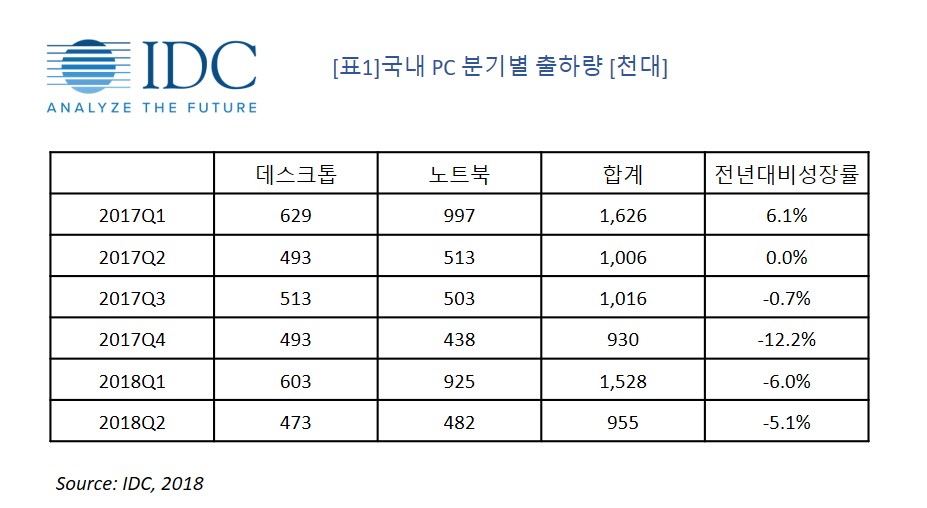
According to a recent domestic PC market research analysis by International Data Corporation Korea Ltd. (IDC Korea), domestic PC shipments in the second quarter of 2018 decreased by 5.1% year-on-year to 470,000 desktops, 480,000 laptops, and 950,000 total units.
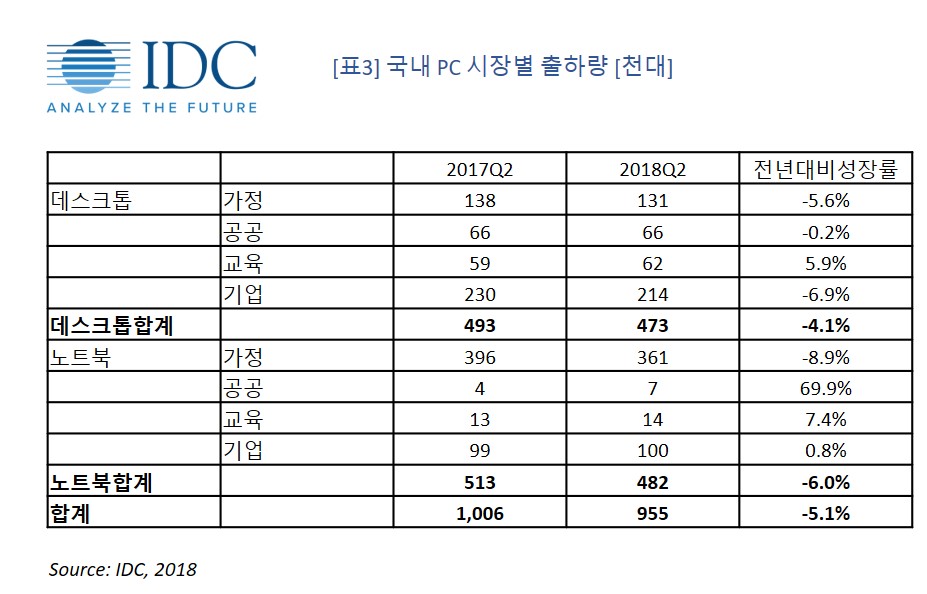
The home segment shipped 490,000 units, an 8.1% year-over-year decrease in volume. However, the decline in sales was relatively small at 2.8%, as the company reduced the proportion of low-priced products and focused on profit-driven premium categories such as gaming, ultra-slim, and convertibles. Demand for gaming PCs expanded approximately 1.3-fold in the first half of 2018 compared to the previous year, and continued demand growth is expected in the second half, driven by the release of high-quality PC games and the gradual introduction of ultra-slim gaming notebooks.
The public sector shipped 72,000 units, while the education sector shipped 77,000 units, representing a 3.8% and 6.2% increase year-on-year, respectively. While the public and education markets have traditionally been desktop-centric PC environments, the adoption of laptops has been steadily increasing. In particular, the education sector is using a variety of computing devices, including tablets, as part of the digital textbook project this year.
The corporate sector shipped 310,000 units, a 4.6% decrease year-over-year, but notebook shipments both increased year-over-year in both volume and share. Replacement and new demand is occurring primarily among large corporations and global companies. While tower-type desktops remain a preferred choice for cost-saving reasons, ultra-slim and convertible notebooks are increasingly used depending on the work environment.
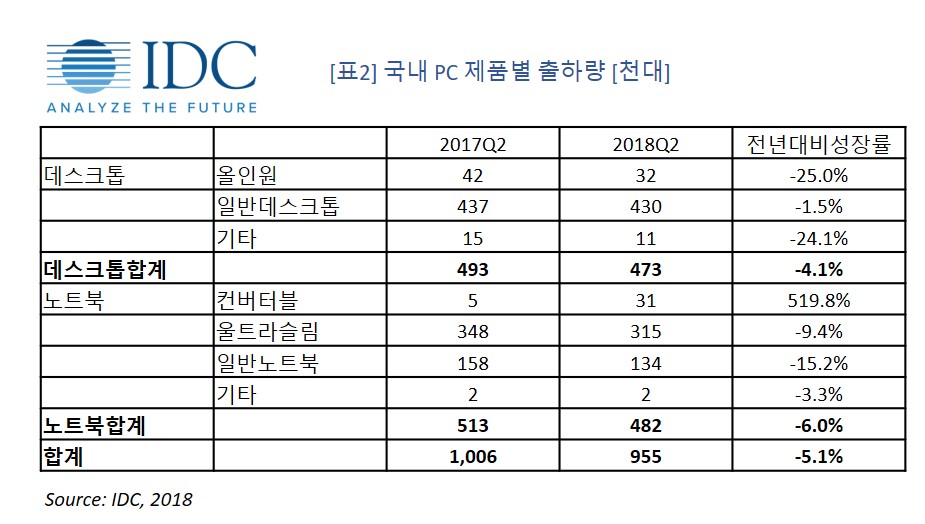
As lifestyles and work environments diversify, computing devices are evolving to keep pace with these changing trends. Ultra-slim laptops, measuring 21mm or less in thickness, are becoming thinner and lighter, with models ranging from 18-21mm down to less than 18mm. Convertible laptops, once a niche market, are also experiencing explosive growth, with product lineups diversifying and supporting handwriting functions, resulting in over 90,000 units shipped in the first half of the year.
“Dual-screen laptops and laptops with mobile processors are expected to expand consumer choices by offering new usage models,” said Kwon Sang-jun, a senior researcher at IDC Korea. “New attempts tailored to user needs require a swift and strategic response from the relevant industry, as securing the initial market lead is paramount.”
Comments
Related news

IDC Korea Accelerates Digital Transformation Innovation
The second platform, a traditional ICT industry, is expected to show negative growth, but the third platform, centered on mobile, social networks, big data, and cloud, is projected to grow at an average annual rate of 4.7% or more. Korean IDC held a press briefing to forecast changes in ICT market trends as the shift to the digital transformation economy era accelerates in earnest. Mark Sullivan, IDC CFO, stated, "The second chapter of the third platform is beginning in earnest. IDC's focus is on mobile, social networks, big data, and cloud," and explained, "Innovation accelerators such as artificial intelligence (AI), security, 3D printing, augmented reality (AR), and virtual reality (VR) utilized on the third platform will continue to achieve high growth of 18.4% or more on an average annual basis."
2018.05.17by 김지혜 기자

IDC Korea Hosts 'CIO Summit 2018' Seoul Conference
International Data Corporation Korea (IDC) announced that it will host the 'CIO Summit 2018' conference on the 24th at the Orchid Room of the Grand InterContinental Seoul Parnas Hotel. The 'IDC CIO Summit' conference, which is held annually in roadshow format across 12 cities in the Asia Pacific region, provides insights to CIOs (Chief Information Officers) through IDC's latest research analysis and case presentations, and delivers actionable insights.
2018.05.23by 김지혜 기자
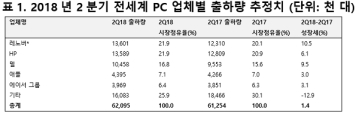
Gartner: Global PC Shipments in Q2 2018 Record Growth for the First Time in 6 Years
First year-over-year PC shipment increase since Q1 2012; PC momentum will weaken as Windows 10 replacement peak passes.
2018.07.13by 명세환 기자
.jpg)
SalePoint Signs Multi-Year Partnership Agreement with AWS… Promoting Identity Security that Integrates Even AI Agents
Sailpoint has entered into a multi-year strategic partnership agreement with AWS and is moving forward with establishing an integrated governance system that manages both human and non-human identities together. The plan is to consistently manage access permissions in an environment where AI agents are increasing as work execution entities, while applying the principle of least privilege and automated policy enforcement. The two companies plan to jointly expand capabilities to manage the identities of various entities, including AI agents, within a single layer in the AWS environment. This collaboration is interpreted as a move to design security and governance together in corporate environments where AI adoption is expanding.
2026.03.26by 배종인 기자
.png)
Databricks Unveils Open AI Security Monitoring 'Lakewatch'
Databricks entered the security market on March 24 by unveiling LakeWatch, an open-source agentic SIEM. The core functionality of this product is to integrate and analyze security, IT, and business data in a single environment to support AI-based threat detection and investigation. The company explained that it reduces the limitations of existing security operations centers, which have had to forgo some data due to high cost structures, and enables large-scale data analysis and automation based on open formats and ecosystems. LakeWatch is currently offered as a private preview, with Adobe and Dropbox mentioned as early customers. Databricks also announced an expanded partnership with Anthropic as well as the acquisition of Antimatter and SiftD.ai.
2026.03.26by 배종인 기자











