


Urgent measures are needed to address Korea's security capabilities, which are ranked among the lowest in the Asia-Pacific region.
 Published2018.09.08 07:02
Domestic companies urgently need to strengthen their security capabilities.
The lowest in the Asia-Pacific region
On the 6th, Cisco Korea announced the 'Cisco 2018 Asia Pacific Security Capabilities Benchmark Study', which was conducted on approximately 2,000 security experts from 11 countries in the Asia Pacific region, including Korea, China, and Japan.
Thousands of security threat alerts sound every day, but resolution rates are low.
According to a Cisco report, 61% of domestic companies detect more than 5,000 security alerts daily. However, the analysis found that 70% of these threat alerts are left unattended without proper action. Even among the 30% of security alerts that are investigated, only 16% are determined to be actual threats. This figure is significantly lower than the global average (34%) and the Asia-Pacific standard (44%), suggesting that companies need to improve the accuracy and effectiveness of their security.
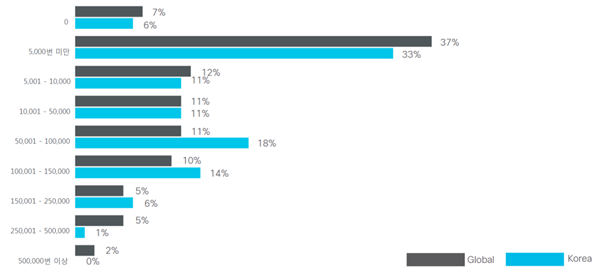
Average number of security alerts generated daily in an organization
Furthermore, the rate of resolving issues among alerts identified as threats was less than half, at 40%. This is lower than the global average of 50% and the Asia-Pacific average of 53%. In this survey of 11 Asia-Pacific countries, the only countries that fell behind Korea were Thailand (37%) and Vietnam (39%).
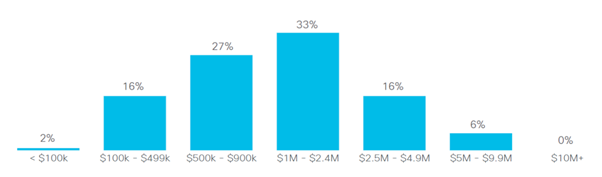
Economic losses due to security threats last year (Korea)
Additionally, half (49%) of domestic respondents who experienced a security attack reported an average economic loss of $1 million to $5 million (approximately KRW 1.11 billion to KRW 5.57 billion). This economic loss encompasses decreased revenue, decreased customers, and increased expenses. Six percent of respondents reported losses of $5 million to $10 million (approximately KRW 11.14 billion). On the other hand, only 2% of the group responded that they suffered relatively low losses of less than $100,000, a large gap from 20% in Asia Pacific and 30% globally, revealing that the economic loss due to security attacks is significant.
Too many security vendors/solutions, increasing complexity and vulnerabilities.
Ninety-two percent of Korean security professionals surveyed said they find it extremely difficult to collaborate and coordinate security threat alerts across multiple partners and products. This figure is significantly higher than the 82% in the Asia-Pacific region and the global average of 74%.
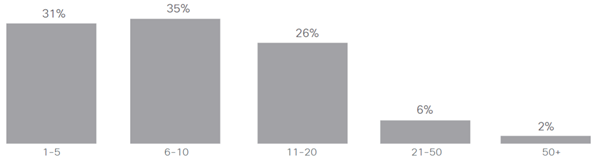
Number of security companies used by Korean security officers
34% of Korean respondents said they work with more than 10 security vendors, and 50% said they operate more than 10 security products simultaneously, which increases the complexity and vulnerability of security measures.
This research found that, among the Asia-Pacific region, Korea needs to significantly strengthen its security threat response capabilities. Respondents cited three obstacles: insufficient budget, compatibility issues with existing systems, and a lack of relevant information. Cisco assessed that security training, organization, and automation would significantly contribute to cybersecurity capabilities.
Cyberattacks are expanding to include operational technologies, raising concerns about the potential for a significant impact on businesses.
Cyber threats are expanding beyond IT infrastructure to encompass operational technology (OT) that impacts the entire corporate operating system, exposing companies to greater risks. Thirty percent of Asia-Pacific respondents reported experiencing a cyberattack on their operational technology, and 50% predicted an increase in similar attacks in the future. Forty-one percent responded that if their company's operational infrastructure technology remains in its current state, it will have a negative impact on their entire business. With the scope of cyber threats expanding, a thorough review of overall security policies is urgently needed.
The Cisco report also released key recommendations for security professionals.
▲Introducing next-generation endpoint process monitoring ▲Accurately identify timely threat intelligence data and processes to integrate data into security monitoring and alerts ▲Implementing scalable front-line defense tools such as cloud security platforms ▲Minimizing exposure to outbreaks through network segments ▲Regularly reviewing and improving security response procedures ▲Utilizing automated solutions and supplementing limited resources with technology
“As we move into a world where everything is connected, from AI and IoT to multi-cloud environments, security is becoming a core part of today’s businesses,” said Cho Beom-goo, CEO of Cisco Korea. “Currently, Cisco blocks 20 billion threats every day, but the scope of threats continues to grow and their complexity is also increasing.” He added, “Rather than providing a one-off security solution, Cisco is striving to provide a complete security platform that covers the entire attack surface across the network.”
Meanwhile, this report surveyed approximately 2,000 security professionals from 11 countries, including Korea, Malaysia, Vietnam, Singapore, India, Indonesia, Japan, China, the Philippines, Thailand, and Australia, on cybersecurity response capabilities and economic losses. More detailed information about the report can be found on the Cisco website.
Comments
Related news
Cisco Successfully Completes Domestic Software Developer Training Program
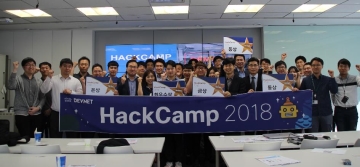
Cisco Korea announced the successful completion of the hackathon event 'Cisco HackCamp 2018' and held an awards ceremony. Cisco has established 'DevNet,' a developer community in the key business areas of collaboration, security, data center, and enterprise network, to foster domestic software developers and ecosystem development. The company is actively running support programs including △Cisco Open API (Application Programming Interface) training △mentoring △hackathon and other initiatives.
2018.05.24by 김지혜 기자
Cisco recommends Samsung SmartThings firmware update
Cisco Talos collaborated with Samsung to distribute firmware that addresses security vulnerabilities in the 'Samsung SmartThings Hub'.
2018.07.27by 이수민 기자
Australian Government Notifies Ban on 'Huawei, ZTE 5G Network' / Samsung Semiconductor Surpasses Intel in Market Sales Share
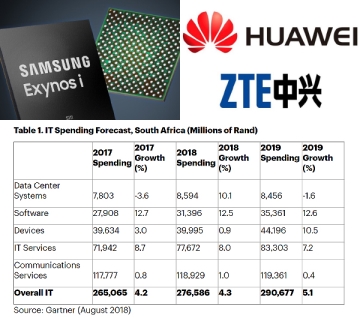
[Americas Weekly IT News] 1. Samsung Finally Surpasses Intel and Maintains Lead in 'Semiconductor Chip' 2. 'Semiconductor Chip Market to Grow to 1 Trillion Dollars by 2030' 3. Australian Government Notifies Ban on 'Huawei, ZTE 5G Network' 4. Gartner Forecasts 4.3% Growth in South Africa's IT Spending This Year 5. VMware Launches New Cloud Services for 'Automotive, Security'
2018.08.28by 류아연 외신
.png)
Databricks Unveils Open AI Security Monitoring 'Lakewatch'
Databricks entered the security market on March 24 by unveiling LakeWatch, an open-source agentic SIEM. The core functionality of this product is to integrate and analyze security, IT, and business data in a single environment to support AI-based threat detection and investigation. The company explained that it reduces the limitations of existing security operations centers, which have had to forgo some data due to high cost structures, and enables large-scale data analysis and automation based on open formats and ecosystems. LakeWatch is currently offered as a private preview, with Adobe and Dropbox mentioned as early customers. Databricks also announced an expanded partnership with Anthropic as well as the acquisition of Antimatter and SiftD.ai.
2026.03.26by 배종인 기자

Kaspersky Unveils Revamped 'NEXT' Combining SOC Integrated Management and AI Analytics
As enterprises increase demand for integrated management and automation in the construction and operation of Security Operations Centers (SOC), Kaspersky has disclosed updates to its B2B security product suite 'Kaspersky Next'. This update expands EPP, EDR, XDR, and SIEM integration through a single console based on OSMP, incorporates AI capabilities such as DLL hijacking detection and suspicious account takeover behavior identification, and includes integration with generative AI assistant tool KIRA. The company stated that in large-scale deployment environments, EDR Expert can reduce resource requirements by up to 30%, and XDR Expert by up to 60%.
2026.03.25by 배종인 기자











