


KITECH Develops Laser Vision Sensor Five Times Cheaper Than Foreign Products
 Published2018.09.19 07:02
Prices at one-fifth the level of foreign products expected to spread to industries such as shipbuilding
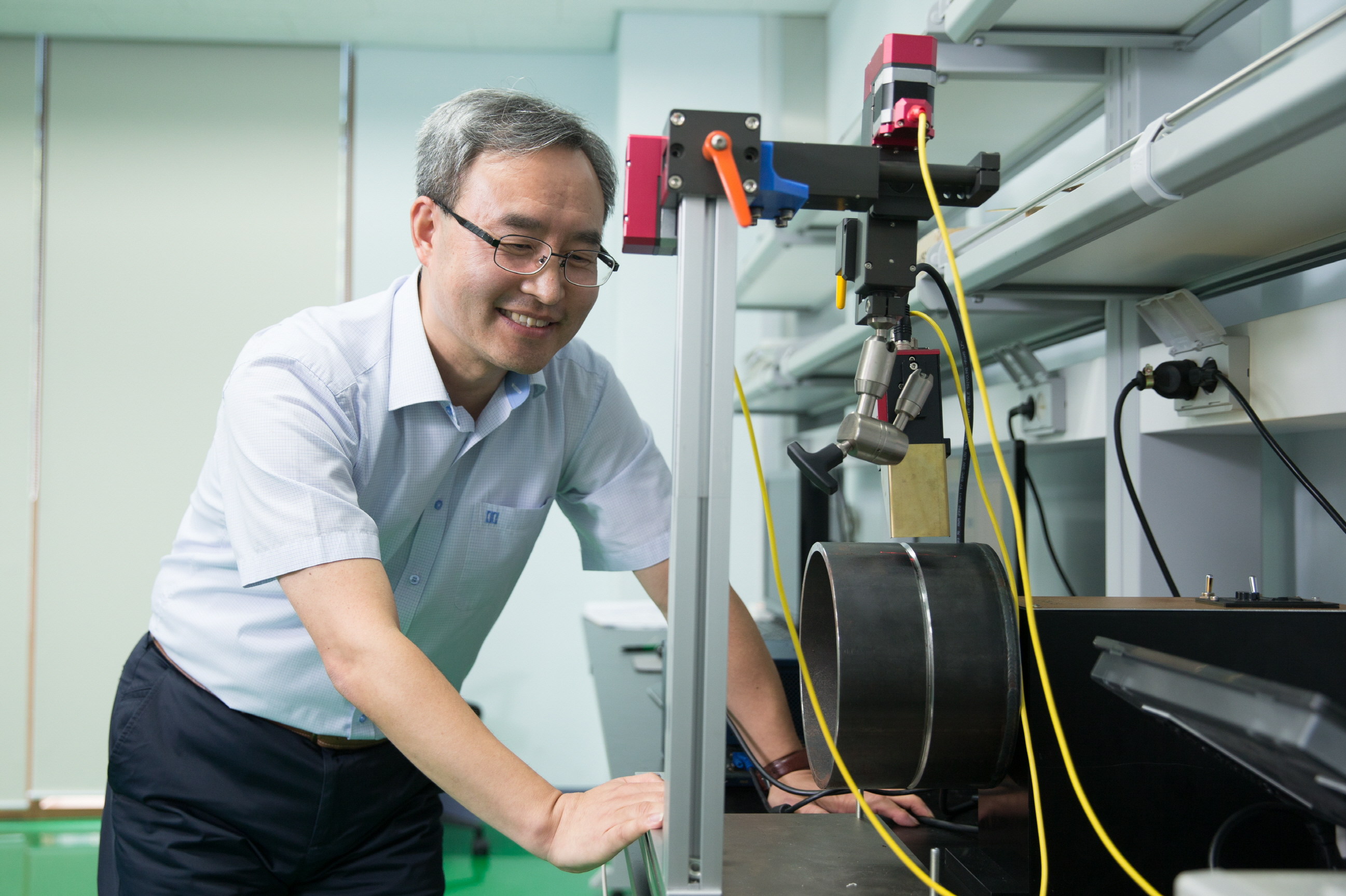
Moon Hyung-soon, Group Leader, Precision Machining Control Group, Korea Institute of Industrial Technology
On the 13th, a research team led by Moon Hyung-soon, head of the Precision Machining Control Group at the Korea Institute of Industrial Technology, developed a laser vision sensor, a core component that can be called the "eyes" of welding automation equipment.
Since welding accounts for approximately 35% of shipbuilding costs, welding technology is directly linked to the competitiveness of the shipbuilding industry. To enhance technological competitiveness and replace the shortage of skilled labor, the industry is expanding the adoption of welding automation equipment capable of maintaining consistent welding quality across various working environments.
A vision sensor is a non-contact sensor that uses a laser to locate weld lines on components or structures and automatically tracks movement to accurately determine the position of the welding torch in real time.
Welding automation equipment sensors are broadly classified into contact and non-contact types. However, due to the issue of reduced durability in contact sensors, advanced manufacturing nations such as Europe and Japan primarily adopt non-contact sensors. Nevertheless, as there are no commercially available domestic vision sensors in Korea yet, contact sensors have been used, or foreign vision sensors costing between 40 million and 100 million won per unit have been imported. Representative examples include the vision sensors from the UK's Meta Vision System and Canada's Cervo Robotics.
However, due to the lack of smooth technology transfer and after-sales service from overseas manufacturers for foreign vision sensors, domestic companies were unable to properly handle situations where sensors malfunctioned or settings needed to be changed due to process variations, resulting in few successful operational cases.
Last year, the research team received a request from Best FA, a company specializing in welding automation machinery, to develop a vision sensor that domestic small and medium-sized enterprises could easily utilize. They commenced research and developed a sensor module capable of immediate commercialization within one year. In particular, they significantly lowered the module price to approximately 10 to 15 million won, which is one-fifth the price of foreign products. They also expanded the range of products available to customers by adding an entry-level model priced between 3 to 5 million won that excludes welding monitoring functions from the module. In addition, we have developed our own image processing algorithm that can track the centerline of the weld with a clean 3D image without noise, enabling high-speed welding at a speed of 1m per minute with a tracking error of up to 0.1mm.
The developed technology has been fully transferred to Best FA, a client company, and is expected to be widely utilized in manufacturing sectors requiring welding, such as shipbuilding, automobiles, oil refining, construction, and wind power generation, through commercialization.
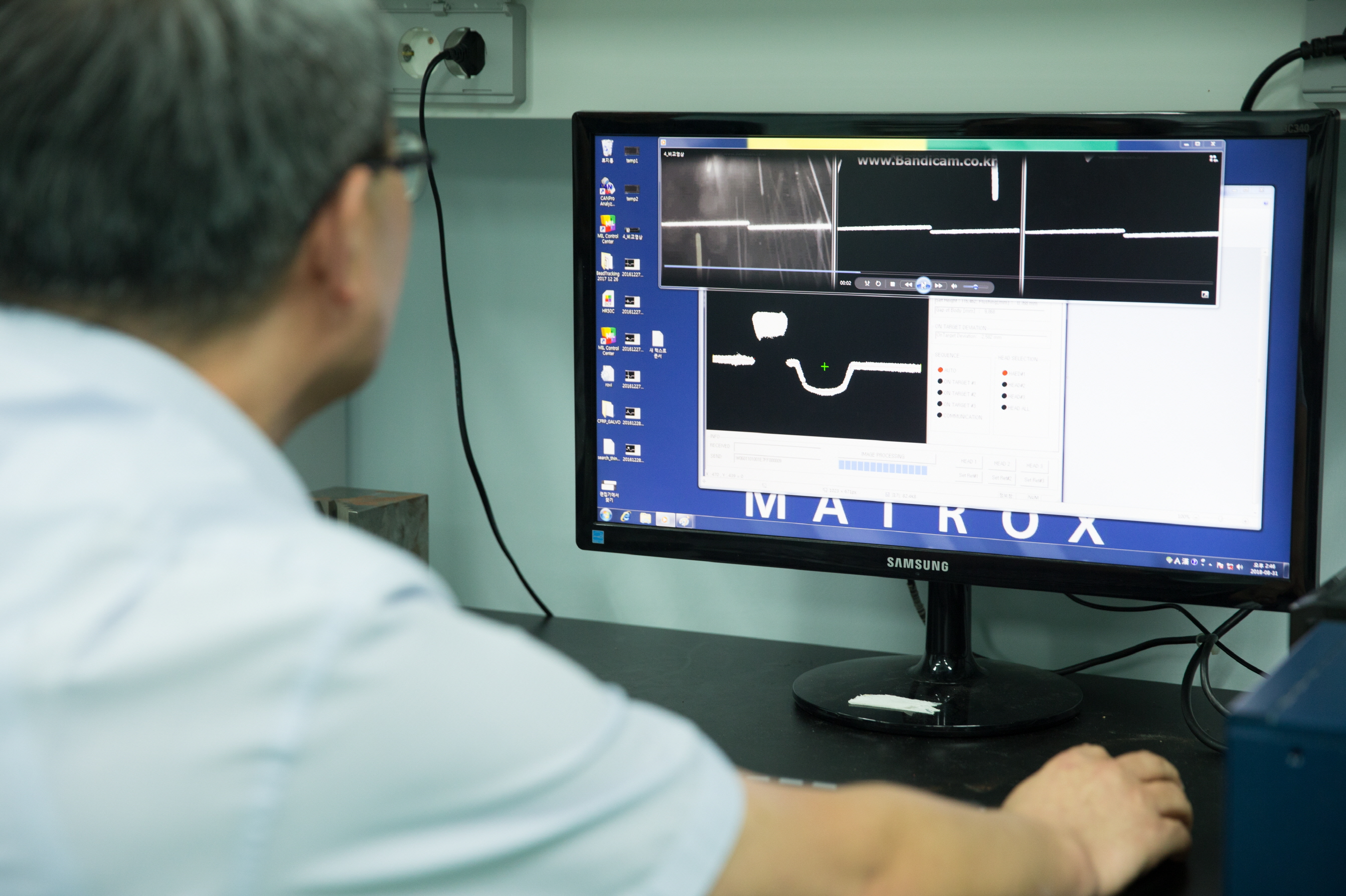
Group Leader Moon Hyung-soon demonstrating the product
Group Leader Moon Hyung-soon stated, “Welding is widely used in any industry, and automation is crucial as work speed and accuracy are directly linked to productivity,” adding, “I hope that welding automation equipment equipped with vision sensors will be widely distributed to small and medium-sized workplaces to contribute to productivity improvement and, furthermore, help the shipbuilding and marine industry currently facing a downturn.”
Meanwhile, according to the Ministry of SMEs and Startups, the global welding automation market is expected to grow from $1.77 billion as of 2016 to approximately $2.51 billion in 2021, with an average annual growth rate of 7.2%.
Comments 1
1 Comments:
Related news
ams completes update for CCS8xx gas sensor IC family
ams has announced that it has completed updates to shorten the initialization time and improve performance of its CCS8xx gas sensor IC product family.
2018.07.17by 이수민 기자
Digi-Key Loads Over 14,000 Parts to Support Industrial Automation
Digi-Key has added over 14,000 industrial automation components to its portfolio, spanning categories including sensors, cables, safety devices, control monitors, relays, timers, switches, lighting, and controllers.
2018.08.23by 이수민 기자
Image sensors, developed through smartphones, are driving cutting-edge industries.
The number of global smartphone users has reached two-thirds of the world's population. To provide the best possible experience for each user, smartphone manufacturers have been dedicated to advancing smartphone camera technology. Various technologies have been developed to overcome the physical limitations of sensor size, and the image sensors that have evolved as a result are now playing their role not only in smartphones but also in cutting-edge industries such as autonomous vehicles and IoT.
2018.09.12by 이수민 기자
Korea Instrument, KOLAS Accredited Calibration Agency First to Simultaneously Acquire ISO/IEC 27,001·27,701
Korea Instrument has become the first among KOLAS accredited calibration agencies to simultaneously acquire ISO/IEC 27,001 and ISO/IEC 27,701 certifications. Through its proprietary platforms CWIZ Enterprise and CWIZ Partners, the company has embedded information security and personal data protection requirements across all business processes including customer information, equipment data, and calibration reports, with plans to continuously advance its management system through regular audits and security inspections.
2026.10.12by 배종인 기자
TeamViewer One, IT Incident Automation Workflow and Resolution Center Enhanced
TeamViewer has added IT incident automation capabilities and an advanced Resolution Center to its integrated digital workplace management platform 'TeamViewer ONE'. Recurrent service disruptions, configuration errors, and capacity shortages are automatically handled according to preset policies, and device status verification through script deployment can be managed in a unified interface, significantly reducing repetitive tasks for IT teams.
2026.10.12by 배종인 기자












기대됩니다