


[Quantum Reflection] It's more shameful not to learn than not to know.
 Published2018.09.20 17:00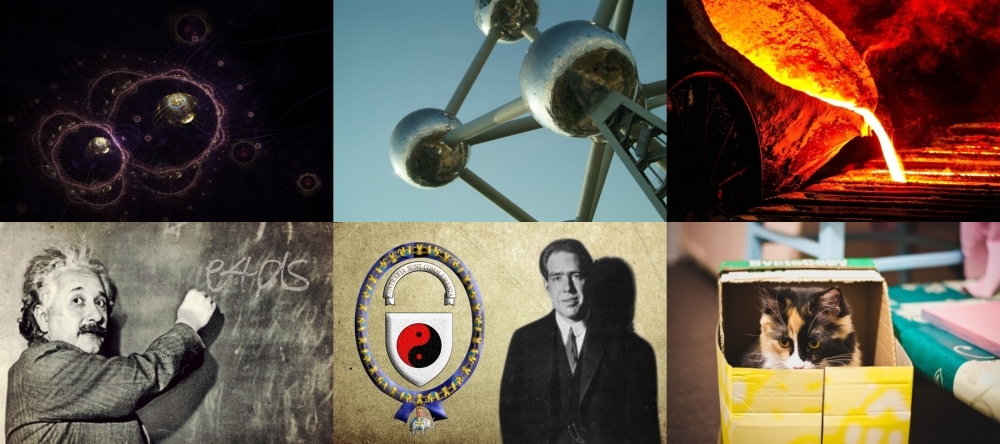
[Quantum Review] A Brief Summary of Episodes 1-6
With the advancement of artificial intelligence, virtual reality, augmented reality, and the Internet of Things, the amount of data to be processed is exploding every day. Consequently, the limits of integrated circuits are also being reached by the day. No matter how finely we implement processes, the inherent limitations of integrated circuits are unavoidable.
There have been frequent attempts to break Moore's Law, including Huang's Law. However, Moore's Law will ultimately be broken by Moore's Law itself. Not by surpassing it, but by failing to surpass it. To prevent this from happening, quantum computers, which use quantum computational principles instead of transistor-based gates, are emerging as an alternative. But what exactly are quantum computers, and what can they do with them, making them a viable alternative?
A reporter with no prior experience in science has been diligently exploring quantum computing, a topic of recent interest, with a learning mindset. This series, "Exploring Quantum," has already reached its sixth installment. When I first started the series, I asked people around me about quantum mechanics and got these answers.

...
In this situation, I was at a loss, but fortunately, I came across an article written by Dr. Richard Feynman, a very important figure in the field of physics and the inventor of the quantum computer, in his 1965 book, “The Characteristics of the Laws of Physics.”
“I think I can confidently say that no one understands quantum mechanics.”
This passage instilled confidence in the reporter. Isn't it more shameful to not learn than to not know? Anyway, I'll summarize the series [Quantum Exploration], which contains the reporter's struggles. Criticism of any errors or shortcomings is always welcome.
[Quantum Exploration] 1. Ant-Man and the Quantum Story

The word audiences who see "Ant-Man and the Wasp" will likely hear most often is "quantum." The main character even asks, "Do you just throw that word 'quantum' around everywhere?" Quantum energy, quantum realm, quantum mechanics, quantum superposition, quantum penetration, and so on. However, the reason quantum is constantly mentioned throughout the film is because Ant-Man and quantum mechanics are inextricably linked. Ant-Man deals with atoms, and quantum mechanics deals with the world at scales smaller than atoms and molecules.
Quantum mechanics is called "quantum mechanics," and the "quantum" comes from the word "quantity," meaning "quantity." It refers to something existing in discrete quantities. Mechanics is the study of how to express the motion and interactions of objects in mathematical formulas. In other words, quantum mechanics is the study of how discrete quantities behave when subjected to force.
Link: http://www.e4ds.com/sub_view.asp?ch=22&t=1&idx=9426
[Quantum Exploration] 2. Everything is made of atoms

When asked what he would leave behind for future generations if all civilization on Earth were to be destroyed, physicist Richard Feynman replied, "Everything is made of atoms!" And he was right. Everything around us, including ourselves, is made of atoms. And quantum mechanics is the study of the behavior of those atoms. So, to understand quantum mechanics, it would be best to learn about atoms.
Through the efforts of timeless scientists like Democritus, Dalton, Boltzmann, Thomson, Rutherford, Bohr, Heisenberg, and Pauli, the existence and structure of atoms were discovered. They also explored why hollow atoms do not collapse. Understanding atoms is the starting point for understanding quantum mechanics.
Link: http://www.e4ds.com/sub_view.asp?ch=22&t=1&idx=9453
[Quantum Exploration] 3. Classical Mechanics, Surpassed by Chance
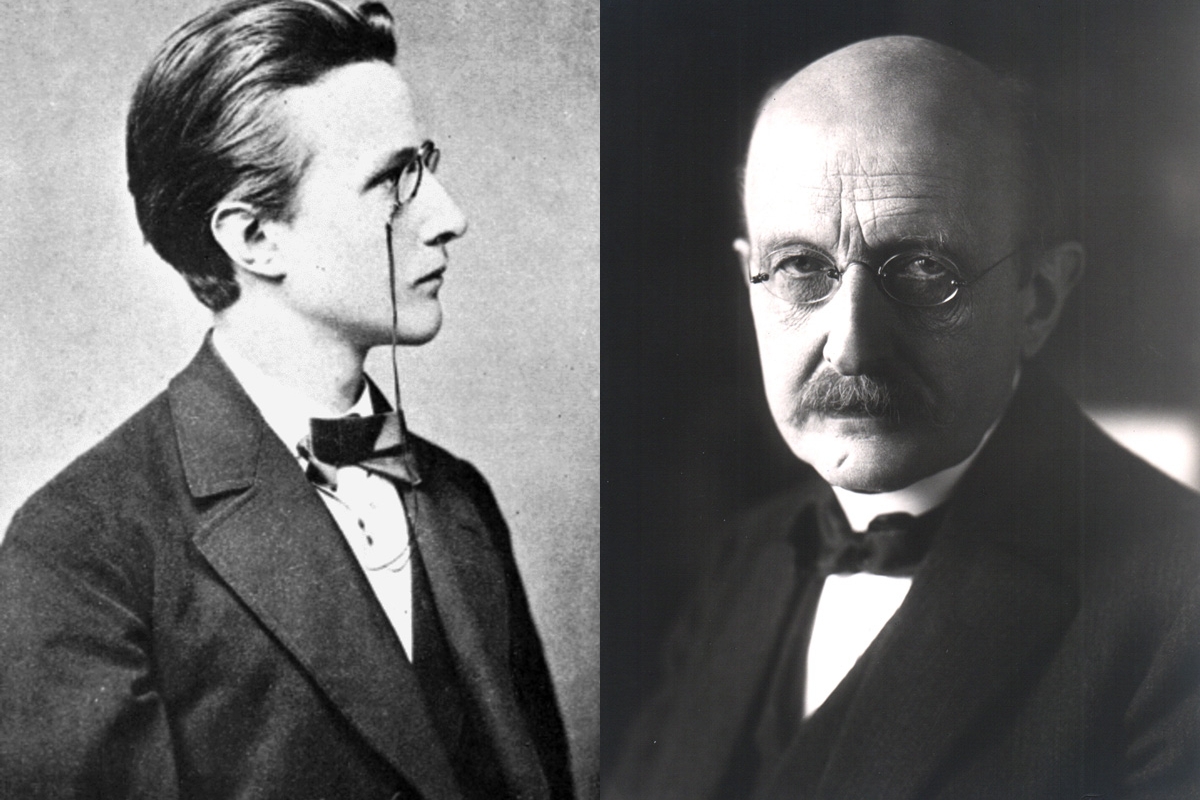
Max Planck, the renowned German physicist, decided to study physics in his youth and visited a physics professor at the University of Munich. The professor advised him against it, saying, "Physics is a field where everything that can be discovered has been almost completely discovered." Planck, however, decided to study physics, saying, "I am satisfied with simply understanding what is already known." However, Planck unexpectedly achieved something greater than he had intended. In the process of solving the problem of black body radiation, he led the birth of quantum mechanics.
Planck solved the blackbody radiation problem by introducing the quantization hypothesis. The core of the quantization hypothesis is that the energy of electromagnetic waves is quantized. Energy cannot be exchanged in arbitrary, small quantities, but only in chunks of fixed size. However, Planck treated the quantization hypothesis as nothing more than a hypothesis and reacted with indifference. This was because he simply could not accept the concept of quanta.
Link: http://www.e4ds.com/sub_view.asp?ch=22&t=1&idx=9479
[Quantum Review] 4. Why can't you believe it when you made it?

Wave-particle duality refers to the property that all matter possesses both particle and wave properties. While classical mechanics considers waves and particles to have very different properties, quantum mechanics integrates the two concepts into a single concept. Wave-particle duality originated from the debate over whether light is a particle or a wave. Experiments have proven that light possesses both properties. Later, it was discovered that not only light, but all other matter possesses both particle and wave properties.
Einstein played a crucial role in this process. He applied Planck's quantization hypothesis to light, positing that light is a particle of energy whose energy is equal to Planck's constant times its frequency. He called these light particles "photons." He believed that light was not a wave, but rather a particle possessing discrete energy. Through this, Einstein laid the main foundation of quantum mechanics, but he himself did not believe in quantum mechanics.
Link: http://www.e4ds.com/sub_view.asp?ch=22&t=1&idx=9504
[Quantum Exploration] 5. The Copenhagen Interpretation: Explaining Quantum Mechanics

Quantum mechanics was founded on the overlapping research results of numerous scientists, even those who were critical of quantum mechanics. The quantum mechanics framework, established in the 1920s, was successful in understanding, predicting, and applying phenomena in the microscopic world. However, the mathematical results of quantum mechanics were so different from the innate intuition of humans that even eminent physicists like Albert Einstein found it difficult to accept. Consequently, various interpretations of quantum mechanics emerged to explain the mathematical results.
The Copenhagen interpretation is based on Bohr's complementarity principle and Heisenberg's uncertainty principle. The complementarity principle states that both wave and particle properties are necessary to fully describe phenomena involving particles. The uncertainty principle states that there is always a certain degree of uncertainty between the observer and the observed. This indeterministic interpretation of quantum mechanics was attacked by many scientists, but quantum mechanics finally became a complete science when Bohr thwarted all of them.
Link: http://www.e4ds.com/sub_view.asp?ch=22&t=1&idx=9520
[Quantum Exploration] 6. Schrödinger's Cat and the Many Worlds Interpretation
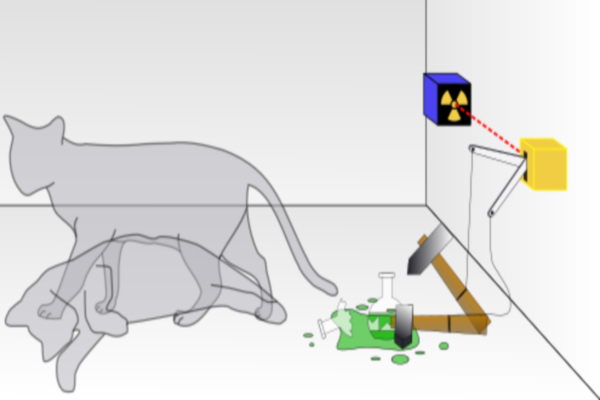
Schrödinger's cat thought experiment was presented to reveal the irrationality of the Copenhagen interpretation. However, contrary to Schrödinger's intention, scientists still frequently use it to explain the uncertainty of quantum mechanics. Schrödinger's cat thought experiment merely compares the microscopic world to the macroscopic world, not the macroscopic world itself. Nothing like Schrödinger's cat occurs in the macroscopic world.
Unlike the macroscopic world we constantly encounter, measurements in the microscopic world affect physical quantities like position and velocity. Because the values change with each measurement, it's possible to estimate the probability of a result from multiple measurements. The world of quantum mechanics is too small for measurements to have such an impact. Because both position and momentum are unknown, predicting the future based on classical mechanics is impossible. Since we had no choice but to use probability, nondeterminism was introduced.
Link: http://www.e4ds.com/sub_view.asp?ch=22&t=1&idx=9565
What we will cover next
The ultimate goal of this series is to introduce the definition and principles of quantum computers, as well as their applications and criticisms. However, quantum mechanics is a discipline so far removed from common sense that even Einstein would have been skeptical. Therefore, I had to examine it carefully from a non-specialist's perspective. Now that we've examined what quantum mechanics is, let's explore how it can practically benefit us.
Comments
Related news
[Quantum Review] 4. Why can't you believe it after making it?
A journalist with a humanities background delves into what quantum mechanics is, what quantum mechanics entails, and explores how quantum mechanics can be applied to our everyday lives.
2018.08.28by 이수민 기자

[Quantum Exploration] 5. The Copenhagen Interpretation: Explaining Quantum Mechanics
A journalist with a liberal arts background wraps their head around what quantum is and what quantum mechanics is, and examines how quantum mechanics can be applied to our everyday lives.
2018.09.04by 이수민 기자

[Quantum Exploration] 6. Schrödinger's Cat and the Many Worlds Interpretation
A journalist from a liberal arts background puts their mind to understanding what quantum mechanics is, what quantum mechanics entails, and how quantum mechanics can be applied to our daily lives.
2018.09.19by 이수민 기자
.jpg)
SalePoint Signs Multi-Year Partnership Agreement with AWS… Promoting Identity Security that Integrates Even AI Agents
Sailpoint has entered into a multi-year strategic partnership agreement with AWS and is moving forward with establishing an integrated governance system that manages both human and non-human identities together. The plan is to consistently manage access permissions in an environment where AI agents are increasing as work execution entities, while applying the principle of least privilege and automated policy enforcement. The two companies plan to jointly expand capabilities to manage the identities of various entities, including AI agents, within a single layer in the AWS environment. This collaboration is interpreted as a move to design security and governance together in corporate environments where AI adoption is expanding.
2026.03.26by 배종인 기자
.png)
Databricks Unveils Open AI Security Monitoring 'Lakewatch'
Databricks entered the security market on March 24 by unveiling LakeWatch, an open-source agentic SIEM. The core functionality of this product is to integrate and analyze security, IT, and business data in a single environment to support AI-based threat detection and investigation. The company explained that it reduces the limitations of existing security operations centers, which have had to forgo some data due to high cost structures, and enables large-scale data analysis and automation based on open formats and ecosystems. LakeWatch is currently offered as a private preview, with Adobe and Dropbox mentioned as early customers. Databricks also announced an expanded partnership with Anthropic as well as the acquisition of Antimatter and SiftD.ai.
2026.03.26by 배종인 기자











