


The Mobile Industry Leads Global Sustainable Development
 Published2018.10.02 07:04
Rise in all 17 Sustainable Development Goals indicators
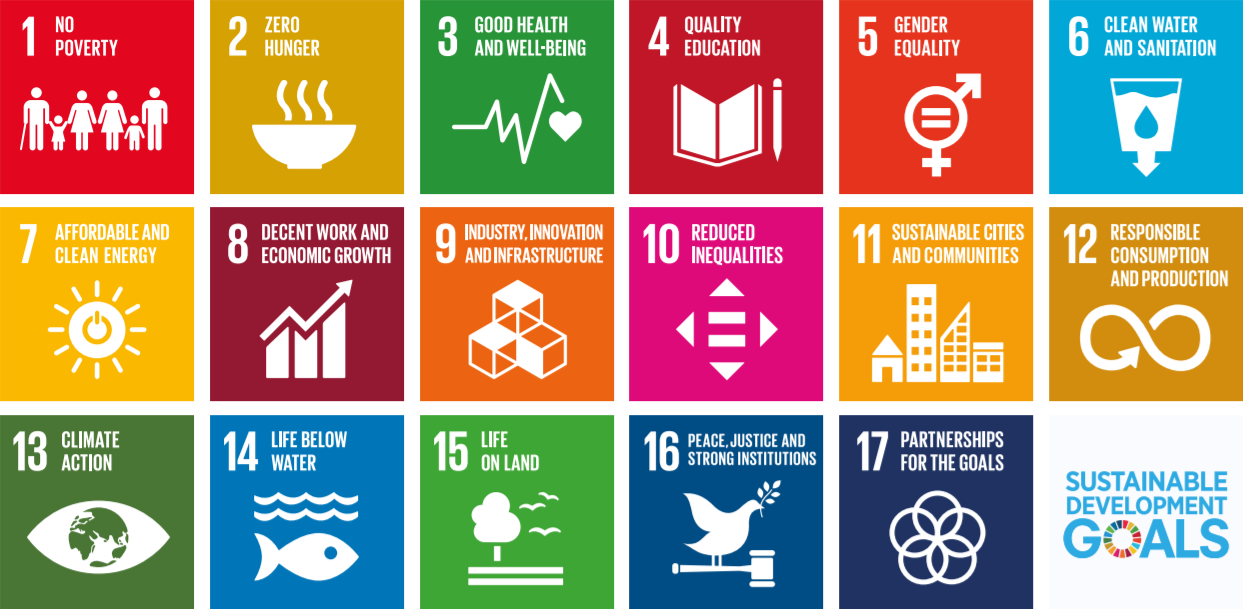
The 17 Sustainable Development Goals set by the UN
According to a new study by GSMA, the global mobile industry is demonstrating a significant and measurable impact on the United Nations' Sustainable Development Goals (SDGs) and is strengthening efforts to improve lives around the world.
The 2018 GSMA annual 'Mobile Industry Impact' report, released in conjunction with the UN General Assembly held on September 26, stated that since mobile became the world's first industry to pledge to implement the SDGs in 2016, its contribution to all 17 goals has been continuously increasing. The increased influence reflects the unprecedented global scale of the mobile industry, providing platforms to connect disconnected communities, reducing poverty, improving access to healthcare and education, and driving sustainable economic development.
Mats Granryd, Director General of GSMA, said, “More than two-thirds of everyone on Earth is currently connected to mobile networks, and for many, mobile is the primary, and sometimes the only, means of accessing the internet and life-improving services. This report once again demonstrates the pivotal role the mobile industry is playing in accelerating the implementation of the SDGs and leveraging the strengths of mobile networks and services to transform the lives of people around the world.”
Mobile Impact and Execution
The Mobile Industry Impact Report applied an 'Impact Score' using a proprietary methodology to measure the industry's contribution to each of the 17 objectives. Since 2015, scores have been improving every year across all sectors as mobile operators worldwide increasingly incorporate SDGs into their core values, strategies, policies, and services, and translate industry commitments to SDGs into practical plans, leading to measurable results.
According to the report, the area where the mobile industry is currently having the greatest impact is SDG 9 (Industry, Innovation and Infrastructure), which is the result of the scope of global mobile networks leading new business models such as the sharing economy, mobile accounts and credit, and prepaid solar power models for access to clean energy.
In addition, since 2015, the mobile industry has achieved a significant increase in influence on SDG 13 (movements toward environmental protection), SDG 11 (stable cities and communities), and SDG 3 (healthy and good quality of life). The major factor that recorded a high impact in these three goals is related to the use of mobile phones and networks to provide essential humanitarian assistance during epidemics, natural disasters, or climate-related disasters.
Various cases
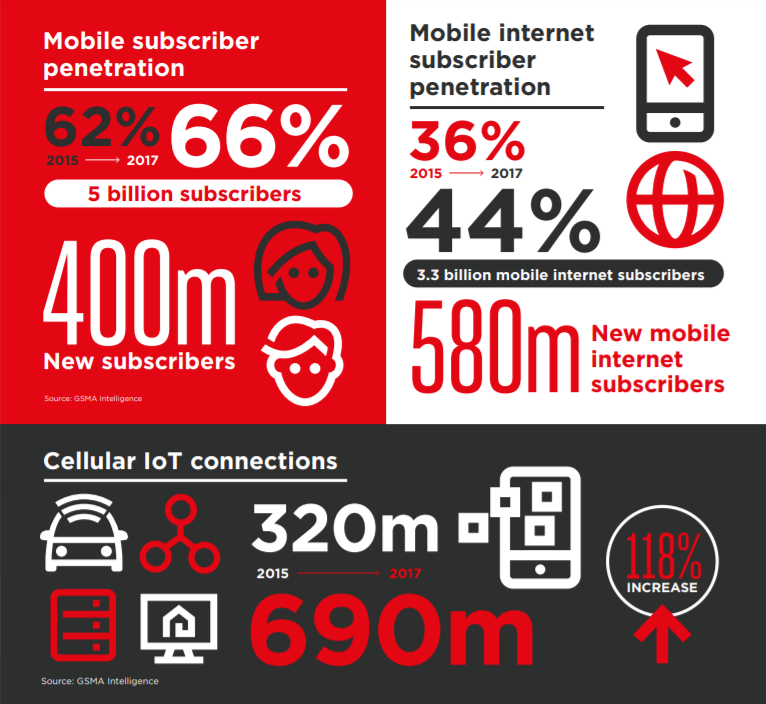
About two-thirds of the world's population is connected to mobile networks.
Currently, more than 5 billion people, or about two-thirds (66%) of the world's population, are connected to mobile networks, an increase from 4.6 billion at the end of 2015, which means that an additional 400 million new mobile subscribers were added during this period.
About 600 million people, the majority from low- and middle-income countries, started using mobile internet services after 2015, and the total number of users was 3.3 billion as of the end of 2017. It is projected that by the end of 2020, half of the world's population will have access to the internet via their phones, up from 36% in 2015.
Since 2015, more than 250 million people have started using mobile currency, making it possible to provide various financial services to people who would otherwise be excluded from the banking system, and as a result, the number of mobile currency accounts reached 700 million by the end of 2017.
There are currently over 750,000 education-related apps available on smartphones, a 62% increase from 2015. Currently, 1.2 billion people are using mobile devices to improve their own or their children's educational levels, and the gender gap in access to education is also being narrowed.
In 2017, signatories to the GSMA Humanitarian Connectivity Charter provided essential humanitarian assistance to more than 30 million people affected by epidemics and natural disasters, including Hurricane Maria in Puerto Rico and floods in Nepal.
Since 2015, more than 1 million households have installed residential solar power systems using a mobile-based prepaid model and are using clean and affordable electricity.
Since 2015, more than 5 million people have started using mobile-based agricultural services supported by the GSMA’s mNutrition Initiative, enabling farmers to access important information needed to improve agricultural productivity and income.
Granryd stated, “While the target date of 2030 to meet all SDGs still seems far off, it is important for stakeholders, including governments, the mobile industry, and related sectors, to take collaborative and significant action to accelerate progress.” He added, “We will continue to develop initiatives to connect the unconnected and drive the adoption of mobile internet, while mobile-based "We must expand our products and services to provide practical solutions to sectors facing development difficulties," he said.
The 2018 Mobile Industry Impact Report was compiled by GSMA Intelligence, a research arm of the GSMA. The report summarizes the impact of mobile on the 17 SDGs and provides in-depth analysis of five selected SDGs, showcasing innovative examples of industry initiatives supporting the goals.
Comments
Related news
KT Global Giga Story 1 Year... Island Villages Embracing Hope Through ICT
KT announced that it held a first-anniversary celebration of the Giga Island launch on Moheshkhali Island in Bangladesh, and shared the results achieved over the past year at the local level. The event, jointly hosted by Bangladesh's ICT Ministry, KT, and the International Organization for Migration (IOM), was attended by KT's Senior Executive Sung Myung-gon in charge of Sustainable Management, Kang Hyun-jung, Head of KT Group Hope Sharing Foundation, IOM Representative Peppi K. Siddiq, Mohammad Abul Kalam, County Administrator of Moheshkhali Island, and approximately 500 residents. The event featured celebratory performances, project video screenings, and commendation ceremonies for contributing organizations, along with testimonials from Giga Island beneficiaries, allowing island residents to directly confirm the changes in their living conditions.
2018.05.10by 김지혜 기자
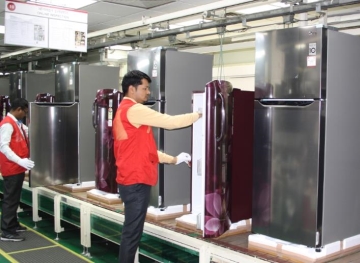
LG Electronics Acquires Carbon Credits from High-Efficiency Refrigerators Sold in India
LG Electronics has been recognized by the UN Framework Convention on Climate Change (UNFCCC) Executive Board for 173,000 tons of carbon credits through highly efficient refrigerators it produces and sells in India. LG Electronics launched a high-efficiency refrigerator distribution project in India following approval from the UNFCCC Executive Board in 2013. By manufacturing and selling energy-efficient refrigerators and reducing electricity consumption, the company received carbon credits equivalent to the amount of emissions reduced.
2018.05.23by 김지혜 기자

Schneider Takes an In-house Look at Sustainability
Schneider Electric announced the results for the second quarter of 2018 from the "Schneider Sustainability Impact 2018-2020" assessment.
2018.08.10by 이수민 기자
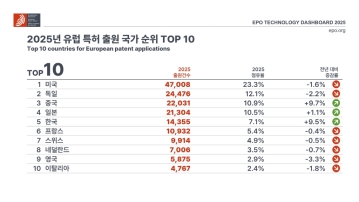
European Patent Applications Surpass 200,000 for the First Time… South Korea Maintains 5th Place, Led by Batteries and Telecommunications
According to the European Patent Office (EPO)'s 'Technology Dashboard 2025', European patent applications last year reached 201,974, surpassing 200,000 for the first time. Korean companies and inventors filed 14,355 applications, representing a 9.5% increase from the previous year and maintaining 5th place by country. Battery, digital communication, and semiconductor technologies led the growth, with Samsung ranking as the top EPO applicant for the second consecutive year and LG reaching 3rd place. The presence of major domestic cities such as Seoul, Suwon, and Yongin was also confirmed. It was also revealed that Korea's European patent strategy is expanding beyond individual technologies to span the entire industry.
2026.03.24by 명세환 기자

SK Telecom First Applies AI-Based Network Operations at Gwanghwamun K-Pop Concert
SK Telecom announced that it applied an AI-based network operation system for the first time at a large-scale K-pop concert held in the Gwanghwamun area of Seoul on March 21st, managing communication quality throughout the event. Mobile data usage during the three hours before and after the concert reached 12.15TB, approximately doubling compared to the same time slot the previous weekend. SK Telecom monitored traffic using the AI system 'A-One' in five-minute and 50-meter units to respond to potential overload situations, while also operating temporary communication facilities and on-site personnel in parallel. This case is interpreted as confirmation of the practical applicability of AI-based autonomous network operation in an environment where demand from dense events and foreign users increases simultaneously.
2026.03.23by 명세환 기자











