



ETRI introduces Ethernet to prevent in-vehicle hacking.
 Published2018.10.13 07:02
Proposing new standards at ITU meetings and promoting international standards.
As the commercialization of Level 3 and 4 autonomous vehicles approaches, domestic researchers have begun conducting security research on malicious hacking that may occur inside the vehicles.
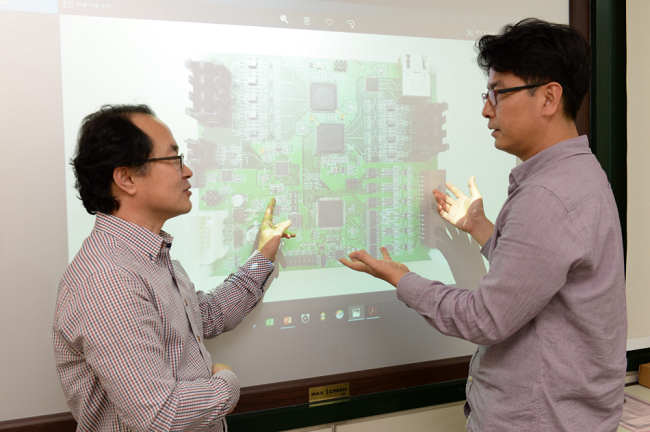
ETRI is developing next-generation Ethernet-based automotive security technology.
The Electronics and Telecommunications Research Institute (ETRI) announced on the 10th that it will develop core security technologies necessary for commercializing Ethernet-based next-generation automotive networks to suit the new environment.
The CAN (Controller Area Network) method, previously used for vehicle networks, supports low-speed networks. However, as automotive electronics become increasingly complex and large-scale data processing becomes increasingly important, the need for communication with the external environment is increasing. Therefore, the communication environment must be changed to Ethernet to improve network performance, such as smooth data processing and data transmission, and reduce complexity.
The research team explained that since the CAN network environment used in existing vehicles is also necessary at times, research and development on new security technologies for a mixed communication environment with Ethernet communication methods is necessary.
ETRI is conducting research that reflects the characteristics of vehicles based on its experience and know-how in implementing core source technologies such as encryption technology, authentication technology, and communication security technology, as well as application service technologies such as IoT and vehicle V2X projects, which have been researched mainly by the Information Security Research Center.
In particular, the research team will develop core security-related software and collaborate with automotive Ethernet specialists and automotive software verification companies to develop the technology. This security technology is expected to be incorporated into automotive Ethernet gateways (GWs) in the future.
Through this project, ETRI will develop ▲vehicle Ethernet onboard security communication technology ▲Ethernet vehicle security threat prediction/analysis/response technology ▲in-circuit-based dynamic vulnerability diagnosis technology ▲Ethernet-based vehicle network access control technology.
The research team explained that, given that this technology is life-saving, they will research and develop it using not only known attack detection methods but also previously unknown abnormal behavior detection techniques, such as packet filtering and access control measures. To achieve this, they will incorporate security vulnerability detection and response techniques, such as cyberattacks, into the technology design, and they plan to continue reinforcing necessary security technologies after development.
In addition, this technology is planned to undergo stability testing at least four times after development. In addition to verifying the stability between existing equipment and networking, we also conduct stability tests after installing SW modules to ensure that there are no issues with human safety.
ETRI announced that its research team's proposed "Ethernet-based In-Vehicle Network Security Guidelines" were adopted as a new standardization task at the ITU conference held in late August, an international standards organization, and that it is also pursuing international standardization. Dr. Sangwoo Lee of ETRI's Information Security Research Division served as a rapporteur, effectively chairing the conference, and explained that ETRI is leading the way in proposing new standards and leading the way in related technologies globally.
Dr. Jeong Bo-Heung, head of ETRI's Information Security Research Center and the person in charge of this project, said, "The goal of this technology development is to secure next-generation vehicle security technology that can predict threats, analyze causes, diagnose vulnerabilities, and secure communication for various security threats in the future automobile service environment."
The research team believes this will ultimately enable the development of an active security system that can fundamentally protect next-generation Ethernet-based vehicle infrastructure from cyberattacks. They also stated that the security technology could be applied not only to unmanned autonomous vehicles but also to other unmanned vehicles, such as ships, drones, and robots.
This technology is being promoted as part of the 'Automotive Ethernet-based Vehicle Security Threat Prediction, Detection, Response, and Security Automatic Diagnosis Technology Development' project, which is being supported by the Ministry of Science and ICT and the National Information and Communications Technology Promotion Center for three years starting in April of this year.
The lead organization for this project is ETRI, and THN, SureSoft Tech, Hancom MDS, and ESCRYPT are participating in the joint development. ESCRYPT, a subsidiary of Bosch's ETAS, is a global automotive embedded security technology company. ETRI plans to enter the global automotive security market through international joint research with ESCRYPT.
Comments
Related news
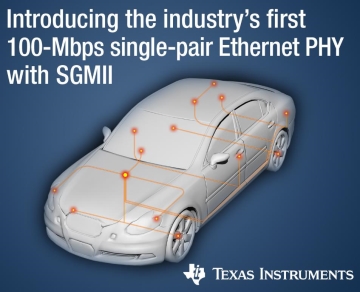
TI Launches Automotive Ethernet Physical Layer Transceiver that Reduces Board Space and Power Consumption
TI has announced the launch of a new automotive Ethernet physical layer (PHY) transceiver product. Using this product, external component count, board space, and power consumption can be reduced by half compared to competing solutions. The new DP83TC811S-Q1 supports SGMII (serial gigabit media independent interface), compact packaging, and integrated diagnostic functions, enabling higher levels of intelligence through Ethernet connectivity in space-constrained automotive applications such as body control modules, infotainment and cluster systems, and ADAS.
2018.05.09by 김지혜 기자
ETRI succeeds in developing satellite frequency interference cancellation technology.
The Electronics and Telecommunications Research Institute has successfully developed technology for efficiently utilizing limited frequency resources currently used in satellites. This technology overlaps transmit and receive frequencies and enables signal separation of terminal signals from the overlapped frequencies. As a result, it is possible to allocate twice as many additional channels compared to existing methods while reducing costs.
2018.08.16by 이수민 기자
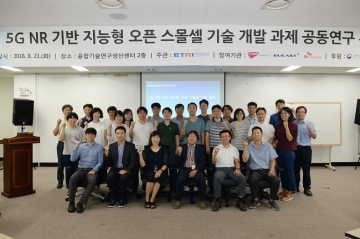
ETRI Develops 5G Small Cell Hardware Following Software Success
The Electronics and Telecommunications Research Institute (ETRI) has achieved localization of LTE small cell software for compact base stations used like wireless access points within a radius of 10m to 1km, and is now embarking on full-scale research for localization of small cell equipment essential to future 5G infrastructure. ETRI is targeting commercialization by 2022.
2018.08.25by 이수민 기자
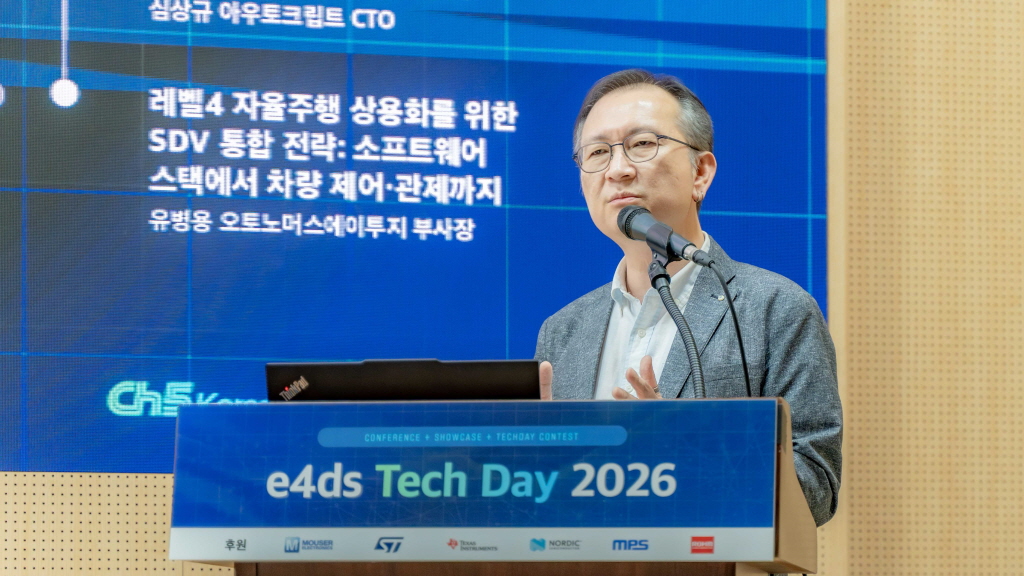
[e4ds Tech Day 2026 ⑨] Sim Sang-gyu, Autocrypt CTO: "In the Physical AI Era, Automotive Security Must Extend Beyond the Vehicle"
At e4ds Tech Day 2026, Sim Sang-gyu, CTO of Autocrypt, explained automotive cybersecurity strategies in the era of Physical AI and SDV (Software-Defined Vehicle). Automobiles are evolving as part of an ecosystem connected to AI, cloud, chargers, IoT, and robots, and he emphasized that the scope of security must expand beyond the vehicle interior to the entire connected environment. In particular, AI model tampering, adversarial attacks, OTA updates, and EV charger hacking were identified as major threats. He explained that response measures require zero trust, AI model integrity protection, intrusion detection, Security by Design and Default, and full lifecycle security management, and that proactive security system establishment beyond regulatory compliance is critical for securing future mobility competitiveness.
2026.10.12by 배종인 기자

Practical HIL Construction Strategy for Automotive and Off-Highway Controller Validation
As vehicle E/E architecture transitions to zonal structures and shifts to software-defined vehicles (SDV), the number of controllers (ECUs) requiring validation and software complexity are surging dramatically. Meanwhile, real vehicle testing cannot provide repeated verification under identical conditions and entails lead time and safety concerns. This white paper explains the principles of HIL (Hardware-in-the-Loop) validation and the structure of the NI platform composed of PXI, SLSC, and VeriStand, and through two actual implementation cases—Camera Record & Replay HIL for In-Cabin Monitoring Controller (ICMU) and Forklift Controller (VCU) HILS—describes how controller-level regression testing becomes possible. Additionally, it explicitly states application boundaries and limitations, such as lack of A2B support.
2026.10.12by 편집부











