


LG Uplus develops 5G integrated optical line monitoring system
 Published2018.12.04 09:31
Improving the efficiency of fault handling through rapid action
Joint development with small and medium-sized enterprise Coweaver
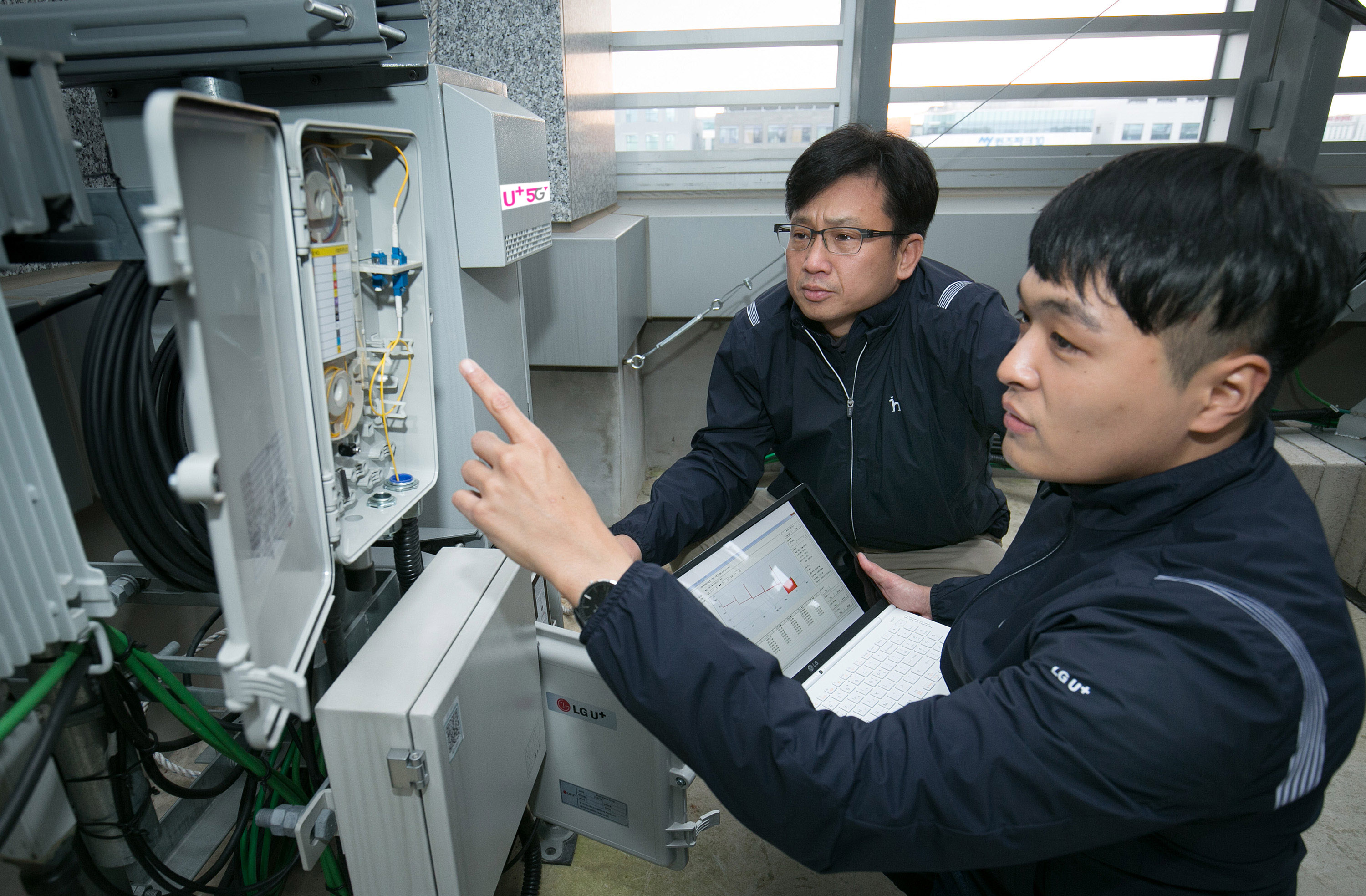
LG U+ employees are testing a newly developed optical fiber monitoring system.
LG Uplus announced on the 4th that it has completed the development of an integrated optical line monitoring system that can systematically manage wired optical lines constructed between base stations and repeaters and identify the cause and location of failures in real time.
The newly developed optical line monitoring system is characterized by its simultaneous application to 5G base stations, relay stations, and wired backbone networks.
This is the first integrated optical fiber management system in Korea that provides both an optical fiber measurement function (Optical Time-Domain Reflectometer, OTDR) that measures loss, disconnection points, and distance of the optical fiber line, and an optical power meter (OPM) that analyzes optical signals by wavelength to measure quality.
While the technology used to monitor existing optical lines was limited to partially identifying open points in optical cables based on OTDR, the integrated optical line monitoring system can simultaneously monitor up to 160,000 optical cables and the optical wavelengths used for 5G services within the optical cables to manage optical line quality.
Accordingly, when a 5G network base station failure occurs, the optical line break, line quality deterioration, or base station equipment problem is immediately identified and provided to the network operator. We have come to provide the highest quality and most stable service.
Additionally, the integrated optical fiber monitoring system can be expanded to cover not only 5G networks but also wired backbone network sections by using wavelengths that do not affect existing services, enabling real-time monitoring of the quality of all optical fiber sections.
LG Uplus plans to apply this system, developed in collaboration with small and medium-sized enterprise Coweaver, to its 5G network sections, and plans to continue developing solutions to improve network quality with domestic manufacturers.
LG Uplus NW Development Manager Lee Sang-heon said, “With the development of the integrated optical line monitoring system, we can now monitor the quality of optical signals in service and whether there are any optical line breaks in real time, allowing us to quickly identify and take action on the cause of service interruptions.” He added, “This will enable us to provide high-quality, uninterrupted 5G services.”
Comments
Related news
LG U+ Releases NFV MANO Interoperability Specifications to Activate 5G Ecosystem
LG U+ has disclosed interconnection specifications for a virtualized integrated management platform jointly developed with Samsung Electronics as part of building a 5G ecosystem based on large and small enterprise coexistence. LG U+ disclosed the virtualized integrated management platform interconnection specifications to AriaaTech, a small telecommunications equipment company, and completed development of virtualized 5G subscriber authentication and policy management equipment. LG U+ plans to commercialize this within next year.
2018.11.26by 이수민 기자

LG U+ to Build 5G-Based Smart Resort in Hongcheon, Gangwon Province
LG uPlus has signed a memorandum of understanding with Daemyung T&P, Daemyung Hotel & Resort, Ericsson-LG, and Hongcheon County to build 5G-based eco-friendly smart resorts, theme parks, and tourism facilities. The 5G-based eco-friendly smart resorts and theme parks will incorporate various information and communications technologies including AI, IoT, energy efficiency, and autonomous driving, based on LG uPlus's 5G network and Ericsson-LG's IoT platform. Through this initiative, the plan is to ensure efficient operation of business facilities as well as secure customer safety and enhance convenience.
2018.11.28by 이수민 기자
"First customers are industrial sectors" Three telecom companies begin 5G commercialization simultaneously
On December 1st, the three domestic mobile carriers simultaneously commenced 5G commercialization. At the first 5G signal transmission ceremony of the three companies, key executives from each company participated to reflect on their efforts thus far and reaffirm their future aspirations.
2018.12.03by 이수민 기자
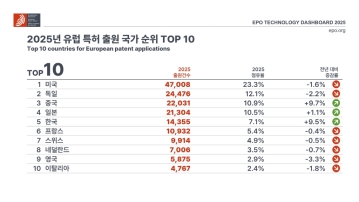
European Patent Applications Surpass 200,000 for the First Time… South Korea Maintains 5th Place, Led by Batteries and Telecommunications
According to the European Patent Office (EPO)'s 'Technology Dashboard 2025', European patent applications last year reached 201,974, surpassing 200,000 for the first time. Korean companies and inventors filed 14,355 applications, representing a 9.5% increase from the previous year and maintaining 5th place by country. Battery, digital communication, and semiconductor technologies led the growth, with Samsung ranking as the top EPO applicant for the second consecutive year and LG reaching 3rd place. The presence of major domestic cities such as Seoul, Suwon, and Yongin was also confirmed. It was also revealed that Korea's European patent strategy is expanding beyond individual technologies to span the entire industry.
2026.03.24by 명세환 기자

SK Telecom First Applies AI-Based Network Operations at Gwanghwamun K-Pop Concert
SK Telecom announced that it applied an AI-based network operation system for the first time at a large-scale K-pop concert held in the Gwanghwamun area of Seoul on March 21st, managing communication quality throughout the event. Mobile data usage during the three hours before and after the concert reached 12.15TB, approximately doubling compared to the same time slot the previous weekend. SK Telecom monitored traffic using the AI system 'A-One' in five-minute and 50-meter units to respond to potential overload situations, while also operating temporary communication facilities and on-site personnel in parallel. This case is interpreted as confirmation of the practical applicability of AI-based autonomous network operation in an environment where demand from dense events and foreign users increases simultaneously.
2026.03.23by 명세환 기자











