This page was machine-translated and may differ from the original. View original
[Quantum Exploration] 10. D-Wave Opens the Door to Commercial Quantum Computers

With the advancement of artificial intelligence and virtual reality, the amount of data we need to process is increasing, but the limits of integrated circuits are approaching. Therefore, quantum computers, which use quantum mechanics as their operational principles instead of transistor gates, are emerging as a viable alternative. What exactly is quantum computing, and how can it be used as a solution? A reporter with no prior scientific background delves into everything from quantum computing to the current buzz, with a learning mindset.
Richard Feynman said this at a computational physics conference hosted by IBM and MIT in May 1981:
"The world we live in is not classical, but quantum. Therefore, to simulate this world, we need quantum mechanics."
That's exactly right. When classical mechanics, established by Isaac Newton, failed to explain the atomic world, quantum mechanics emerged, and physicists discovered through quantum mechanics that this world is quantum. The reason we need quantum computers is because the world we live in is not classical, but quantum.
The power of quantum computers
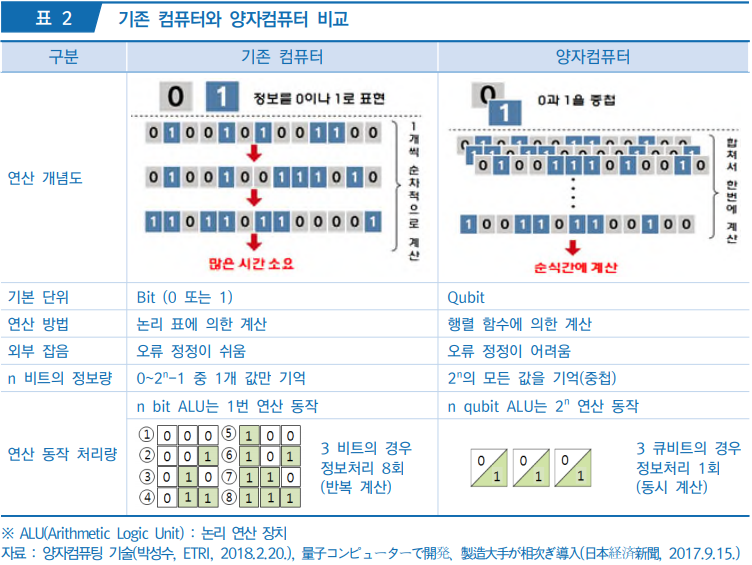
Why can't I fall asleep after drinking a caffeinated beverage? Scientists haven't yet figured out why. It's because they haven't been able to analyze the caffeine molecule, which would require 1048 bits on current computers. A quantum computer, on the other hand, only needs 160 qubits.
As the number of qubits increases, their processing power doubles. As the number of qubits increases, the performance increases by a factor of two. 50 qubits have 2.50 times the performance of 1 qubit. 
Source: ICT Spot Issue (February 2018) Quantum Computer Development Trends and Implications, National Information and Communications Technology Promotion Agency
A quantum computer is a computer that can compute multiple pieces of information simultaneously by utilizing quantum mechanical phenomena such as quantum superposition and entanglement. It is an ultra-fast, large-capacity computing technology optimized for specific calculations.
Based on its parallel computing processing capabilities, it boasts computational performance that is incomparably superior to that of existing computers, and it is expected to have a significant impact on existing industries.
When will quantum computers be commercialized?
So when will quantum computers become fully commercially available?
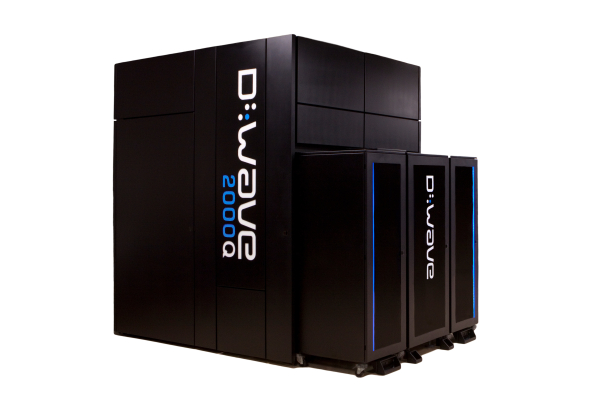
There are already computers on the market that claim to be quantum computers. Of course, the price of that computer, the D-Wave 2000Q, is 15 million dollars, or 16.6 billion won in Korean currency.
Canada's D-Wave Systems is known as the first company to create a quantum computer. 
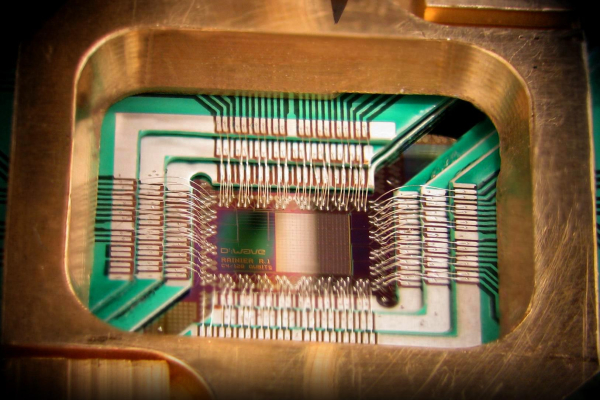
D-Wave 1's 128-qubit processor
In 2011, Canada's D-Wave Systems developed the 128-qubit quantum computer, the D-Wave 1. The following year, it released the 512-qubit D-Wave 2, followed by the 1,152-qubit D-Wave 2X in 2015 and the 2,048-qubit D-Wave 2000Q in 2017.
But if 160 qubits can reveal the structure of molecules, why can't we explain why coffee keeps us awake even now, despite the existence of quantum computers with over 2,000 qubits? The reason is that D-Wave's computer is different from the quantum computers we typically talk about.
D-Wave's computer observes quantum annealing
D-Wave is a "special-purpose computer" built to observe quantum annealing, a far cry from a general-purpose quantum computer that uses quantum gates.
D-Wave solves only optimization problems. Optimization problems are about finding the best conditions. When the degree of badness is called a 'badness index', the optimization problem is to find the condition under which the badness index is minimized.
Finding the lowest point in a 10 km2 area requires meticulously measuring the elevation above sea level. But how can we prove that the lowest point is the lowest point once it's been found? Considering the elevation of each point as a badness index, this becomes an optimization problem.
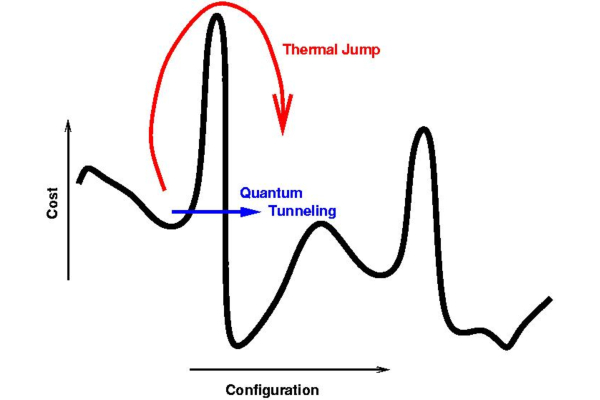
Here's how to solve an optimization problem: First, jump around quickly to find the lowest point. High speed means high temperature. Temperature is the average kinetic energy of numerous particles. When the particles move quickly as a whole, their momentum is high. This movement is random; they don't all move in the same direction. If they move randomly, they can find the lowest point and pass through, but they won't stay at a point that's slightly shallower than their surroundings.
If the temperature is gradually lowered here, the shallow areas will be missed and the probability of being located near the deeper areas increases. This process of gradually lowering the temperature to find the lowest point is called annealing. 
Quantum tunneling can be used to solve optimization problems at high speeds.
D-Wave uses the tunneling phenomenon to speed up this process. In quantum mechanics, tunneling is the phenomenon in which nucleons constituting the nucleus probabilistically escape from the atom even at an energy state lower than the potential well of the nuclear force that binds them.
When solving the above optimization problem, the tunneling phenomenon allows for a single, rapid movement from one location to another at a similar depth.
Is D-Wave's computer a true quantum computer?
There has been much debate over whether D-Wave is a true quantum computer.
In 2014, a research team led by Matthias Troyer of ETH Zurich in Switzerland had a D-Wave and a regular computer solve a specific computational problem and compared how much the problem-solving time increased as the size of the computational problem increased.
The research team said in the abstract that they found no evidence of a breakthrough in computational speed that would occur on quantum computers. The research team reported that in several computational comparisons, in some problem-solving cases, the D-Wave showed computational speed performance that was several times faster, but in other problem-solving cases, the general computer showed much higher performance. 
D-Wave 2000Q
Meanwhile, in 2016, Google reported that its D-Wave 2X had achieved 100 million times the speed of a conventional computer using the same algorithm, and in 2017, D-Wave claimed that its D-Wave 2000Q had achieved 2,600 times the speed of the fastest conventional computer.
It's now widely accepted that D-Wave computers are capable of quantum annealing. Because quantum annealing can only solve specific problems and not general calculations, it's not what we typically call a quantum computer. It's simply another form of computer that utilizes quantum phenomena. Nevertheless, the D-Wave remains an exceptional computer.
Furthermore, major countries such as the United States, Europe, China, and Japan are actively supporting the development of quantum computers through policy. Global companies such as IBM, Google, Microsoft, and Intel are also investing heavily in quantum computer development. And no one can deny that D-Wave started it all.
The growing interest in quantum computers
Gartner listed quantum computing as the last of its 10 ICT trends for businesses to pay attention to in 2019. 
David Cearley, Vice President at Gartner, explains the importance of quantum computing.
“CIOs and IT leaders should plan for quantum computing while the technology is still in its emerging stages,” said David Cearley, vice president at Gartner. “They should identify real-world problems where quantum computing has potential and consider the potential security implications.”
"Most organizations should be learning about and monitoring quantum computing by 2022," he added, "because they won't be able to leverage it until 2023 or 2025."
As interest in quantum computers continues to grow, IBM is one of the most active companies in this field. IBM hosted the May 1981 Conference on Computational Physics, the very conference where Richard Feynman proposed quantum computing.
The following article will discuss IBM's quantum computer development history and quantum computer policy.
References - Kim Sang-wook's Quantum Studies, Science Books, 2017.
Richard Feynman said this at a computational physics conference hosted by IBM and MIT in May 1981:
"The world we live in is not classical, but quantum. Therefore, to simulate this world, we need quantum mechanics."
That's exactly right. When classical mechanics, established by Isaac Newton, failed to explain the atomic world, quantum mechanics emerged, and physicists discovered through quantum mechanics that this world is quantum. The reason we need quantum computers is because the world we live in is not classical, but quantum.
The power of quantum computers
Why can't I fall asleep after drinking a caffeinated beverage? Scientists haven't yet figured out why. It's because they haven't been able to analyze the caffeine molecule, which would require 1048 bits on current computers. A quantum computer, on the other hand, only needs 160 qubits.
As the number of qubits increases, their processing power doubles. As the number of qubits increases, the performance increases by a factor of two. 50 qubits have 2.50 times the performance of 1 qubit.

Source: ICT Spot Issue (February 2018) Quantum Computer Development Trends and Implications, National Information and Communications Technology Promotion Agency
A quantum computer is a computer that can compute multiple pieces of information simultaneously by utilizing quantum mechanical phenomena such as quantum superposition and entanglement. It is an ultra-fast, large-capacity computing technology optimized for specific calculations.
Based on its parallel computing processing capabilities, it boasts computational performance that is incomparably superior to that of existing computers, and it is expected to have a significant impact on existing industries.
When will quantum computers be commercialized?
So when will quantum computers become fully commercially available?
There are already computers on the market that claim to be quantum computers. Of course, the price of that computer, the D-Wave 2000Q, is 15 million dollars, or 16.6 billion won in Korean currency.
Canada's D-Wave Systems is known as the first company to create a quantum computer.

D-Wave 1's 128-qubit processor
In 2011, Canada's D-Wave Systems developed the 128-qubit quantum computer, the D-Wave 1. The following year, it released the 512-qubit D-Wave 2, followed by the 1,152-qubit D-Wave 2X in 2015 and the 2,048-qubit D-Wave 2000Q in 2017.
But if 160 qubits can reveal the structure of molecules, why can't we explain why coffee keeps us awake even now, despite the existence of quantum computers with over 2,000 qubits? The reason is that D-Wave's computer is different from the quantum computers we typically talk about.
D-Wave's computer observes quantum annealing
D-Wave is a "special-purpose computer" built to observe quantum annealing, a far cry from a general-purpose quantum computer that uses quantum gates.
D-Wave solves only optimization problems. Optimization problems are about finding the best conditions. When the degree of badness is called a 'badness index', the optimization problem is to find the condition under which the badness index is minimized.
Finding the lowest point in a 10 km2 area requires meticulously measuring the elevation above sea level. But how can we prove that the lowest point is the lowest point once it's been found? Considering the elevation of each point as a badness index, this becomes an optimization problem.
Here's how to solve an optimization problem: First, jump around quickly to find the lowest point. High speed means high temperature. Temperature is the average kinetic energy of numerous particles. When the particles move quickly as a whole, their momentum is high. This movement is random; they don't all move in the same direction. If they move randomly, they can find the lowest point and pass through, but they won't stay at a point that's slightly shallower than their surroundings.
If the temperature is gradually lowered here, the shallow areas will be missed and the probability of being located near the deeper areas increases. This process of gradually lowering the temperature to find the lowest point is called annealing.

Quantum tunneling can be used to solve optimization problems at high speeds.
D-Wave uses the tunneling phenomenon to speed up this process. In quantum mechanics, tunneling is the phenomenon in which nucleons constituting the nucleus probabilistically escape from the atom even at an energy state lower than the potential well of the nuclear force that binds them.
When solving the above optimization problem, the tunneling phenomenon allows for a single, rapid movement from one location to another at a similar depth.
Is D-Wave's computer a true quantum computer?
There has been much debate over whether D-Wave is a true quantum computer.
In 2014, a research team led by Matthias Troyer of ETH Zurich in Switzerland had a D-Wave and a regular computer solve a specific computational problem and compared how much the problem-solving time increased as the size of the computational problem increased.
The research team said in the abstract that they found no evidence of a breakthrough in computational speed that would occur on quantum computers. The research team reported that in several computational comparisons, in some problem-solving cases, the D-Wave showed computational speed performance that was several times faster, but in other problem-solving cases, the general computer showed much higher performance.

D-Wave 2000Q
Meanwhile, in 2016, Google reported that its D-Wave 2X had achieved 100 million times the speed of a conventional computer using the same algorithm, and in 2017, D-Wave claimed that its D-Wave 2000Q had achieved 2,600 times the speed of the fastest conventional computer.
It's now widely accepted that D-Wave computers are capable of quantum annealing. Because quantum annealing can only solve specific problems and not general calculations, it's not what we typically call a quantum computer. It's simply another form of computer that utilizes quantum phenomena. Nevertheless, the D-Wave remains an exceptional computer.
Furthermore, major countries such as the United States, Europe, China, and Japan are actively supporting the development of quantum computers through policy. Global companies such as IBM, Google, Microsoft, and Intel are also investing heavily in quantum computer development. And no one can deny that D-Wave started it all.
The growing interest in quantum computers
Gartner listed quantum computing as the last of its 10 ICT trends for businesses to pay attention to in 2019.

David Cearley, Vice President at Gartner, explains the importance of quantum computing.
“CIOs and IT leaders should plan for quantum computing while the technology is still in its emerging stages,” said David Cearley, vice president at Gartner. “They should identify real-world problems where quantum computing has potential and consider the potential security implications.”
"Most organizations should be learning about and monitoring quantum computing by 2022," he added, "because they won't be able to leverage it until 2023 or 2025."
As interest in quantum computers continues to grow, IBM is one of the most active companies in this field. IBM hosted the May 1981 Conference on Computational Physics, the very conference where Richard Feynman proposed quantum computing.
The following article will discuss IBM's quantum computer development history and quantum computer policy.
References - Kim Sang-wook's Quantum Studies, Science Books, 2017.
본 기사에 대한 정정·반론·추후보도 청구는 보도 청구 안내를, 그간 게재된 보도문은 정정·반론보도 모아보기를 참고해 주세요.