


4G to spearhead 5G deployment in Central and South America
 Published2018.12.10 09:01
Expanding 4G investment will serve as a stepping stone for building 5G networks.
The 5G era is dawning as South Korea launches the world's first commercial 5G service. It's important to note that the arrival of the 5G era doesn't mean previous-generation technologies will be obsolete.
2G, 3G, and LTE (4G) will continue to support 5G and play their roles. In some regions, they will exert even greater influence than 5G or serve as a springboard for 5G network deployment. Latin America is one such region.

Mobile 360 Series Latin America
4G is expected to surpass 3G as the mainstream technology in Latin America by the end of 2018, according to a new GSMA report released at the Mobile 360 Series - Latin America in Buenos Aires, Argentina, on December 6.
The report, ' The Mobile Economy: Latin America and the Caribbean 2018 ', forecasts that 4G networks will account for the largest share (38%) of connections in the region by the end of this year. This is a significant increase from 8% three years ago.
As 4G reaches critical mass in terms of coverage (82% of the population), carriers will invest heavily in network updates to support the surge in smartphone and data usage, paving the way for the 5G era.
4G is expected to account for two-thirds of all connections by 2025, with 5G networks expected to be deployed primarily in key markets such as Brazil and Mexico by then, accounting for 8% of all connections in the region.
“Consumers across Latin America are rapidly migrating to 4G services, driven by video viewing and social media usage, and this traffic growth is necessitating significant investment in networks to support new and existing digital services,” said Michael O’Hara, chief marketing officer, GSMA.
“Mobile operators in the region are expected to invest approximately $50 billion in network upgrades from 2018 to 2020 ahead of the move to 5G,” it said.
An active pricing policy is needed to bridge the digital divide.
Currently, more than two-thirds of the region's population is connected to mobile networks. By mid-2018, there were 442 million mobile subscribers across the Latin American region (68% of the total population), a figure projected to increase to 517 million (74%) by 2025.
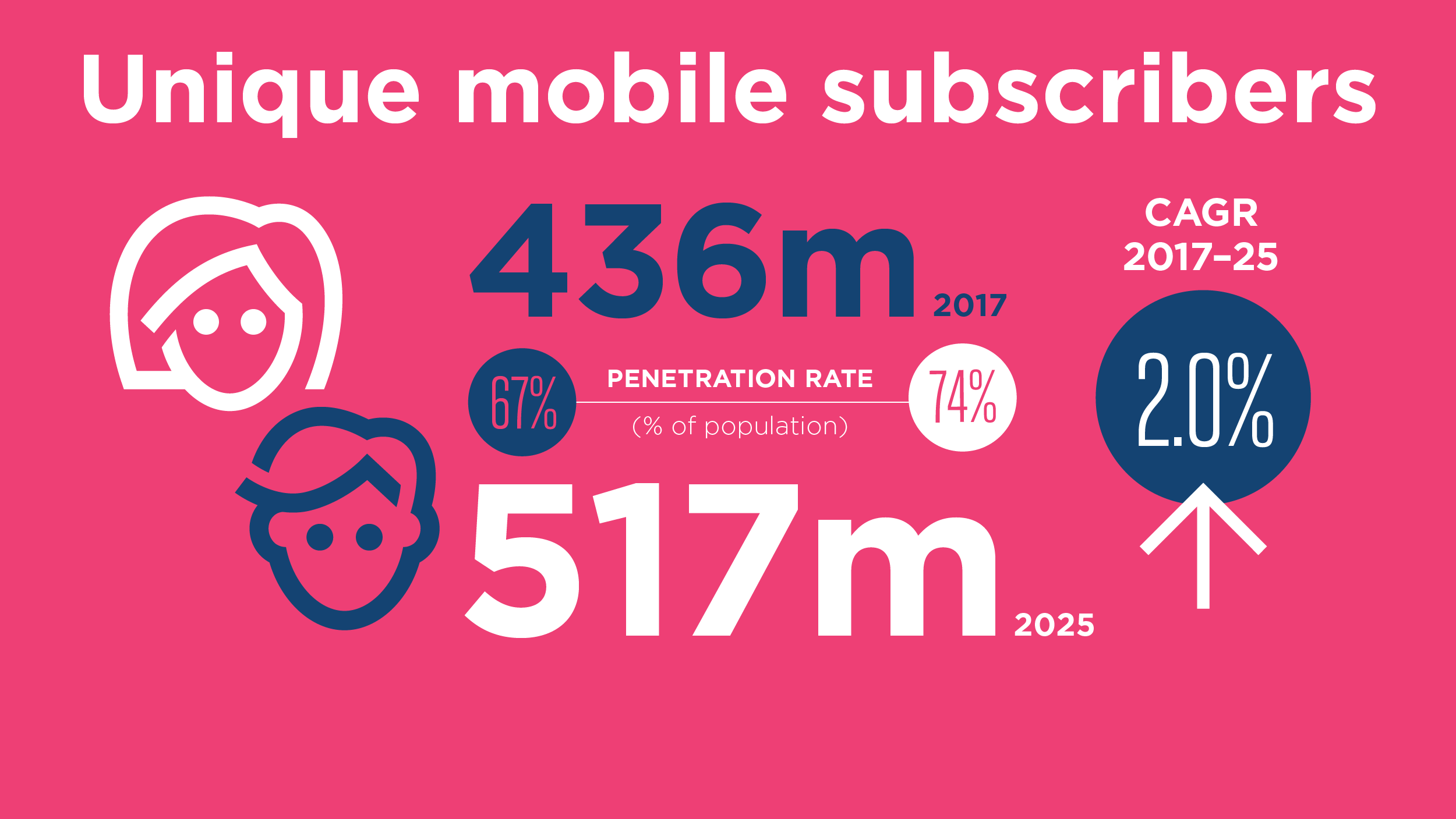
The number of mobile subscribers in Latin America is projected to increase to 517 million by 2025.
There is a significant difference in coverage rates between countries, with countries such as Argentina, Chile, and Uruguay nearing nationwide coverage, while countries such as Guatemala, Honduras, and Nicaragua have not.
“Currently, half the region’s population is connected to the mobile internet, and that number is projected to rise to 65% by 2025, but there is still much work to be done to ensure that millions of citizens are digitally included and can access the social and economic benefits that online presence offers,” O’Hara said.
He added that it was “critical for the mobile industry to work with governments and potential stakeholders to address barriers to mobile internet adoption, such as excessive taxes and fees that negatively impact affordability.”
Mobile technologies and services that contribute significantly to the local economy
The mobile industry is projected to account for 5.2% of Latin America's total GDP.
Mobile technology and services contributed 5% of Latin America's total GDP last year, adding $280 billion in economic value. This figure is projected to increase to $330 billion (5.2% of GDP) by 2022.
The region's mobile ecosystem also directly and indirectly supported approximately 1.6 million jobs in 2017 and contributed significantly to public sector funding, including approximately $36 billion in general taxes and sectoral levies in 2017.
Mobile Drives Innovation and Generates Public Benefits
Latin America's mobile ecosystem is fueling a wave of innovation across the region, driven by a growing number of new technologies, services, and use cases.
For example, mobile operators contribute significantly to the IoT market. The number of IoT connections in the region is expected to triple from 2017 to 2025, reaching 1.3 billion, transforming both consumer and industrial sectors.
The report cites examples of how mobile-based innovations have had a positive impact, including contributing to the achievement of the United Nations' Sustainable Development Goals (SDGs).
Claro has partnered with Córdoba, Argentina, to develop an IoT solution that will connect machines and farm animals via sensors to enable traceability of livestock products.
In La Guajira, Colombia, Telefoìnica and the UN Food and Agriculture Organization (FAO) are using mobile big data to measure how climate change is affecting internal displacement and the movement of people.
This initiative, part of the GSMA's Big Data for Social Good (BD4SG) programme, aims to provide countries and institutions with the insights they need to make informed decisions and implement targeted policy interventions.
Comments
Related news
By 2025, half of sub-Saharan Africa's population will be connected to mobile devices.
GSMA's report forecasts that by 2025, half of the sub-Saharan African population will subscribe to mobile services.
2018.07.24by 이수민 기자
The Mobile Industry Leads Global Sustainable Development
GSMA released its 2018 annual Mobile Industry Impact Report on September 26, coinciding with the UN General Assembly. The report stated that since 2016, when mobile became the first industry to commit to implementing the 'Sustainable Development Goals,' its contributions to all 17 goals have been continuously increasing.
2018.10.02by 이수민 기자
"First customers are industrial sectors" Three telecom companies begin 5G commercialization simultaneously
On December 1st, the three domestic mobile carriers simultaneously commenced 5G commercialization. At the first 5G signal transmission ceremony of the three companies, key executives from each company participated to reflect on their efforts thus far and reaffirm their future aspirations.
2018.12.03by 이수민 기자
European Patent Applications Surpass 200,000 for the First Time… South Korea Maintains 5th Place, Led by Batteries and Telecommunications
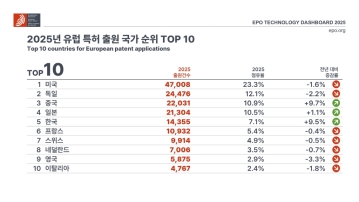
According to the European Patent Office (EPO)'s 'Technology Dashboard 2025', European patent applications last year reached 201,974, surpassing 200,000 for the first time. Korean companies and inventors filed 14,355 applications, representing a 9.5% increase from the previous year and maintaining 5th place by country. Battery, digital communication, and semiconductor technologies led the growth, with Samsung ranking as the top EPO applicant for the second consecutive year and LG reaching 3rd place. The presence of major domestic cities such as Seoul, Suwon, and Yongin was also confirmed. It was also revealed that Korea's European patent strategy is expanding beyond individual technologies to span the entire industry.
2026.03.24by 명세환 기자

SK Telecom First Applies AI-Based Network Operations at Gwanghwamun K-Pop Concert
SK Telecom announced that it applied an AI-based network operation system for the first time at a large-scale K-pop concert held in the Gwanghwamun area of Seoul on March 21st, managing communication quality throughout the event. Mobile data usage during the three hours before and after the concert reached 12.15TB, approximately doubling compared to the same time slot the previous weekend. SK Telecom monitored traffic using the AI system 'A-One' in five-minute and 50-meter units to respond to potential overload situations, while also operating temporary communication facilities and on-site personnel in parallel. This case is interpreted as confirmation of the practical applicability of AI-based autonomous network operation in an environment where demand from dense events and foreign users increases simultaneously.
2026.03.23by 명세환 기자











