



SK Telecom to Introduce Mobile Edge Computing Technology to 5G
 Published2018.12.13 09:41
Promotion of data center installation at base stations, etc.
Data processing speed and enhanced security effects
SK Telecom is partnering with Deutsche Telekom to introduce mobile edge computing technology to 5G. 5G latency will be further reduced, and ultra-high-capacity communication will become faster.
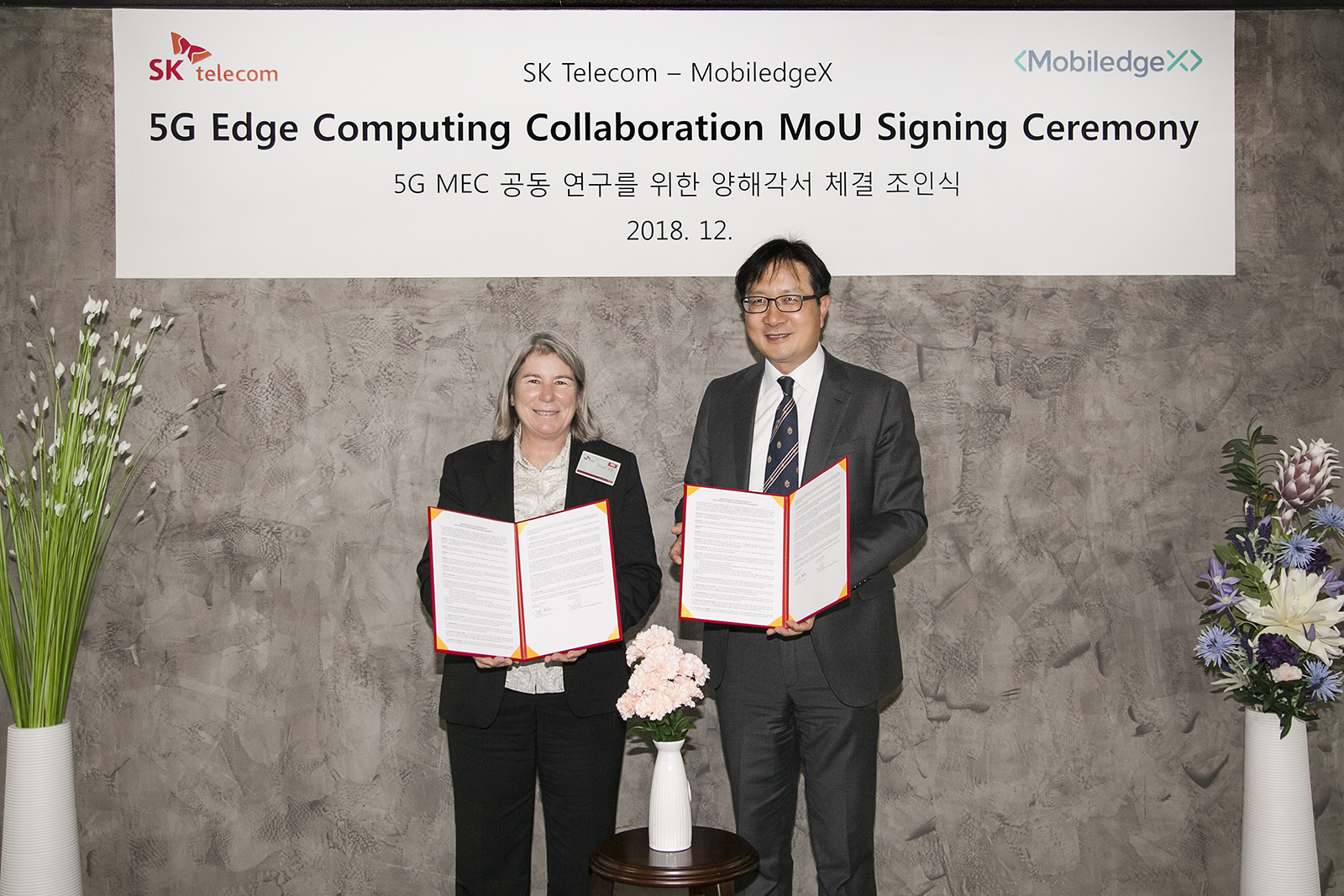
SK Telecom partners with Deutsche Telekom to introduce mobile edge computing technology to 5G
SK Telecom announced on the 13th that it has signed a business agreement with MobiledgeX, a subsidiary of Deutsche Telekom, for collaboration on mobile edge computing technology.
Mobile Edge X possesses platform technology to provide an integrated mobile edge computing environment for various developers and carriers.
Mobile edge computing is a technology that installs data centers or solutions physically close to customers and provides services.
Subscriber data typically moves from a customer's smartphone to a base station → switch → wired network → service provider's data center, but SK Telecom plans to install small-scale 5G data centers at base stations or switches.
Service latency is reduced because data can be processed immediately at data centers in direct contact with customers. Mobile edge computing technology is highly utilized in 5G-based next-generation industries such as autonomous driving, disaster response robots and drones, large-capacity cloud gaming, and AR/VR.
It can also be utilized in B2B business models such as 5G smart factories. This involves directly installing a small-scale data center within the smart factory. Data processing time for data exchanged during the production process is reduced, and data security is further enhanced as business-critical data can be processed internally within the factory.
The two companies agreed to jointly pursue the development of core technologies related to mobile edge computing, platform integration, ecosystem expansion, and business model development.
In particular, the focus is on platform interoperability and ecosystem expansion. Given the current lack of standards for the interoperability or integration of mobile edge computing, the plan is to integrate the two companies' platforms and provide a common platform to global 5G service developers to expand the ecosystem.
Park Jong-kwan, Head of SK Telecom’s Network Technology Institute, said, “Mobile edge computing is a core technology for next-generation 5G-based industries such as immersive media, autonomous driving, and smart factories,” adding, “We will continue technological innovation to provide differentiated 5G services to our customers.”
Eric Brown, Chief Business Officer of Mobile Edge X, stated, “I am pleased to work with SK Telecom, which has been striving for network innovation and the creation of an open developer ecosystem,” adding, “Together with SK Telecom, we will build a foundation for mutual growth among operators and usher in a new 5G era.”
Comments
Related news
SK Telecom Opens 5G Device Performance Testing Facility for SMEs
SK Telecom has opened a 5G Device Test Lab at its Seongnam Bundang headquarters, serving as the final gateway for testing 5G device performance. The 5G Device Test Lab, with a floor area of 100 pyeong, is equipped with measurement equipment, laboratories, and conference rooms, staffed with specialized personnel who conduct quality verification. Inside the laboratory are 5G base stations, repeaters, measurement instruments for radio wave testing, and electromagnetic field measurement equipment. Additionally, it is enclosed by radio wave shielding walls made of steel plates 25cm thick, which completely block external frequency signals and enable accurate testing.
2018.12.05by 이수민 기자
SK Telecom Joins Hands with Hyundai Construction Equipment and Trimble to Implement 5G and AI-Based Smart Construction
SK Telecom has signed a memorandum of understanding with Hyundai Construction Equipment and Trimble to develop and advance a 5G smart construction solution. Through this MOU, the three companies will develop a 5G smart construction solution that can increase construction efficiency by applying 5G and ICT technologies to civil engineering and construction sites. The three companies plan to maximize operational management efficiency at construction sites by applying AI solutions across all construction stages including quotation, surveying, design, planning, construction, and inspection.
2018.12.10by 이수민 기자
KT, "K-City will be the cradle of autonomous driving technology in Korea"
KT jointly established K-City, Korea's first autonomous driving experimental city based on 5G networks under the auspices of the Korea Transportation Safety Authority, and unveiled the 5G Remote Cockpit autonomous driving remote control system for the first time. K-City is a 5G autonomous driving technology verification testbed established on a 360,000㎡ site within the Korea Transportation Safety Research Institute in Hwaseong, Gyeonggi Province, for the early commercialization of Level 3 autonomous vehicles.
2018.12.10by 이수민 기자
European Patent Applications Surpass 200,000 for the First Time… South Korea Maintains 5th Place, Led by Batteries and Telecommunications
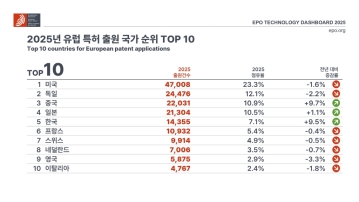
According to the European Patent Office (EPO)'s 'Technology Dashboard 2025', European patent applications last year reached 201,974, surpassing 200,000 for the first time. Korean companies and inventors filed 14,355 applications, representing a 9.5% increase from the previous year and maintaining 5th place by country. Battery, digital communication, and semiconductor technologies led the growth, with Samsung ranking as the top EPO applicant for the second consecutive year and LG reaching 3rd place. The presence of major domestic cities such as Seoul, Suwon, and Yongin was also confirmed. It was also revealed that Korea's European patent strategy is expanding beyond individual technologies to span the entire industry.
2026.03.24by 명세환 기자
SK Telecom First Applies AI-Based Network Operations at Gwanghwamun K-Pop Concert
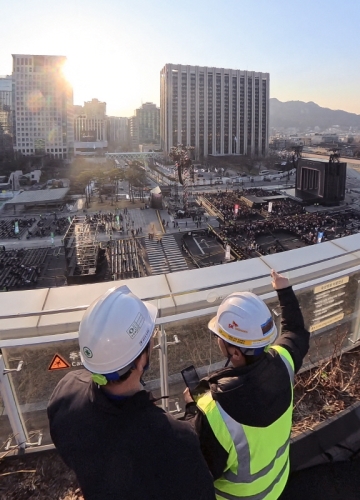
SK Telecom announced that it applied an AI-based network operation system for the first time at a large-scale K-pop concert held in the Gwanghwamun area of Seoul on March 21st, managing communication quality throughout the event. Mobile data usage during the three hours before and after the concert reached 12.15TB, approximately doubling compared to the same time slot the previous weekend. SK Telecom monitored traffic using the AI system 'A-One' in five-minute and 50-meter units to respond to potential overload situations, while also operating temporary communication facilities and on-site personnel in parallel. This case is interpreted as confirmation of the practical applicability of AI-based autonomous network operation in an environment where demand from dense events and foreign users increases simultaneously.
2026.03.23by 명세환 기자











