


u-blox and MBC jointly develop an RTK receiver capable of centimeter-level positioning.
 Published2018.12.13 16:37
Processing the received GNSS correction data
Centimeter-level accuracy
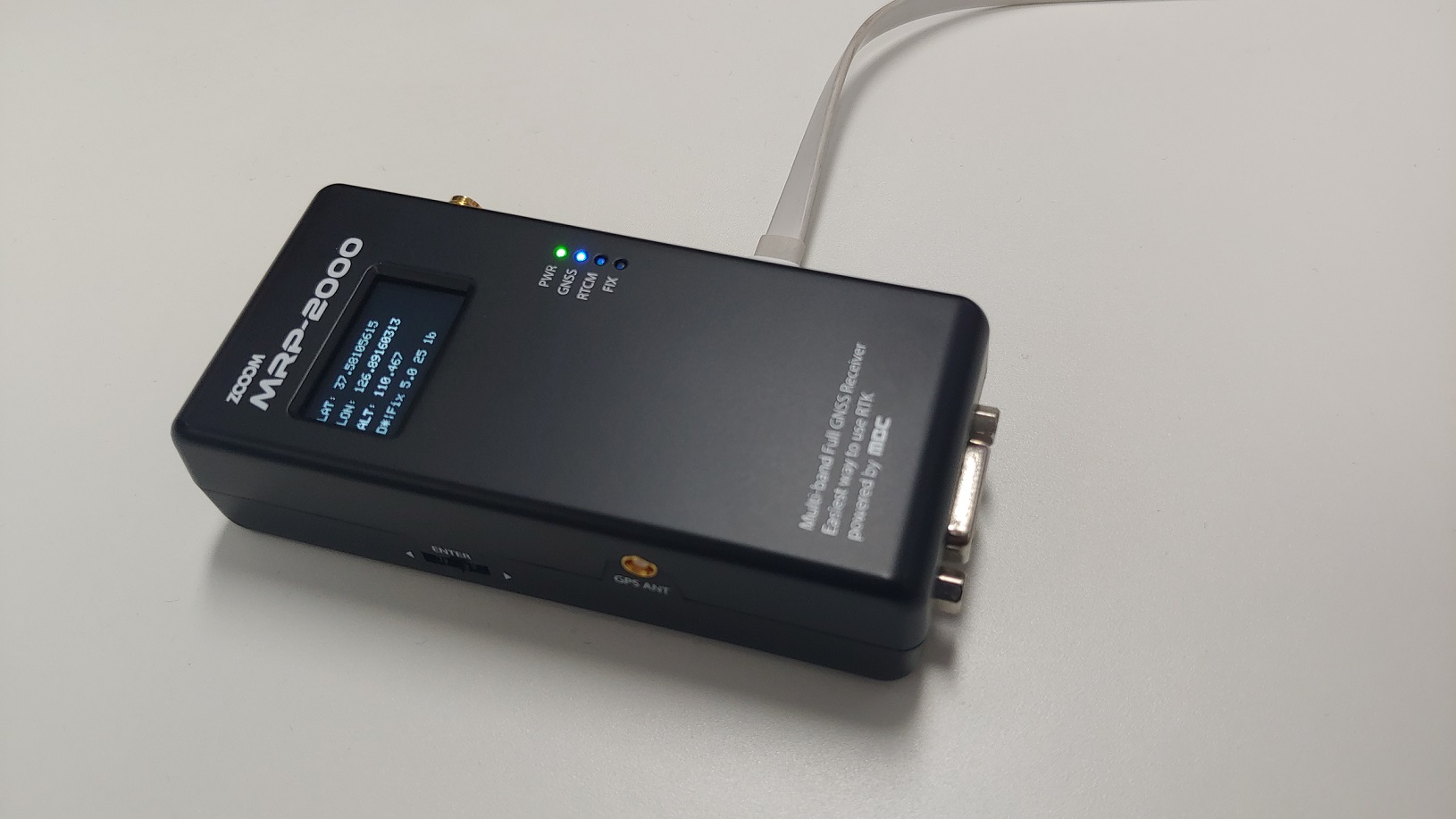
u-blox-MBC, MRP-2000
On the 12th, u-blox announced the results of its collaboration with Munhwa Broadcasting Corporation (MBC). MBC showcased the "MRP-2000," an ultra-compact L1/L2 multiband real-time kinematic (RTK) device equipped with the u-blox ZED-F9P high-precision GNSS module. This product is Korea's first centimeter-level RTK receiver that integrates a GNSS RTK receiver and the ability to receive GNSS correction services.
High-precision GNSS receivers require multiband satellite signal reception and GNSS correction data to deliver centimeter-level positioning accuracy. Multiband receivers not only reduce positioning errors that occur when satellite signals pass through the ionosphere, but also significantly reduce the time it takes for the receiver to determine a precise position. The ZED-F9P utilizes integrated RTK algorithms to process GNSS correction data received via DMB or LTE, enabling centimeter-level accuracy.
The MRP-2000, developed by MBC this time, is an ultra-small, ultra-low-power product weighing just 50g, providing centimeter-level positioning accuracy in a wide range of industries such as autonomous vehicles, drones, and exploration equipment. In particular, GNSS correction data generated through the reference station infrastructure built by MBC across the country is provided using the DMB data channel, and in DMB shadow areas, it is provided using the LTE network.
The u-blox ZED-F9P GNSS receiver featured in the MRP-2000 keeps the solution's cost, size, and power consumption to a minimum. With the latest multi-band RTK algorithms integrated into u-blox' chips, MBC has achieved centimeter-level positioning without the need for additional hardware or third-party RTK libraries.
“The integration of u-blox’s ZED-F9P, a mass-market RTK receiver, into MBC’s MRP-2000 product provides an opportunity to introduce u-blox’s advanced high-precision positioning technology to the market,” said Son Kwang-soo, Country Manager of u-blox Korea. “Combined with MBC’s existing DMB channel, the MRP-2000 solution will provide enhanced correction services to vehicles and industrial devices nationwide.”
He added, "We are very pleased that this collaboration will enable MBC to dramatically reduce the cost of ownership of centimeter-level positioning technology."
“We were able to develop the MRP-2000 through collaboration with u-blox,” said Seungho Lee, team leader of the MBC Technology Information Business Team. “This product is an integrated positioning solution that can use RTK data over an LTE network even in areas where DMB reception is dark.”
He added, "This will allow users to obtain centimeter-level high-precision location information throughout South Korea, and this will be a groundbreaking solution that can reduce the price of RTK terminals, which currently cost tens of millions of won in the existing market, by more than half."
Comments
Related news
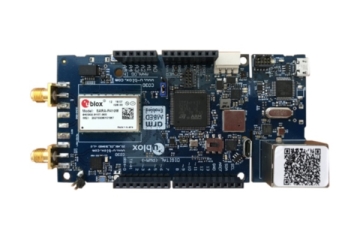
u-blox Releases Location Tracking Application Prototype Development Toolset
u-blox announced a toolkit comprised of u-track software and a C030-R410M application board. This toolkit serves as a platform to accelerate prototype development, enabling product designers to test and optimize location accuracy and power consumption for wireless location tracking applications using LTE-M and NB-IoT cellular networks, as well as GNSS technology.
2018.10.11by 이수민 기자
u-blox modules certified for T-Mobile's new NB-IoT network
With u-blox SARA-N410 now certified for T-Mobile's new NB-IoT network, u-blox's position as a leader in the narrowband IoT field, recognized as a global standard for expanded coverage and low-power consumption performance, will be further strengthened.
2018.10.25by 명세환 기자

Velodyne Lidar Presents the Future of Lidar at IDTechEX
Velodyne Lidar will host a conference on the future of lidar technology at IDTechEX, taking place November 14-15 at the Santa Clara Convention Center in California, USA. The event is expected to attract over 3,500 participants from diverse academic backgrounds, including industry executives and manufacturers. The conference will be led by Dr. Anand Gopalan, Chief Technology Officer of Velodyne Lidar, and Dr. Stephen Nestinger, Director of Mechanical Engineering.
2018.11.11by 이수민 기자
ESP32 Development Environment Selection and GPS Application Implementation
The ESP32 is a microcontroller that integrates Wi-Fi, Bluetooth, 12-bit ADC, capacitive touch, PWM, DAC, and UART in a single SoC. However, the abundance of features does not by itself solve the designer's problems. The real challenges lie in selecting the appropriate development environment, determining which pins can be used and which must be avoided, and converting raw data from modules into usable information. This document addresses ESP32 peripheral constraints (ADC2 and Wi-Fi coexistence limitation, UART1 occupancy, ADC non-linear regions), the trade-offs between Arduino IDE and ESP-IDF, and the process from connecting NEO-6M/NEO-M8N GPS modules to UART2, parsing NMEA sentences, and visualizing routes in Google Earth, all organized based on documented references.
2026.10.12by 편집부
MIPI CSI-2, DSI-2, C-PHY, D-PHY Test Solution Technical White Paper
The MIPI interface adopts a burst mode that transitions between low-power (LP) and high-speed (HS) states for low-power consumption, and in return, strict timing rules are imposed on state transitions. Additionally, the high-speed section operates as a packet-based protocol with headers, ECC, and CRC, so verification engineers must handle waveforms and protocols simultaneously. Traditional configurations combining general-purpose oscilloscopes and AWGs reveal limitations in setup complexity, measurement uncertainty, and lack of reproducibility when faced with these requirements. This white paper, based on webinar materials, organizes the structure of this problem and describes how the SV5C-DPTXCPTX generator for receiver testing and SV5C-DPRXCPRX analyzer for transmitter testing integrate state transition testing, stressed eye testing, and protocol analysis into a single bench, along with their application boundaries.
2026.10.12by 편집부











