



MathWorks Announces Sensor Fusion and Tracking Toolbox for Autonomous Systems Engineers
 Published2018.12.17 17:52
Sensor fusion architecture testing is possible
MathWorks today announced the availability of Sensor Fusion and Tracking Toolbox in Release 2018b.

MathWorks
Engineers working on autonomous systems in aerospace and defense, automotive, consumer electronics, and other industries can use the new toolbox to equip themselves with algorithms and tools to maintain position, orientation, and situational awareness. Additionally, MATLAB-based workflows can be extended to develop accurate perception algorithms for autonomous systems.
Engineers responsible for the perception stage of autonomous system development must fuse inputs from various sensors to estimate the location of objects around the system.
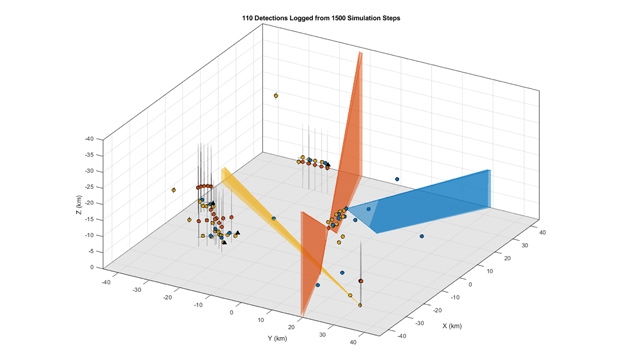
Multiplatform radar detection generation
Researchers and developers can now use algorithms for positioning and tracking, along with reference examples within the toolbox, as a starting point for implementing components of airborne, ground-based, ship-based, and underwater surveillance, navigation, and autonomous systems.
The new toolbox provides a flexible and reusable environment that can be shared between developers. Engineers can simulate sensor detection, perform localization, test sensor fusion architectures, and evaluate tracking results.
The Sensor Fusion and Tracking Toolbox includes:
▲Algorithms and tools to design, simulate, and analyze systems that fuse data from multiple sensors to maintain position, orientation, and situational awareness ▲Reference examples that provide a starting point for airborne, ground-based, shipborne, and underwater surveillance, navigation, and autonomous systems ▲Multi-object trackers, sensor fusion filters, motion and sensor models, and data correlation algorithms that can be used to evaluate fusion architectures using real and synthetic data ▲Scenario and trajectory generation tools ▲Synthetic data generation for active and passive sensors, including RF, acoustic, EO/IR, and GPS/IMU sensors ▲System accuracy and performance standard benchmarks, metrics, and animated plots ▲Deployment options for simulation acceleration using C code generation or for desktop prototyping.
“Algorithm designers working on tracking and navigation systems often use in-house tools that can be difficult to maintain and reuse,” said Paul Barnard, marketing director for design automation products at MathWorks. “Sensor Fusion and Tracking Toolbox enables engineers to explore multiple designs and perform ‘what-if analysis’ without having to write custom libraries.”
He added, "We can also simulate converged architectures in software that can be shared across teams and organizations."
Comments
Related news
KARI Develops Helicopter Operation Software with Artificial Intelligence Support
The Korea Aerospace Research Institute (KARI) has adopted MathWorks' model-based design solution to develop automatic flight control system (AFCS) software for helicopters that complies with the international aviation software standard DO-178C.
2018.08.07by 이수민 기자
MathWorks Announces Release 2018b of MATLAB and Simulink
MathWorks announced Release 2018b with new features added to MATLAB and Simulink. This release includes updates and bug fixes for deep learning across the entire product family. The new Deep Learning Toolbox, which replaces the Neural Network Toolbox, provides a framework for designing and implementing deep neural networks. Engineers in image processing, computer vision, signal processing, and systems can use MATLAB to more easily design complex network architectures and improve the performance of deep learning models.
2018.09.23by 이수민 기자
.jpg)
Siemens Improves 3D Printing Accuracy with Additive Manufacturing Process Simulation Solutions
Siemens PLM Software has announced a new additive manufacturing process simulation solution that can predict distortions that may occur during 3D printing. This product is delivered with complete integration into Siemens' end-to-end additive manufacturing solution. Manufacturers can leverage it for component design and printing according to their desired scale. The new additive manufacturing process simulation solution is based on Siemens' comprehensive digital transformation platform and Simcenter portfolio. Through digital twin technology, it simulates the build process prior to printing and predicts distortions that may occur during the printing process. It subsequently generates automatically corrected geometry to compensate for distortions. This simulation process is critical in building correct designs from the outset.
2018.12.01by 이수민 기자
.jpg)
SalePoint Signs Multi-Year Partnership Agreement with AWS… Promoting Identity Security that Integrates Even AI Agents
Sailpoint has entered into a multi-year strategic partnership agreement with AWS and is moving forward with establishing an integrated governance system that manages both human and non-human identities together. The plan is to consistently manage access permissions in an environment where AI agents are increasing as work execution entities, while applying the principle of least privilege and automated policy enforcement. The two companies plan to jointly expand capabilities to manage the identities of various entities, including AI agents, within a single layer in the AWS environment. This collaboration is interpreted as a move to design security and governance together in corporate environments where AI adoption is expanding.
2026.03.26by 배종인 기자
.png)
Databricks Unveils Open AI Security Monitoring 'Lakewatch'
Databricks entered the security market on March 24 by unveiling LakeWatch, an open-source agentic SIEM. The core functionality of this product is to integrate and analyze security, IT, and business data in a single environment to support AI-based threat detection and investigation. The company explained that it reduces the limitations of existing security operations centers, which have had to forgo some data due to high cost structures, and enables large-scale data analysis and automation based on open formats and ecosystems. LakeWatch is currently offered as a private preview, with Adobe and Dropbox mentioned as early customers. Databricks also announced an expanded partnership with Anthropic as well as the acquisition of Antimatter and SiftD.ai.
2026.03.26by 배종인 기자











