



Arm, which launched the first multi-threaded processor to promote the spread of autonomous driving
 Published2018.12.26 09:05
Processing multiple streams more efficiently
On the 20th, Arm announced the Arm Cortex-A65AE to expand the use of safe autonomous vehicles. This is the latest addition to Arm's automotive IP portfolio and is Arm's first multi-threaded processor with integrated safety.
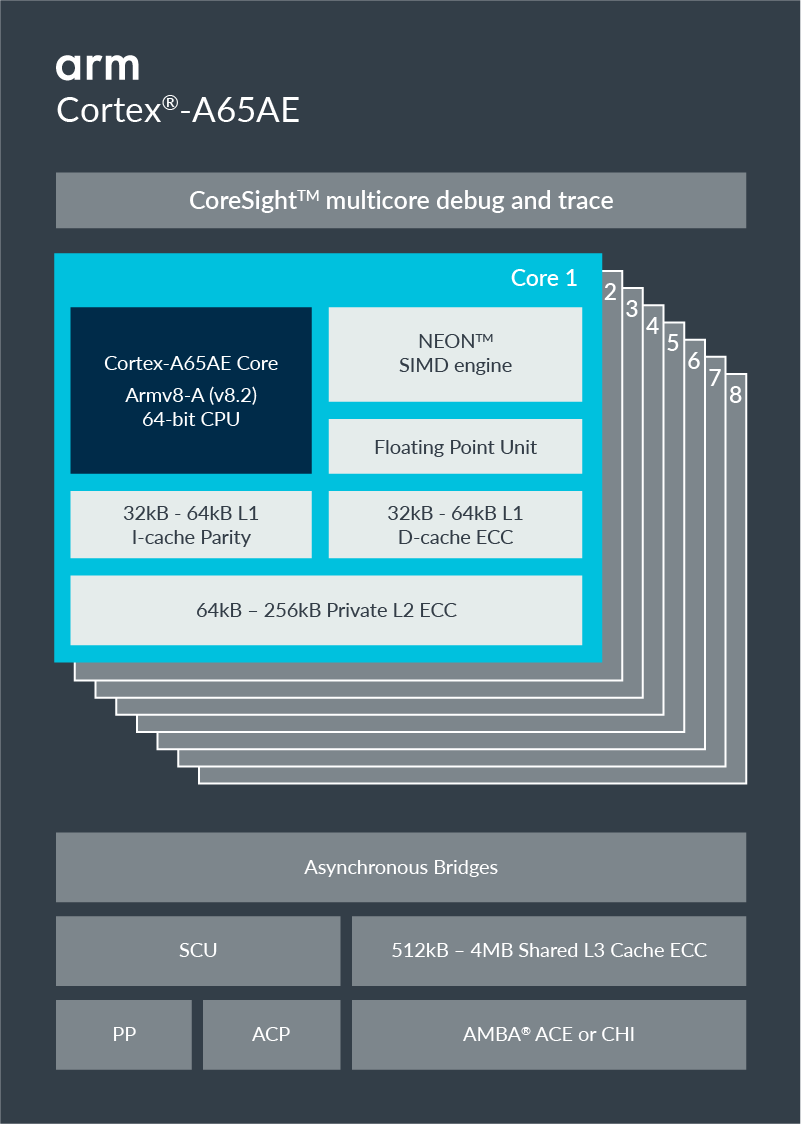
Arm Cortex-A65AE
According to the American Automobile Association (AAA), 73% of American drivers are very afraid to ride in a fully autonomous vehicle, and 63% of American adults feel somewhat uneasy about being on the road alongside an autonomous vehicle while walking or cycling. For humans to accept Advanced Driver Assistance Systems (ADAS) and increasingly sophisticated autonomous driving technology, they must be convinced that these technologies are safe to use.
In other words, gaining consumer trust is crucial. To provide a trustworthy experience, automakers must strike the right balance between innovation and safety and develop solutions that are deployable, scalable, and ready for mass production.
As a result of regularly exchanging opinions with major OEMs and Tier 1 vendors, Arm was able to identify two facts. The first was that extensive computing power is required to meet the requirements of future vehicles, and the second was that there is no one-size-fits-all solution for the computing power to support autonomous vehicles.
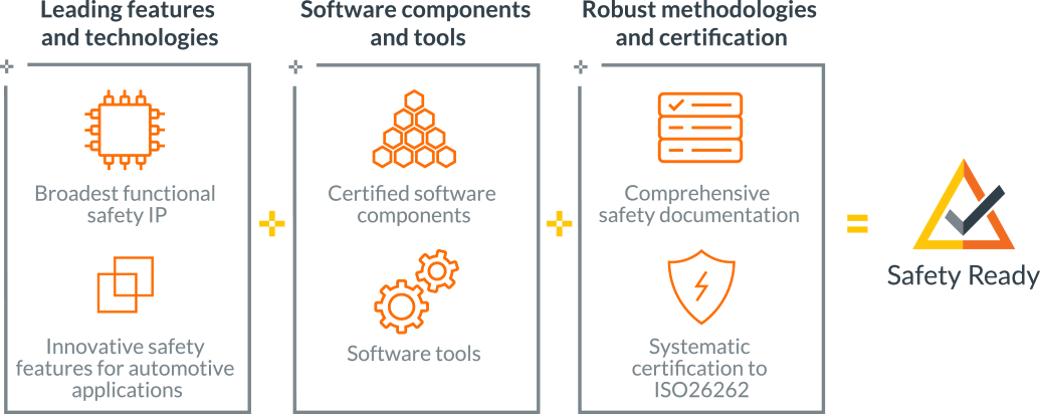
Arm Safety Ready
Earlier this year, Arm introduced automotive IP, including the Cortex-A76AE, which provides the performance and integrated safety required for the Safety Ready program and autonomous driving applications. This demonstrated a commitment to accelerating the adoption of safe, fully autonomous vehicles for OEMs and Tier 1 suppliers. In line with this, Arm has newly launched the product previously introduced as Helios-AE in the existing product roadmap as the Arm Cortex-A65AE to expand its portfolio of advanced automotive IP.
The Arm Cortex-A65AE is designed to process multiple streams of sensor data generated in next-generation vehicles more efficiently and to safely implement innovative and new driver experiences.
To implement higher levels of autonomous capabilities, more sensors such as cameras, LiDAR, and radar must be installed to monitor the vehicle's surroundings. Consequently, the throughput and computing requirements for securely processing the generated data increase significantly. Multi-sensor input enables the vehicle to explore the surrounding environment, perceive the situation, plan a drivable path, and provide commands to actuators on the determined path.
In situations where vast amounts of data are collected from various points on the vehicle and multiple heterogeneous systems required to implement ADAS and autonomous driving applications are integrated, high data throughput capabilities play a key role.
The Cortex-A65AE is the optimal product for managing high throughput requirements for collecting sensor data. It can be used in lockstep mode connected to the accelerator for machine learning or computer vision, which helps process data effectively. And it performs all these tasks with a high level of safety features.
With the increase in the number of sensors and the further enhancement of autonomy and driver assistance features, the human automotive experience is expected to change dramatically.
For example, consider the case where more screens are installed inside the vehicle to enhance the driver experience. Drivers receive guidance through augmented reality-based head-up displays, warnings, and the latest maps. While occupants will enjoy an immersive experience through rich video entertainment provided by multiple screens mounted in the car, trust, stability, and safety are crucial for embracing such new experiences.

Automotive manufacturers must build high reliability to provide customers with the autonomous driving experience.
The sensor detects not only external conditions but also internal conditions to monitor the driver. By monitoring eyelid movements to detect fatigue, body temperature, vital signs, and behavioral patterns, it is possible to provide an in-vehicle experience specialized for the driver. Implementing these capabilities requires high data throughput, machine learning processing, and massive heterogeneous computing.
Heterogeneous computing clusters are required to provide a rich, immersive in-vehicle experience. The Cortex-65AE is Arm's first throughput-oriented application-class core with split-locking. Together with the Cortex-A76AE, these cores deliver the highest level of safety integrity with high performance and power efficiency.
Arm solidifies its position in the automotive sector by adding the multithreaded Cortex-A65AE processor to its automotive platform. The Arm software ecosystem, equipped with Arm Safety Ready developer tools and already upstreamed Linux patch support, is ready to use the Cortex-65A.
The annual driving distance of vehicles and light vehicles based on Arm processors amounts to 5.3 trillion miles. In 2019, Arm will add Hercules-AE, optimized for 7nm, to its automotive roadmap and plans to release a new version of its Cortex-R solution. The entire Arm platform is supported by the Arm Safety Ready program, which helps OEMs, Tier 1 automakers, and silicon partners deliver safer automotive solutions more quickly.
Comments
Related news

Arm Launches BLE Stack to Drive IoT Innovation
Arm has introduced Arm Mbed Cordio Stack, an open source low-power Bluetooth software stack. Arm Cordio BLE Stack enables developers to build wireless IoT solutions tailored to their own applications and market needs. With Bluetooth 5 certified Mbed Cordio Bluetooth 5 Stack, it delivers the latest features to the Mbed ecosystem, which consists of over 350,000 developers.
2018.09.27by 이수민 기자

Arm Offers Free Cortex-M Processors for Xilinx FPGAs
Arm has announced that it is integrating the advantages of Cortex-M processors into Xilinx FPGAs, providing scalability and standardized processor architecture across the Xilinx portfolio. The enhanced Arm DesignStart program accelerates FPGA performance by speeding up embedded developers' work. The partnership between Arm and Xilinx has opened the door for all developers to leverage the flexibility of Arm processors and provides the benefits of a complete embedded ecosystem.
2018.10.05by 이수민 기자

SK Telecom Accelerates Domestic Manufacturing Innovation with 5G-AI-Cloud
SK Telecom announced its 5G smart factory expansion strategy at the Smart Manufacturing Innovation Center located in Ansan, Gyeonggi Province, and demonstrated five solutions combining 5G and advanced ICT, including 5G multi-functional collaborative robots, 5G smart flexible production equipment, 5G small autonomous mobile robots, AR smart glasses, and 5G-AI machine vision.
2018.12.20by 이수민 기자

[e4ds Tech Day 2026 ⑨] Sim Sang-gyu, Autocrypt CTO: "In the Physical AI Era, Automotive Security Must Extend Beyond the Vehicle"
At e4ds Tech Day 2026, Sim Sang-gyu, CTO of Autocrypt, explained automotive cybersecurity strategies in the era of Physical AI and SDV (Software-Defined Vehicle). Automobiles are evolving as part of an ecosystem connected to AI, cloud, chargers, IoT, and robots, and he emphasized that the scope of security must expand beyond the vehicle interior to the entire connected environment. In particular, AI model tampering, adversarial attacks, OTA updates, and EV charger hacking were identified as major threats. He explained that response measures require zero trust, AI model integrity protection, intrusion detection, Security by Design and Default, and full lifecycle security management, and that proactive security system establishment beyond regulatory compliance is critical for securing future mobility competitiveness.
2026.10.12by 배종인 기자

Practical HIL Construction Strategy for Automotive and Off-Highway Controller Validation
As vehicle E/E architecture transitions to zonal structures and shifts to software-defined vehicles (SDV), the number of controllers (ECUs) requiring validation and software complexity are surging dramatically. Meanwhile, real vehicle testing cannot provide repeated verification under identical conditions and entails lead time and safety concerns. This white paper explains the principles of HIL (Hardware-in-the-Loop) validation and the structure of the NI platform composed of PXI, SLSC, and VeriStand, and through two actual implementation cases—Camera Record & Replay HIL for In-Cabin Monitoring Controller (ICMU) and Forklift Controller (VCU) HILS—describes how controller-level regression testing becomes possible. Additionally, it explicitly states application boundaries and limitations, such as lack of A2B support.
2026.10.12by 편집부











