


ASMG Lays the Foundation for 5G Commercial Services in the Arab Region
 Published2018.12.21 15:35
5G to account for 16% of all telecommunications connections in the MENA region by 2025.
The Global System for Mobile Communications Association (GSMA) welcomed the decision of the Arab Spectrum Management Group (ASMG) to use the 3.3-3.8GHz frequency band for broadband mobile services, the GSMA said on the 20th.

ASMG Lays the Foundation for 5G Commercial Services in the Arab Region
This move will accelerate the deployment of ultra-fast 5G networks across the Arab region by allocating frequency bands suitable for 5G communications.
The ASMG, comprised of 22 Arab countries, coordinates frequency band management among Arab countries and matters related to the World Radiocommunication Conference of the International Telecommunication Union (ITU).
The ASMG approved the use of the 3.4-3.8GHz band for ultra-fast mobile across the Arab region, while partially allowing the use of the 3.3-3.4GHz band as some countries continue to reserve it for other services.
5G mobile devices will operate broadly across the entire 3.3–3.8 GHz band. This will support the rapid growth of the 3GHz bandwidth equipment ecosystem, expanding the economic scale of the device manufacturing industry and creating an environment for faster release of affordable devices.
The decision, announced at ASMG's December meeting in Amman, Jordan, underscores the accelerating pace of next-generation mobile connectivity technologies.
The GSMA recently released reports, "The Mobile Economy: Middle East and North Africa 2018" and "5G in MENA," predicting that Arab countries in the Gulf Cooperation Council (GCC) will launch 5G commercial services in 2019, enabling the provision of new services and accelerating market growth across MENA.
By 2025, 5G is expected to account for 16% of all telecommunications connections in the MENA region. 5G mobile services are expected to be available in over 50 countries across North America, Europe, the Middle East, and Asia Pacific between 2018 and 2020.
Several countries, including some ASMG members such as Qatar, Saudi Arabia, and the United Arab Emirates, are expected to launch 5G commercial services earlier than initially announced. Ultra-fast 5G networks will require a significant range of newly regulated mobile frequency bands, including intermediate frequency bands in the 3.4 to 3.8 GHz band.
The GSMA recommends that national regulators allocate 80-100MHz of adjacent frequency bands per operator in the core 5G mid-band, such as the 3GHz band, and around 1GHz of bandwidth in millimeter-wave bands, such as above 24GHz.
“The 3GHz spectrum is one of the first resources that will be used for 5G communications globally,” said Tariq Al Awadhi, chairman of ASMG. “This spectrum can be a crucial foundation for providing 5G services in Arab countries.”
“With the increased availability and capacity of mobile networks, governments across the Arab region are paving the way for investment in infrastructure and services,” said Jawad Abbassi, head of MENA, GSMA. “The ASMG is providing strong leadership to support the future of 5G in the region.”
Comments
Related news

The Mobile Industry Leads Global Sustainable Development
GSMA released its 2018 annual Mobile Industry Impact Report on September 26, coinciding with the UN General Assembly. The report stated that since 2016, when mobile became the first industry to commit to implementing the 'Sustainable Development Goals,' its contributions to all 17 goals have been continuously increasing.
2018.10.02by 이수민 기자
Maxim Supplies Battery Monitoring ICs to Nissan / ST Supplies Fingertips to Xiaomi
[Asia Weekly IT News] 1. Maxim supplies battery monitoring IC for Nissan EV Leaf / 2. ST provides fingerprint sensor for Xiaomi flagship smartphone / 3. GSMA urges allocation of 700MHz bandwidth in Indonesia / 4. Panasonic proposes technology for Taiwan smart meters to be implemented in December 2018 / 5. Toshiba launches motor driver IC with output current limiting
2018.10.04by 명세환 기자

4G to spearhead 5G deployment in Central and South America
By the end of 2018, 4G is expected to surpass 3G and become the mainstream technology in Central and South America. According to the "Mobile Economy: Latin America and the Caribbean 2018" report published by GSMA, 4G networks are projected to hold the largest share (38%) of connectivity in the Central and South American region by year-end. This represents a significant increase from 8% three years ago. 4G is expected to account for two-thirds of total connectivity by 2025, and by that time, 5G networks are anticipated to be deployed primarily in major markets such as Brazil and Mexico, capturing approximately 8% of total regional connectivity.
2018.12.10by 이수민 기자
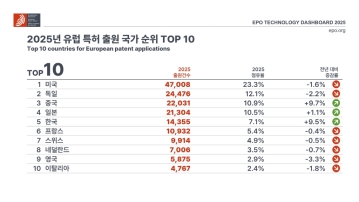
European Patent Applications Surpass 200,000 for the First Time… South Korea Maintains 5th Place, Led by Batteries and Telecommunications
According to the European Patent Office (EPO)'s 'Technology Dashboard 2025', European patent applications last year reached 201,974, surpassing 200,000 for the first time. Korean companies and inventors filed 14,355 applications, representing a 9.5% increase from the previous year and maintaining 5th place by country. Battery, digital communication, and semiconductor technologies led the growth, with Samsung ranking as the top EPO applicant for the second consecutive year and LG reaching 3rd place. The presence of major domestic cities such as Seoul, Suwon, and Yongin was also confirmed. It was also revealed that Korea's European patent strategy is expanding beyond individual technologies to span the entire industry.
2026.03.24by 명세환 기자
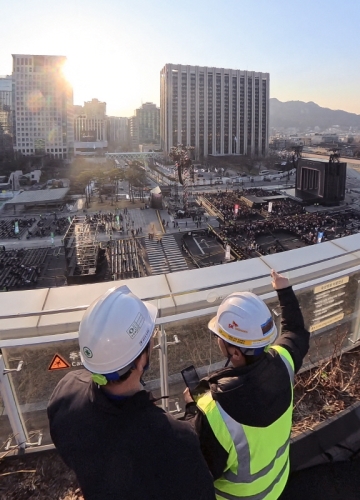
SK Telecom First Applies AI-Based Network Operations at Gwanghwamun K-Pop Concert
SK Telecom announced that it applied an AI-based network operation system for the first time at a large-scale K-pop concert held in the Gwanghwamun area of Seoul on March 21st, managing communication quality throughout the event. Mobile data usage during the three hours before and after the concert reached 12.15TB, approximately doubling compared to the same time slot the previous weekend. SK Telecom monitored traffic using the AI system 'A-One' in five-minute and 50-meter units to respond to potential overload situations, while also operating temporary communication facilities and on-site personnel in parallel. This case is interpreted as confirmation of the practical applicability of AI-based autonomous network operation in an environment where demand from dense events and foreign users increases simultaneously.
2026.03.23by 명세환 기자











