


[CES 2019] GSMA Releases 5G Consumer Trend Data, Saying “Doubts About Innovation”
 Published2019.01.12 09:03
Smart speaker penetration rate doubled compared to 2017
VR headset penetration rate remains stagnant at 6%, unchanged from the previous year.
.jpg)
GSMA Intelligence
GSMA Intelligence has newly investigated consumer trends and released initial data related to them.
The data is rich in insights that allow us to glimpse consumer technology adoption trends and predict the industrial landscape.
Based on this data, GSMA Intelligence released two new reports at 'CES 2019'.
The first report, 'The Future of Devices,' focused on the transformation and global adoption of smartphones entering the 5G era, the expansion of smart speaker adoption, and newly emerging consumer device categories.
The second report, '5G's Great Expectations,' examined what consumers expect from upcoming 5G networks and 5G devices.
Peter Jarich, President of GSMA Intelligence, said, “We [are] new consumer devices powered by advancements in immersive reality and AI "We are at the starting line of an era," he said, adding that "immersive reality and AI, which sparked demand for products like smart speakers, have emerged as a new competitive arena for tech industry leaders."
He continued, “While smartphones maintain their superior consumer technology, smartphone manufacturers and carriers expect 5G to open a new chapter in the smartphone growth story,” but added, “the survey results showed that there is still much work to be done to convince consumers of the benefits that the transition to 5G will bring.”
The key points of the upcoming 2018 GSMA Intelligence Consumer Survey report are as follows.
Smartphones have become a common consumer technology found everywhere. About 90% of consumers in developed countries owned one smartphone, and among them, the United States owns an average of 2.5 smartphones per household.
Along with smartphones, a wider variety of connected devices and internet access channels have emerged than ever before. The UK and the US own an average of six connected devices per household, including TVs, consoles, and smart speakers.
The penetration rate of smart speakers in developed countries has nearly doubled over the past 12 months. In the United States, the percentage of households owning smart speakers increased from 9% last year to 16% currently.
Amazon and Google are maintaining their market dominance, recording a combined global smart speaker market share of 85%.
Contrary to initial expectations, the penetration rate of virtual reality (VR) headsets remained stagnant. The penetration rate of VR headsets in developed countries stood at about 6%, remaining stagnant compared to the previous year, while in some key markets such as the UK, it was found to have actually decreased.
The adoption rate of augmented reality (AR) applications in the fashion, gaming, and enterprise industries has been reported to be increasing.
More than half (54%) of consumers in developed countries predicted that 5G networks would provide faster speeds and that 5G promotional activities would highlight faster network speeds compared to 4G as a differentiating factor. However, it could not be guaranteed whether consumers would be willing to pay a premium for faster speeds.
One in four consumers (25%) expected 5G to deliver 'new and innovative services,' while only 20% of consumers thought 5G would usher in an era of new devices.
GAMA Intelligence’s annual consumer trends report is compiled using a combination of online and interview methods with 36,000 respondents across 34 key markets.
The two reports released by GSMA Intelligence this time were based on the 2018 Consumer Trends Report.
Comments
Related news

4G to spearhead 5G deployment in Central and South America
By the end of 2018, 4G is expected to surpass 3G and become the mainstream technology in Central and South America. According to the "Mobile Economy: Latin America and the Caribbean 2018" report published by GSMA, 4G networks are projected to hold the largest share (38%) of connectivity in the Central and South American region by year-end. This represents a significant increase from 8% three years ago. 4G is expected to account for two-thirds of total connectivity by 2025, and by that time, 5G networks are anticipated to be deployed primarily in major markets such as Brazil and Mexico, capturing approximately 8% of total regional connectivity.
2018.12.10by 이수민 기자

ASMG Lays the Foundation for 5G Commercial Services in the Arab Region
The Global System for Mobile Communications Association (GSMA) welcomed the Arab Spectrum Management Group's (ASMG) decision to allocate the 3.3–3.8 GHz frequency bandwidth for ultra-high-speed mobile services, according to an announcement on the 20th. This measure enables the assignment of harmonized frequency bands suitable for 5G communications across the Arab region, accelerating the deployment of ultra-high-speed 5G networks.
2018.12.21by 이수민 기자

Three major carriers for 2019 New Year's commitment, "Let's transform into platform operators through 5G" in unified voice
The heads of the three mobile carriers set each company's 2019 goals at New Year's events and encouraged the efforts of executives and employees. SK Telecom President Park Jung-ho revealed the New Year's goal to lead the 5G era. KT Chairman Hwang Chang-kyu expressed his determination to provide top-tier 5G services. LG U+ Vice Chairman Ha Hyun-hoe said they should lead 5G innovation by stepping away from the traditional telecommunications business perspective, proactively reading the direction of change, and turning crises into opportunities.
2019.01.07by 이수민 기자
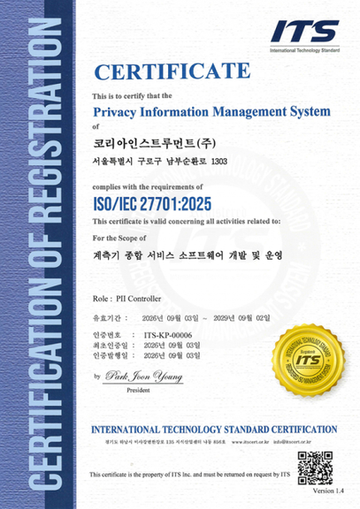
Korea Instrument, KOLAS Accredited Calibration Agency First to Simultaneously Acquire ISO/IEC 27,001·27,701
Korea Instrument has become the first among KOLAS accredited calibration agencies to simultaneously acquire ISO/IEC 27,001 and ISO/IEC 27,701 certifications. Through its proprietary platforms CWIZ Enterprise and CWIZ Partners, the company has embedded information security and personal data protection requirements across all business processes including customer information, equipment data, and calibration reports, with plans to continuously advance its management system through regular audits and security inspections.
2026.10.12by 배종인 기자
TeamViewer One, IT Incident Automation Workflow and Resolution Center Enhanced
TeamViewer has added IT incident automation capabilities and an advanced Resolution Center to its integrated digital workplace management platform 'TeamViewer ONE'. Recurrent service disruptions, configuration errors, and capacity shortages are automatically handled according to preset policies, and device status verification through script deployment can be managed in a unified interface, significantly reducing repetitive tasks for IT teams.
2026.10.12by 배종인 기자











