



Maxim Unveils Wearable PMICs That Maximize Optical Sensing Performance and Battery Efficiency
 Published2019.01.14 10:01
Optimized for accurate heart rate and oxygen saturation detection
Maxim Integrated Korea released the ultra-small, highly integrated power management integrated circuit (PMIC) 'MAX20345' on the 10th.
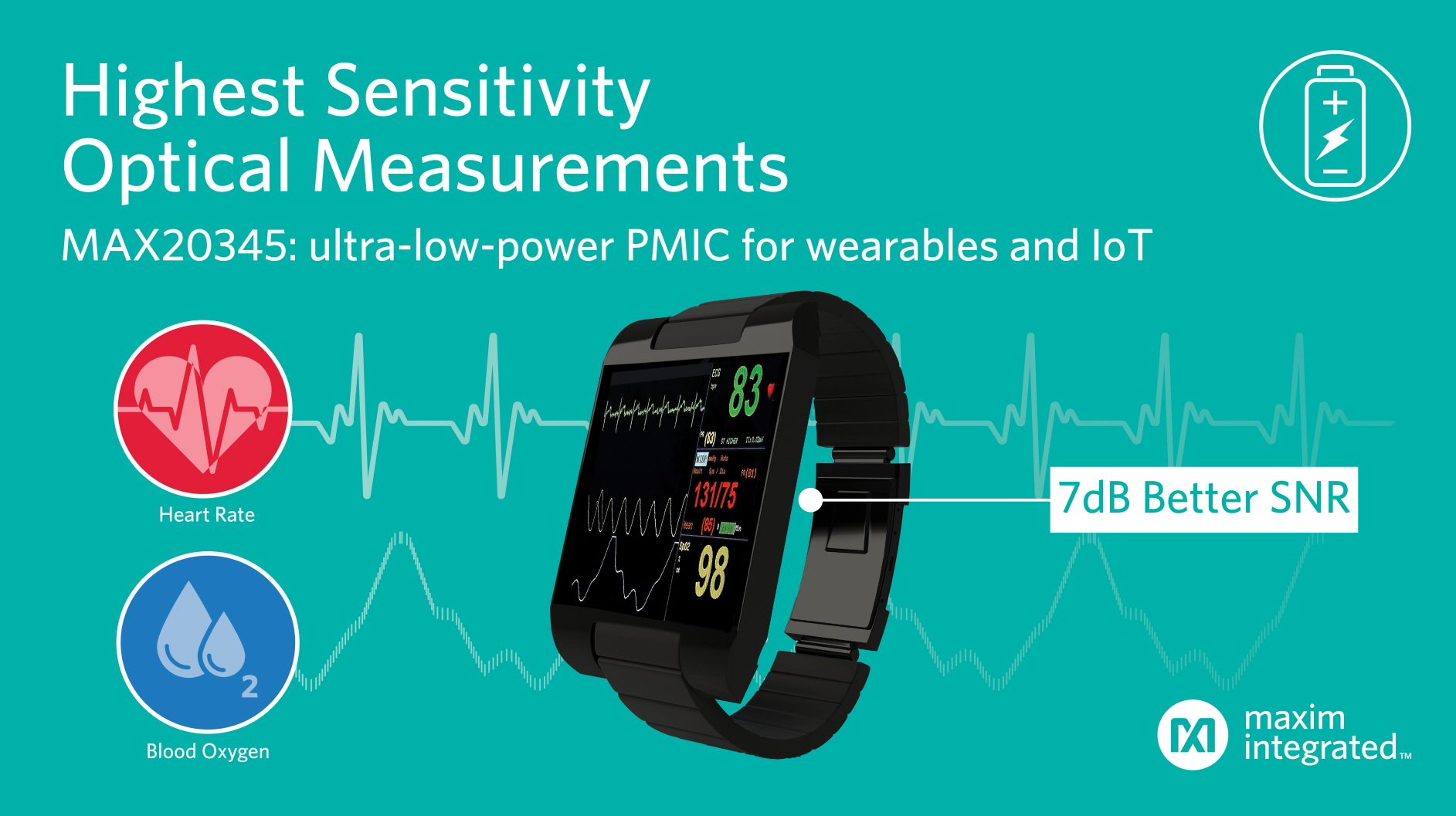
Maxim MAX20345
Designers of always-on wearables and IoT devices can easily reduce form factor and extend battery life with the MAX20345.
The MAX20345 integrates a lithium charger and implements a unique architecture that optimizes optical measurement sensitivity for wearable fitness and health applications.
The optical sensing accuracy of wearables is affected by several user-specific biological factors. Designers are working to expand the range of wearable applications by increasing the sensitivity of optical systems, including the signal-to-noise ratio (SNR).
Wearable applications using regulators with low standby current suffer from low SNR accuracy on the wrist due to high amplitude, low frequency ripple, and long settling times.
Some designers use high standby current products to address these shortcomings, but this increases power consumption, shortens battery life, and requires larger batteries.
The MAX20345 is the first of its kind to integrate a buck-boost regulator with an innovative architecture optimized for high-accuracy heart rate, blood oxygen saturation (SpO2), and other optical measurements.
This buck-boost regulator, which delivers low ripple even at high frequencies, does not interfere with optical measurements and enables high-sensitivity optical sensor measurements in wearables with short settling times. This regulator delivers the low quiescent current performance designers expect without compromising SNR, improving performance by up to 7 dB depending on measurement conditions.
The MAX20345, the latest in a family of ultra-low-power PMICs for small wearables and IoT devices, improves efficiency without compromising battery life.
Regulators with nanopower standby current reduce power consumption and standby power, extending battery operating time and reducing battery size. High-efficiency regulator conserves battery energy during operation.
The MAX20345 integrates a lithium-ion battery charger, six voltage regulators with ultra-low quiescent current, three 900nA nanoPower bucks, and three 550nA ultra-low quiescent current LDO (Low Dropout) regulators.
Two load switches disconnect the system peripherals to minimize unnecessary battery drain.
Both buck-boost and buck support dynamic voltage scaling (DVS), which allows for additional power savings by using lower voltages under appropriate conditions.
The MAX20345 is available in a 56-bump, 0.4mm pitch, 3.37mm x 3.05mm wafer-level package (WLP).
“The market for wearable electronics for fitness and wellness is expected to grow to 114 million units by 2020,” said Kevin Anderson, senior analyst for power IC research at IHS Markit. “As the market grows, demand is also increasing for better and more accurate sensing technologies for measuring health signals such as heart rate and blood oxygen saturation.”
“The MAX20345 expands Maxim’s portfolio of ultra-low-power PMICs for wearable and always-on applications,” said Frank Dowling, director of business management for the Industrial and Healthcare business unit at Maxim Integrated. “It enables the highest sensitivity optical sensing in a wrist-worn form factor, enabling more accurate vital sign measurements.”
Comments
Related news

ADI Launches Micromodule Regulator for Data Center Cooling
Analog Devices has launched the LTM4700, a new step-down DC/DC power regulator that mitigates data center cooling requirements. The LTM4700 can be used in applications including cloud computing, high-performance computing and optical network systems, telecommunications infrastructure, PCIe boards, as well as medical, industrial, and instrumentation equipment. Unlike other modular solutions that typically operate at 90°C, the LTM4700 operates at 73°C with heatsink packaging technology. The LTM4700 delivers 100A output current at 12VIN and 0.8VOUT with 200 LFM air flow and 70°C ambient temperature.
2018.11.14by 이수민 기자

Maxim Launches Three Analog ICs, Building Blocks That Boost Electronic System Efficiency
Maxim Integrated has introduced three building block analog ICs. The MAX41464 is a sub-1GHz FSK transmitter with 16dBm output power for various long-range wireless sensor applications such as building automation and security systems. The MAX38888 reversible buck/boost regulator delivers 95% peak efficiency. The MAX16141 is a 36V ORing FET controller with integrated power and voltage circuit breakers that monitor overvoltage, undervoltage, overcurrent, reverse current, and overtemperature conditions.
2018.11.14by 이수민 기자

Maxim Launches 6 Ultra-Small SIMO PMICs for IoT Devices
Maxim Integrated Korea announced on the 11th the launch of six ultra-compact, low-power power management semiconductors that extend battery life. The MAX17270, MAX77278, MAX77640, MAX77641, MAX77680, and MAX77681 PMICs reduce the power management footprint by up to 50% for size-constrained products such as wearables, hearables, sensors, smart home automation hubs, and IoT devices. Maxim's new PMICs improve overall system efficiency by 9% compared to competing products and reduce heat dissipation, an important consideration for wearable products that contact skin.
2018.12.12by 이수민 기자

Intel Unveils Next-Generation 'Core Ultra Series 3' and vPro Platform for Enterprise PCs
Intel has officially unveiled the "Intel Core Ultra Series 3" for next-generation enterprise PCs and the latest vPro platform, addressing a wide range of demands from enterprise notebooks to high-performance workstations.
2026.03.26by 배종인 기자

ROHM Launches ESD Protection Diode Compatible with High-Speed Interfaces of 10Gbps or Higher
Semiconductor specialist ROHM has developed the 'RESDxVx series' of ESD (electrostatic discharge) protection diodes capable of responding to next-generation high-speed data communication environments exceeding 10Gbps, simultaneously enhancing both signal quality maintenance required in high-speed interfaces and IC protection performance.
2026.03.26by 배종인 기자











