


5 Challenges 5G NR Device Designers Must Overcome <1> Utilizing Variable Slot Duration
 Published2019.01.15 17:50
5G NR (5G New Radio) refers to wireless access technology between a terminal and a base station on a 5G network.
3GPP established the NR standard with the goal of providing wireless access technology by integrating the performance requirements of IMT-2020 core technologies and three use scenarios: enhanced Mobile Broadband (eMBB), Ultra Reliable and Low Latency Communications (URLLC) for end-to-end data transmission, and massive Machine Type Communications (mMTC).
Accordingly, 5G NR Release-15, introduced in December 2017, laid the foundation for very fast communication speeds, very low latency, and connectivity with billions of IoT devices. The new physical layer standards define flexible air interfaces to support various use cases that will occur on 5G networks.
Now, when designers design devices that will be affected by 5G, such as smartphones, tablets, laptops, and wearables, they must consider that the devices to be designed must operate with new technology in new frequency bands.
5G NR Release-15 defined specifications to support eMBB and URLLC. This enables high data throughput for high-definition video and movie streaming, as well as low latency for remote-controlled drones and VR applications.
The emergence of something new in the ICT industry means that the workload for designers has increased accordingly. More complex and numerous challenges await design teams utilizing 5G NR.
The five challenges that device designers must overcome to implement 5G NR are as follows.
1. Optimizing Performance Using Scalable Numerology
2. Supporting higher throughput through carrier aggregation, mmWave frequencies, and wide bandwidth
3. Effectively Utilizing Beam Steering Techniques at mmWave Frequency
4. Perform OTA testing on 5G mmWave components and devices
5. Realizing peaceful coexistence with LTE and other wireless communications
Companies that overcome all these challenges will be able to shorten the time-to-market for 5G NR devices. First, let's look at the first task.
Optimizing Performance Using Scalable Numerology
Performance optimization using scalable numerology is a 5G NR feature that provides flexible resource allocation to support various use cases that may occur across various frequency bands.
Here, numerology is a waveform parameter function that includes subcarrier intervals and symbol times.
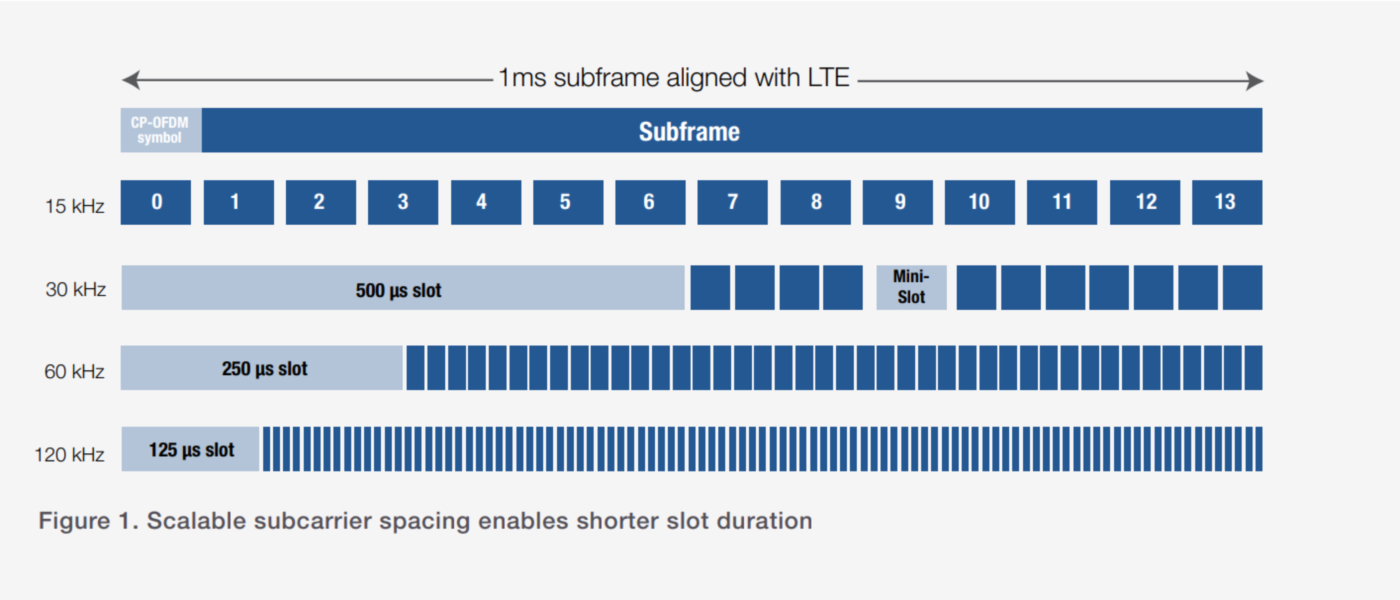
<Figure 1> The slot duration was shortened by widening the subcarrier spacing.
The subcarrier spacing is adjusted from 15 kHz to a maximum of 120 kHz, and as the subcarrier spacing widens, the slot length shortens, reducing the slot duration as shown in <Figure 1>. The variable slot duration adapts more easily to channel characteristics such as frequency range, phase noise, and delay spread.
Scalable subcarrier spacing and slot durations in the frame structure enable high-throughput mmWave operation, high-reliability IoT services, low latency, and error-free applications.
In addition, 5G NR can use mini slots (also known as mapping type "B") to initiate transmission anywhere within the slot, thereby enabling the rapid delivery of ultra-low latency payloads.
However, this scalable numerology increases the complexity of testing. More permutations are required to test various use cases. Consider a use case for the maximum throughput of 28 GHz. How a designer allocates resources within a frame affects how and when the device transmits and receives, and influences overall device performance.
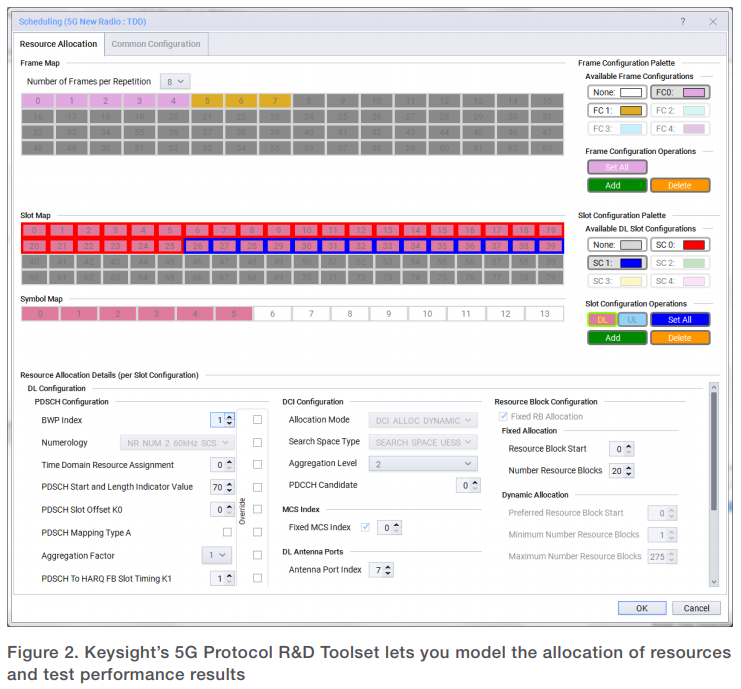
<Figure 2> Keysight Protocol R&D Toolset
If you use tools such as Keysight's Protocol R&D toolset, you can model resource allocation and execute scripts to test and optimize device performance under various conditions. The designer can model parameters such as the number of slots per frame and the order and number of symbols assigned to downlinks and uplinks within the frame.
In the next article, we will look at the second challenge: supporting higher throughput through carrier sets, mmWave frequencies, and wide bandwidth.
View the 5 Challenges 5G NR Device Designers Must Overcome
<1> Utilizing Variable Slot Duration
<2> Increasing throughput at high frequencies and wide bandwidths
<3> Effectively Using Beam Steering Technology at mmWave Frequency
<4> Testing OTA on 5G mmWave Devices
<5> Peaceful coexistence with LTE and other wireless communications
Comments
Related news
Toshiba Launches 4-Channel IC for Car Audio with Up to 45W Output
1. Toshiba launches 4-channel IC with maximum 45W output for car audio / 2. NTT-Furuno develops GPS time synchronization receiver utilizing multiple satellites / 3. NEC strengthens 5G strategy through partnership with Samsung Electronics / 4. Infineon establishes space for startups in Singapore / 5. Anritsu achieves 5G NR full stack IODT with Samsung Electronics using MT8000A
2018.11.01by 명세환 기자
Intel Accelerates Launch of Multimode Modem to Open Global 5G World
Intel has unveiled the "Intel XMM 8160 5G Modem," optimized for connecting 5G to devices. It is scheduled to be released in the second half of 2019, more than six months ahead of schedule, and supports a maximum speed of up to 6 gigabits per second—3 to 6 times faster than the latest LTE modems currently on the market. The Intel XMM 8160 is a multimode modem that supports legacy 4G/3G/2G radio as well as the new 5G NR standard including SA and NSA on a single chipset.
2018.11.15by 이수민 기자
Japan's SoftBank Adopts Anritsu's 5G Test Solutions
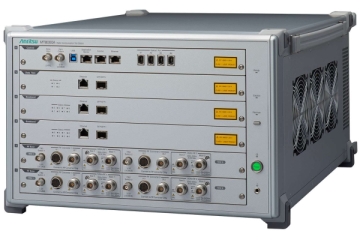
Anritsu Corporation announced that SoftBank has decided to use its MT8000A 5G NR protocol test solution for 5G NR device performance testing. The MT8000A operates as a base station simulator for testing the functionality and performance of 5G terminals and chipsets under development, which is being developed as a test platform for next-generation technology development such as wideband signal processing and beamforming required for 5G mobile communication systems. A single MT8000A supports both sub-6 GHz and mmWave frequency bands used in 5G, and when combined with an OTA chamber, it enables mmWave signal quality and communication protocol testing in an OTA environment.
2019.01.08by 이수민 기자
European Patent Applications Surpass 200,000 for the First Time… South Korea Maintains 5th Place, Led by Batteries and Telecommunications
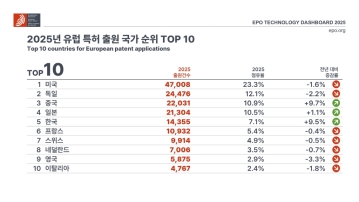
According to the European Patent Office (EPO)'s 'Technology Dashboard 2025', European patent applications last year reached 201,974, surpassing 200,000 for the first time. Korean companies and inventors filed 14,355 applications, representing a 9.5% increase from the previous year and maintaining 5th place by country. Battery, digital communication, and semiconductor technologies led the growth, with Samsung ranking as the top EPO applicant for the second consecutive year and LG reaching 3rd place. The presence of major domestic cities such as Seoul, Suwon, and Yongin was also confirmed. It was also revealed that Korea's European patent strategy is expanding beyond individual technologies to span the entire industry.
2026.03.24by 명세환 기자

SK Telecom First Applies AI-Based Network Operations at Gwanghwamun K-Pop Concert
SK Telecom announced that it applied an AI-based network operation system for the first time at a large-scale K-pop concert held in the Gwanghwamun area of Seoul on March 21st, managing communication quality throughout the event. Mobile data usage during the three hours before and after the concert reached 12.15TB, approximately doubling compared to the same time slot the previous weekend. SK Telecom monitored traffic using the AI system 'A-One' in five-minute and 50-meter units to respond to potential overload situations, while also operating temporary communication facilities and on-site personnel in parallel. This case is interpreted as confirmation of the practical applicability of AI-based autonomous network operation in an environment where demand from dense events and foreign users increases simultaneously.
2026.03.23by 명세환 기자











