



Grab Partners with Hyundai Motor to Launch EV Ride Service in Southeast Asia
 Published2019.01.16 10:32
We plan to start with the 20s and increase it to 200 by the end of the year.
Hyundai, Kia, and Grab Collaborate on Service-Optimized EV Production
Hyundai Motor's flagship electric vehicle (EV) model, the Kona Electric (Kona EV), is making a full-scale entry into the Singapore sharing economy market.
Hyundai Motor announced on the 16th that Grab, Southeast Asia's largest car hailing company, has launched a car hailing pilot service using the Kona EV.
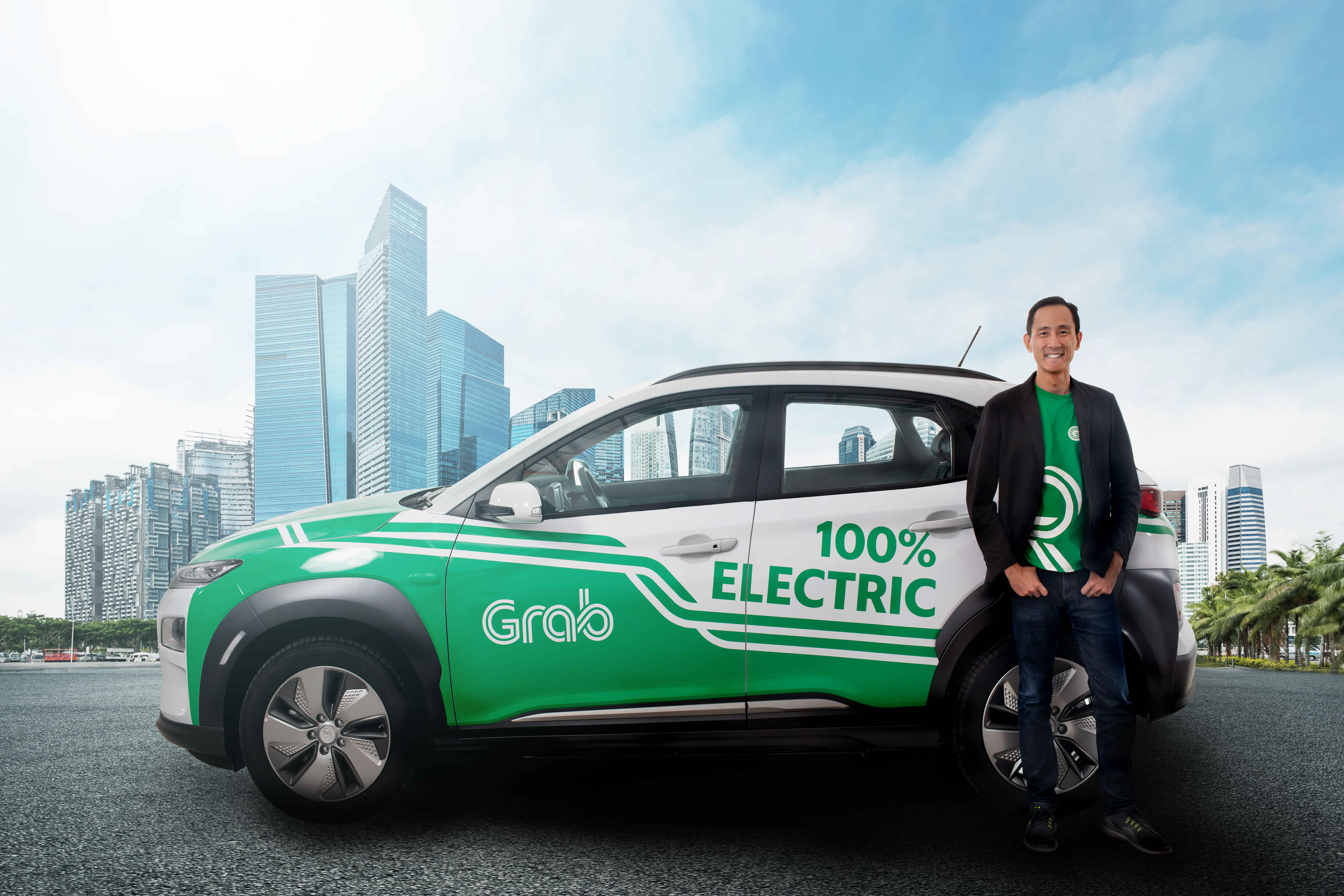
A ride-hailing service utilizing the Kona EV is launching in Singapore.
This is the first ride-hailing service utilizing EVs in Southeast Asia.
Hyundai Motor supplied 20 Kona EVs to Grab for the launch of this service. Grab plans to purchase a total of 200 Kona EVs by the end of the year.
Grab has completed leasing all 20 Kona EVs to its affiliated drivers. Grab drivers rent the Kona EVs from Grab and generate revenue by providing ride-hailing services to local customers. Grab aims to create an initial boom by setting the daily rental fee at 80 Singapore dollars (approximately 66,000 won), which is not significantly different from the daily rental fee of a standard internal combustion engine vehicle.
The Kona EV's competitive driving range on a single charge makes it a vehicle optimized for local ride-hailing services. Although the average daily driving distance for Grab drivers is only 200 to 300 km, the Kona EV can travel over 400 km on a single charge, allowing them to provide service without worrying about charging. When using a fast charger, it can be charged to 80% within 30 minutes, saving time spent on charging.
The Kona EV, which emits zero exhaust gases, has the advantage of significantly reducing fuel costs compared to internal combustion engine vehicles, so it is expected to provide very high satisfaction for both drivers and passengers.
Singapore Power Group, a leading power supplier in Singapore, is also stepping in to help establish the ride-hailing service utilizing electric vehicles. Singapore Power has enabled Grab drivers to charge their vehicles at EV charging stations at a 30% discount.
Through this collaboration with Grab, Hyundai Motor plans to rapidly enter the Southeast Asian EV market and secure a head start, while simultaneously enhancing the customer experience for its EV models and further elevating its image as an innovative company.
Hyundai Motor and Kia Motors announced in November 2018 that they would make a strategic investment of a total of $250 million in Grab and plan to pursue new mobility projects utilizing EV models on Grab's business platform.
At the time, the scale of the investment was the largest ever made by Hyundai Motor Group in an external company, and Hyundai-Kia Motors made the decision after carefully reviewing Grab's future growth potential as well as the importance of the strategic partnership.
The three companies will closely analyze charging infrastructure, driving range, and driver and passenger satisfaction through pilot projects to assess the potential for expansion and business viability of EV vehicle call services. Afterwards, the plan is to expand the vehicle-hailing service using electric vehicles to major Southeast Asian countries such as Vietnam and Malaysia.
The three companies also agreed to actively cooperate to develop EV models optimized for future mobility services.
Hyundai Motor announced that it plans to further solidify its image as an eco-friendly vehicle brand in Southeast Asia through the launch of a car-hailing service utilizing the Kona EV, and to further strengthen its position in Southeast Asia, which is rapidly emerging as an automotive market, by leveraging partnerships with influential local companies such as Grab.
Meanwhile, Hyundai Motor is continuing its efforts to transform into a smart mobility solution provider by collaborating with global car-sharing companies, such as India's Revv and the U.S. mobility service provider Migo, to establish a response system for the future mobility market.
Comments
Related news

To bridge the gap with the world in domestic autonomous driving technology
Waymo, a spinoff from Google, is the leading company in autonomous vehicle technology. In the global competition score for autonomous driving patents among major companies, Waymo topped the rankings with 2,815 points, surpassing Toyota. Among the world's top 50 companies in autonomous driving patent technology, Hyundai Motor Company was the only Korean company included. While Hyundai ranked 10th globally in terms of the number of patents held, it was evaluated as relatively modest in securing advanced patents.
2018.10.29by 이수민 기자
"Car doors open with fingerprints" Hyundai Motors develops fingerprint authentication entry system
Hyundai Motor has developed a smart fingerprint authentication access and start system that allows drivers to unlock car doors and start the engine using their fingerprints. The system also provides personalized driving environments for individual users. Multiple registered drivers' preset information is automatically applied, with the vehicle automatically adjusting the driver's seat position and outside mirror angles according to each driver's stored settings.
2018.12.17by 이수민 기자
[CES 2019] CTA Unveils 16 Innovation Champion Countries: “Korea Is Not On the List”
The Consumer Technology Association announced the 16 countries with the most excellent innovation environments among 61 countries worldwide during the keynote address at 'CES 2019'. According to the 2019 International Innovation Scorecard released by the CTA, 16 countries including Australia, Canada, Denmark, Estonia, Finland, Germany, Israel, Luxembourg, Netherlands, New Zealand, Norway, Singapore, Sweden, Switzerland, United Kingdom, and United States made the list as 2019 Innovation Champions. South Korea was ranked in the Innovation Leaders category, which follows the Innovation Champions.
2019.01.14by 이수민 기자

[e4ds Tech Day 2026 ⑨] Sim Sang-gyu, Autocrypt CTO: "In the Physical AI Era, Automotive Security Must Extend Beyond the Vehicle"
At e4ds Tech Day 2026, Sim Sang-gyu, CTO of Autocrypt, explained automotive cybersecurity strategies in the era of Physical AI and SDV (Software-Defined Vehicle). Automobiles are evolving as part of an ecosystem connected to AI, cloud, chargers, IoT, and robots, and he emphasized that the scope of security must expand beyond the vehicle interior to the entire connected environment. In particular, AI model tampering, adversarial attacks, OTA updates, and EV charger hacking were identified as major threats. He explained that response measures require zero trust, AI model integrity protection, intrusion detection, Security by Design and Default, and full lifecycle security management, and that proactive security system establishment beyond regulatory compliance is critical for securing future mobility competitiveness.
2026.10.12by 배종인 기자

Practical HIL Construction Strategy for Automotive and Off-Highway Controller Validation
As vehicle E/E architecture transitions to zonal structures and shifts to software-defined vehicles (SDV), the number of controllers (ECUs) requiring validation and software complexity are surging dramatically. Meanwhile, real vehicle testing cannot provide repeated verification under identical conditions and entails lead time and safety concerns. This white paper explains the principles of HIL (Hardware-in-the-Loop) validation and the structure of the NI platform composed of PXI, SLSC, and VeriStand, and through two actual implementation cases—Camera Record & Replay HIL for In-Cabin Monitoring Controller (ICMU) and Forklift Controller (VCU) HILS—describes how controller-level regression testing becomes possible. Additionally, it explicitly states application boundaries and limitations, such as lack of A2B support.
2026.10.12by 편집부











