



Government CIOs Worldwide to “Invest Heavyly in Data Analytics and Cybersecurity”
 Published2019.01.26 07:01
Government CIOs Name AI as Most Breakthrough Technology
Government digital initiatives lag behind other industries
Gartner announced the results of a survey conducted among Chief Information Officers (CIOs) of governments around the world.

Gartner
Gartner's 2019 CIO Agenda Survey was conducted with a total of 3,102 CIOs from major industries, including 528 government CIOs from 89 countries worldwide. To identify trends by sector, government respondents were classified into national/federal, state/provincial (regional), local government, and defense/intelligence.
According to the survey results, in 2019, government CIOs worldwide ranked data analytics and cybersecurity as the top sector for the largest expansion of technology investment, surpassing the cloud. The high level of interest in data reflects the perception that AI and data analytics will be the most groundbreaking technologies for the government in 2019.
“Data utilization is the core of digital government and a key asset of everything the government oversees and provides,” said Rick Howard, a vice-president analyst at Gartner. “The ability to strategically utilize data in real time will be of great help to the government in providing services smoothly, even as the burden on limited resources increases.”
Improving digital maturity
A survey on strategic business priorities revealed that 18% of CIOs across various government agencies cited digital initiatives as a key factor in achieving performance goals this year. Meanwhile, 23% of CIOs in other industries gave the same answer. Among the business priorities selected by government CIOs, industry-specific goals (13%), operational excellence (13%), and cost optimization and reduction (8%) followed.
According to the survey results, the government is making gradual progress in designing and delivering digital services and has reached a level of maturity comparable to the overall industrial sector. When asked about the stage of their organizations' digital initiatives, 29% of government respondents answered that they are in the expansion and improvement phase, which is considered a turning point where digital initiatives are deemed mature. This represents a 15% increase compared to the survey conducted in 2018.
However, the government still lags behind other industries (33% of the total) in expanding and improving digital initiatives. This gap is particularly pronounced in the defense and intelligence sectors, where only 9% of respondents said they had expanded digital initiatives.
Howard, an analyst, stated, “Governments must continuously improve their digital maturity to meet citizens’ demands and expectations for effective and efficient services,” adding, “Government CIOs have clearly recognized the potential of digital government and have begun developing new digital services, but now is the time to move beyond vision to action through digital leadership.”
Despite their interest in digital, only 17% of government CIOs responded that they plan to expand investment in digital business initiatives. This contrasts with the 34% of CIOs in other industries who have plans to expand investment. While government CIOs present a clear vision of the potential of digital government and new technologies, 45% of them stated that they lack the IT and business resources necessary to implement them.
Groundbreaking Technologies for Government: “AI, Data Analytics, Cloud”
In 2019, 27% of government CIOs cited AI as the most groundbreaking technology. Data analytics followed at 22%, and cloud technology at 19%. Cloud, which took first place in last year's survey, fell to third place in this year's survey.
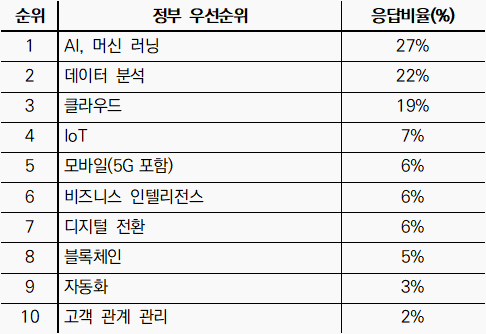
Breakthrough technology (Source: Gartner)
Howard, an analyst, stated, “Through new insights and delivery methods provided by AI, governments will be able to scale to unprecedented levels,” adding that “critical human resources will be deployed for more complex processes and decision-making.”
Among government respondents, 10% said they have already adopted AI solutions, 39% said they intend to adopt AI solutions within the next 1-2 years, and 36% said they intend to adopt AI solutions within the next 2-3 years.
Increased investment expected in cybersecurity, cloud, and data
Across the government, business intelligence (BI) and data analytics (43%), cyber and information security (43%), and cloud services and solutions (39%) were ranked as the top technology sectors where technology investment is expected to expand in 2019. Cloud ranked first in last year's survey but dropped to second place in 2019.
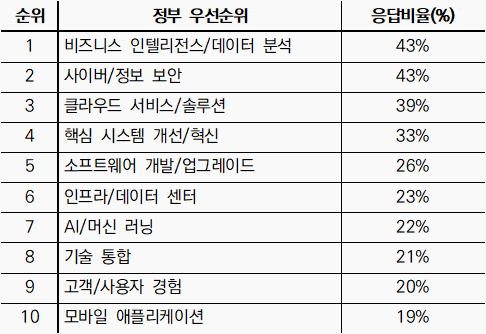
Key Technology Investment Areas in 2019 (Source: Gartner)
According to Howard Analysts, the expected increase in spending on cybersecurity reflects the government's recognition of its role as a public data keeper, as secure transactions in the digital world have become critical for the government as well.
He also stated, “In today’s digital world, cyber attacks are highly visible, malicious, costly, and undermine public trust,” adding, “Government CIOs have steadily raised the priority of cybersecurity over the past few years and are doing their utmost to remain vigilant to mitigate constantly evolving malicious attacks and threats as much as possible.”
Comments
Related news

Gartner: "Asia-Pacific's Digital Maturity Has Reached a Turning Point"
Gartner has released survey results on digital maturity in the Asia-Pacific region. According to Gartner's survey, 31% of Asia-Pacific CIOs stated that they have advanced their organizations' digital initiatives to the scaling phase. Additionally, 34% of Asia-Pacific CIOs identified AI as the technology that will bring the most innovative change to their organizations in 2019, with AI ranking first, surpassing data and analytics, which currently stands at 26% in second place.
2018.11.01by 이수민 기자

Global Semiconductor Sales Forecast: 2018 "Sunny," 2019 "Damp"
Gartner announced preliminary results for global semiconductor revenue in 2018. Global semiconductor revenue in 2018 reached $476.7 billion, representing 13.4% growth compared to 2017. In particular, memory's share of total semiconductor revenue increased from 31% in 2017 to 34.8% in 2018, establishing itself as the largest semiconductor segment. However, uncertainty in the semiconductor market is intensifying due to the memory market downturn that began in the second half of 2018 and the U.S.-China trade conflict.
2019.01.07by 이수민 기자

Global companies adopting AI increased by 270% in 4 years
According to Gartner, the number of enterprises adopting AI has increased 270% over the past four years, with a threefold increase in just the past year alone. This significant growth appears to be driven by the maturation of AI capabilities and enterprises' greater commitment to implementing related technologies. Additionally, while companies across all industry sectors are leveraging AI for various applications, it has been revealed that they are experiencing severe shortages of specialized workforce.
2019.01.24by 이수민 기자
Nvidia invests $5 billion in Intel
NVIDIA and Intel, leaders in global AI computing technology, are now forging ahead in providing cutting-edge solutions through NVLink-based architecture integration. NVIDIA and Intel have officially announced a strategic partnership and stated that they will jointly develop customized data center and personal computing products to accelerate diverse applications and workloads ranging from hyperscale to enterprise and consumer markets, thereby laying the foundation for the next generation computing era.
2025.09.22by 배종인 기자
.jpg)
Applied Materials Launches Environmental Protection Campaign to Mark World Cleanup Day
Applied Materials Korea (CEO Park Kwang-seon) is carrying out environmental cleanup activities with employees and their families around the Dongtan Sinricheon area on the occasion of World Cleanup Day, evolving into a company that engages with the local community beyond technological innovation.
2025.09.22by 명세환 기자











