


Saenggiwon Develops Variable Architecture EV Platform, "Even EVs Can Be Customized"
 Published2019.01.31 09:01
Freely adjustable wheelbase
Building a multi-variety, small-scale EV-based production base
The automotive market is shifting towards mobility based on electric vehicles (EVs) and autonomous vehicles.
However, EVs have different components required for vehicle operation, such as battery packs and motors, from internal combustion engine vehicles, so there are limitations in reusing internal combustion engine platforms, such as powertrains.
Using a dedicated EV platform allows for optimal placement of components to maximize space utilization, and is also advantageous in terms of interior and exterior design.
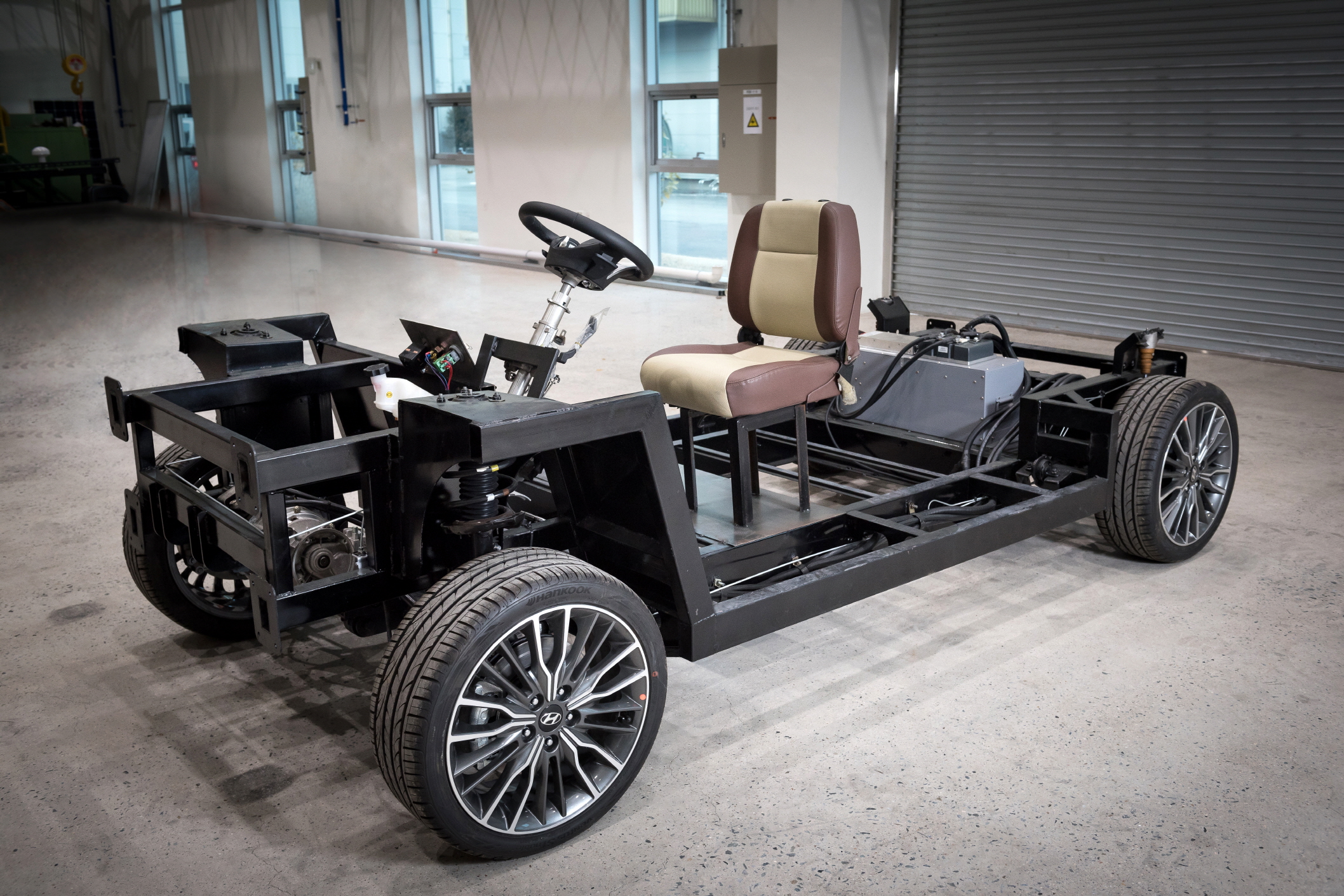
Prototype built on a variable architecture electric vehicle platform
The Korea Institute of Industrial Technology (KITECH) has developed a 'variable architecture electric vehicle platform' that can produce various types of industrial EVs, such as shuttles, logistics, and cleaning, using a single EV platform.
The EV platform developed by the team led by Hyunrok Cha, head of the EV Components and Materials Group at the Southwest Regional Headquarters, has a variable structure that allows for free adjustment of the wheelbase, which is the distance between the vehicle's front and rear axles.
As the wheelbase gets longer, the battery capacity that can be installed increases, which increases the transport capacity and driving range, but the vehicle price also increases by the amount of battery capacity installed.
On the other hand, if you utilize the developed platform, you can get the vehicle that the consumer wants.It is possible to produce a variety of small-quantity EVs, reflecting the vehicle's mileage and price, and because it is a single platform, the manufacturing process is simplified, reducing production costs.
The structure of the variable architecture EV platform is largely composed of a front wheel frame, a rear wheel frame, and a center frame where the battery pack is mounted.
The core of the technology is the 'variable module', a connecting part that connects the center frame and the front and rear wheel frames. By inserting the variable module between the two frames according to the vehicle specifications, the vehicle length can be increased by up to 40 cm in the longitudinal direction and 28 cm in the lateral direction, and the suspension height can also be adjusted depending on the insertion location.
We also developed an integrated drive module that integrates the motor, inverter, and reducer, which are essential components of EVs but were previously manufactured as individual parts.
The developed drive module can be placed in one space, which is advantageous for securing space, and can be equipped with motors at each end, so it can produce an output of up to 120 kW.
In addition, to increase the convenience of installing the battery pack, a metal bar was installed inside the center frame and a slide method was applied to insert it by sliding it in.
The research team is currently conducting research to integrate Level 3 autonomous driving technology into the developed EV platform, and plans to conduct a pilot operation of autonomous vehicles on a 2.9km course that goes back and forth between Bitgoeul Chonnam National University Hospital and the Senior Welfare Center, which have a large elderly population, within this year.
Autonomous EVs based on a variable platform are expected to be used in unmanned shuttle buses, cleaning vehicles, and delivery vehicles that travel along set routes at speeds of less than 30 km/h due to their advantageous characteristics for small-scale, multi-variety production in the future.
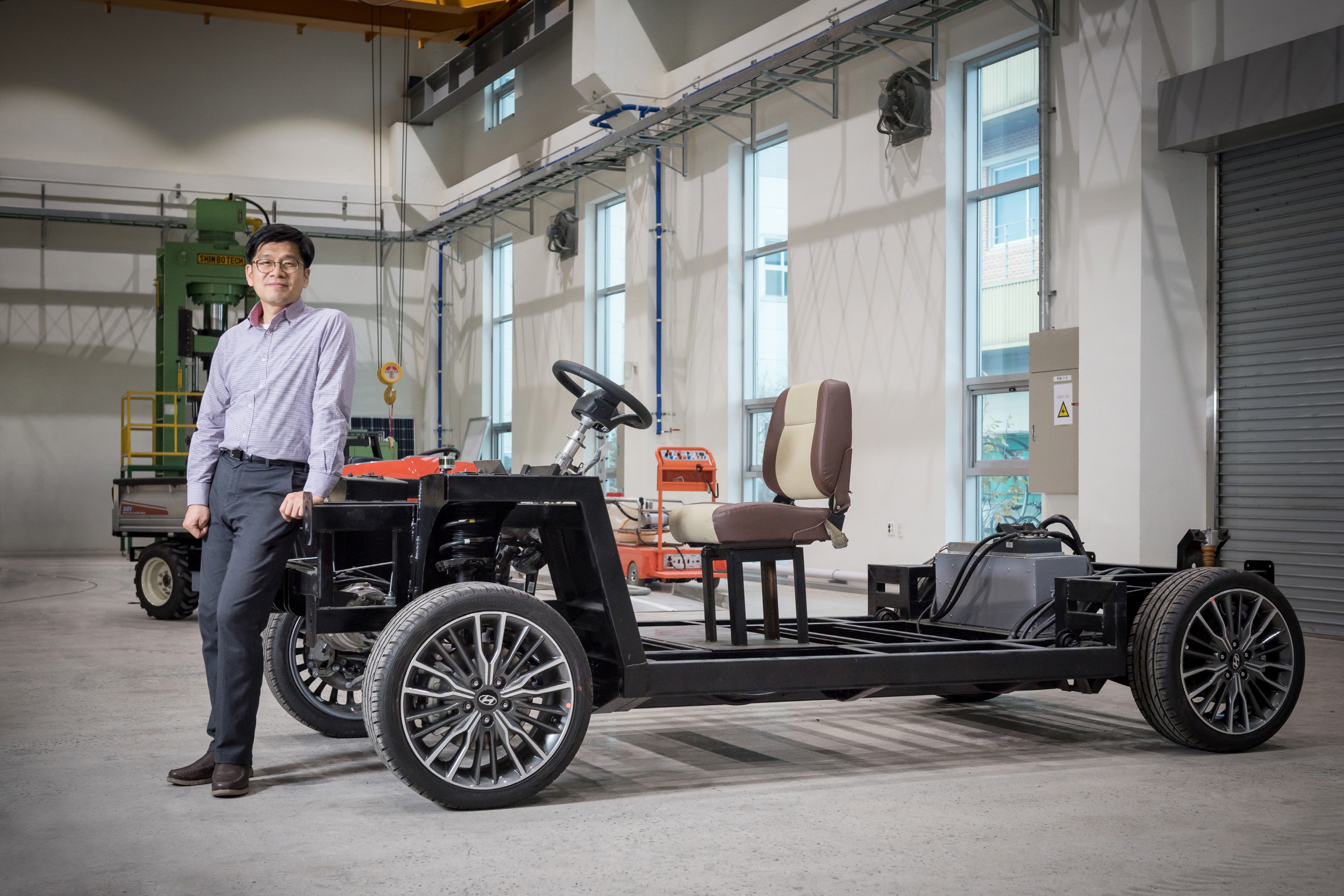
Cha Hyeon-rok, Group Leader, EV Components and Materials Group, Southwest Regional Headquarters, Korea Institute of Industrial Technology
Group Leader Cha Hyeon-rok stated, “We are promoting an agricultural EV business together with the Daegyeong Electric Vehicle Cooperative to quickly commercialize the variable architecture EV platform,” and “We will work to build an electric vehicle industry ecosystem led by small and medium-sized enterprises in the future.”
Meanwhile, the Daegyeong Electric Vehicle Cooperative is an organization established in December 2018 by 11 small and medium-sized enterprises, including root companies in the southwestern region, joining forces.
Comments
Related news
KITECH Improves Energy Processes Using Computer Simulation
Saenggi-won is implementing a corporate energy process optimization support project targeting energy-intensive companies with support from Ulsan Metropolitan City. This project, which began in 2017, selects six small and medium-sized enterprises in the Ulsan region annually through open recruitment and runs for five years through 2021. Optimization know-how and installed facility assets are transferred to participating companies for each enterprise. Chemical company Neo represents a notable success case of this project, with sales increasing more than 2.5 times since participating in the project.
2018.12.18by 이수민 기자

Checking on a child asleep in the car with a Bluetooth cushion
Safety accidents continue to occur annually, with children being left unattended in daycare shuttle vehicles for extended periods, sometimes resulting in fatalities. As part of accident prevention measures, the government has decided to mandate installation of "sleeping child detection devices" starting next year. The Korea Institute of Industrial Technology jointly developed a smart child confirmation cushion with three partner companies that allows parents to easily check their children's boarding and alighting status via smartphone.
2018.12.26by 이수민 기자
Efficient battery manufacturing processes increase EV production volume
Despite high battery costs, the share of battery-powered vehicles in total vehicle sales is projected to increase from currently less than 1% to as much as 10% by 2025. Battery costs account for nearly half of the total manufacturing cost of electric vehicles. If battery activation and testing stages, which represent up to 20% of battery costs, can be improved, significant reductions in battery costs could be achieved. Electric vehicle battery manufacturers can reduce these costs through collaboration with suppliers that possess expertise in battery activation and testing systems.
2019.01.22by 이수민 기자

[e4ds Tech Day 2026 ⑨] Sim Sang-gyu, Autocrypt CTO: "In the Physical AI Era, Automotive Security Must Extend Beyond the Vehicle"
At e4ds Tech Day 2026, Sim Sang-gyu, CTO of Autocrypt, explained automotive cybersecurity strategies in the era of Physical AI and SDV (Software-Defined Vehicle). Automobiles are evolving as part of an ecosystem connected to AI, cloud, chargers, IoT, and robots, and he emphasized that the scope of security must expand beyond the vehicle interior to the entire connected environment. In particular, AI model tampering, adversarial attacks, OTA updates, and EV charger hacking were identified as major threats. He explained that response measures require zero trust, AI model integrity protection, intrusion detection, Security by Design and Default, and full lifecycle security management, and that proactive security system establishment beyond regulatory compliance is critical for securing future mobility competitiveness.
2026.10.12by 배종인 기자

Practical HIL Construction Strategy for Automotive and Off-Highway Controller Validation
As vehicle E/E architecture transitions to zonal structures and shifts to software-defined vehicles (SDV), the number of controllers (ECUs) requiring validation and software complexity are surging dramatically. Meanwhile, real vehicle testing cannot provide repeated verification under identical conditions and entails lead time and safety concerns. This white paper explains the principles of HIL (Hardware-in-the-Loop) validation and the structure of the NI platform composed of PXI, SLSC, and VeriStand, and through two actual implementation cases—Camera Record & Replay HIL for In-Cabin Monitoring Controller (ICMU) and Forklift Controller (VCU) HILS—describes how controller-level regression testing becomes possible. Additionally, it explicitly states application boundaries and limitations, such as lack of A2B support.
2026.10.12by 편집부











