



Three Mobile Carriers Announce 2018 Earnings: "Wireless Stagnates, IPTV Strong"
 Published2019.02.14 10:01
While operating profits for all three companies decreased overall, losses were mitigated as the number of IPTV subscribers increased explosively.
With the wireless market fully mature, the three companies intend to turn things around through the commercialization of 5G networks. In addition, they plan to seek new growth engines in areas such as finance, home media, and security. Below are the specific 2018 performance results of the three companies.
LG Uplus to Secure Future Growth Engines Focused on New Businesses

Preparing new AR and VR services for 5G smartphones
IPTV and High-Speed Internet Subscribers Surpass 4 Million
Home media business drives strong performance
LG Uplus achieved annual revenue of 12.1251 trillion won and an operating profit of 730.9 billion won in 2018 based on consolidated financial statements under K-IFRS No. 1115.
In 2018, operating revenue reached 9.3445 trillion won and terminal revenue reached 2.7806 trillion won, respectively, and net profit was recorded at 481.6 billion won.
It was also announced that the board of directors decided to pay a dividend of 400 won per share.
Under the old accounting standards, total revenue and operating revenue increased by 0.7% and 0.6%, respectively, compared to the previous year. Operating profit reached 856.6 billion won, up 3.7% from the previous year.
Wireless revenue among operating revenues recorded 5.415 trillion won, a 2.8% decrease from the previous year, due to factors such as an increase in the proportion of subscribers on selective contract plans, expanded discounts, and an increase in bundled subscribers.
However, an official from LG Uplus explained that the company minimized the decline in wireless revenue by securing 13,336,000 high-quality LTE subscribers, accounting for 94.4% of total wireless subscribers, along with a net increase of 945,000 subscribers and a subscriber churn rate lowered to 1.6%.
In addition, the growth in wireless subscribers and the decrease in churn rates were attributed to the launch of innovative rate plans, such as the nation's first "Data Plan with No Speed or Capacity Worries" that places no restrictions on data volume or speed, as well as the introduction of differentiated services like U+ Pro Baseball, U+ Golf, and U+ Idol Live.
Wired revenue (IPTV + high-speed internet + internet phone + e-Biz + IDC + dedicated line + phone) reached 3,999.8 billion won, up 5.2% from the previous year due to increased revenue from IPTV and high-speed internet.
Home media revenue, which combines revenue from IPTV, high-speed internet, and internet phone, rose 12.5% year-on-year to reach 1.9903 trillion won. IPTV subscribers increased by 13.5% year-on-year to 4.019 million, surpassing 4 million for the first time in the fourth quarter of last year, while high-speed internet subscribers also increased by 222,000 (5.8%) year-on-year to 4.038 million, ushering in the era of 4 million subscribers.
Corporate revenue recorded 2.0095 trillion won, down 1.1% from the previous year, despite increases in revenue from e-Biz (including electronic payments), IDC, and dedicated lines, due to a decrease in one-time revenue such as equipment sales.
In 2018, marketing expenses amounted to 2.0929 trillion won, a 3.6% decrease from the previous year due to market stabilization and efficient execution of marketing costs. Under the new accounting standards, marketing expenses in 2018 amount to 2.0663 trillion won.
CAPEX amounted to 1.3971 trillion won, including investments in 5G networks, an increase of 22.8% compared to the previous year.
The financial structure also improved due to increased profits and reduced borrowings. The net borrowing ratio fell by 6.2 percentage points from 43.8% in 2017 to 37.5% in 2018, and the debt ratio also decreased by 4.0 percentage points from 107.4% to 103.4%.
Based on K-IFRS No. 1115 consolidated financial statements, total revenue for the fourth quarter of 2018 increased by 6.0% from the previous quarter to 3.1725 trillion won, and operating revenue increased by 3.4% from the previous quarter to 2.4056 trillion won.
Operating profit was recorded at 104.1 billion won, down 54.4% from the previous quarter, and net profit was 75.3 billion won, down 51.0% from the previous quarter.
LG Uplus plans to continue its sustained growth by securing future growth engines through a focus on home media businesses such as IPTV and AI, as well as new businesses such as 5G, in 2019.
Starting with Seoul, the metropolitan area, and major cities, 5G networks will be built in major regions by the end of this year, and then gradually expanded to 85 cities and counties. In addition to B2B services, new B2C services such as AR and VR will also be prepared to coincide with the launch of 5G smartphones.
The home media business plans to build a service lineup capable of providing differentiated value to all demographics, ranging from childcare to seniors, while AIoT will continuously strengthen the integration between voice AI, home IoT, and IPTV to add convenient and useful home services.
LG Uplus CFO Lee Hyuk-joo, Vice President, said, “We will build a Uplus 5G culture that exceeds customer expectations in terms of network, service, and marketing in 5G services,” adding, “This year, we will expand profits through the best 5G infrastructure and customer value propositions, and do our best to enhance shareholder value by achieving management goals.”
KT to Captivate Both Businesses and Individuals with 5G
TMTKM.png" style="width: 400px; height: 71px;" />
| Wireless revenue declines due to increase in selective contract customers
Mobile surpasses 21 million, Internet 8.7 million, and IPTV 7.85 million.
Will strengthen competitiveness in new businesses based on 5G networks
KT recorded annual revenue of 23.4601 trillion won and an operating profit of 1.2615 trillion won in 2018 based on consolidated financial statements under K-IFRS No. 1115.
Under the old accounting standards, revenue recorded 23.7517 trillion won, a 1.6% increase from the previous year. Although wireless service revenue decreased, service revenue surpassed 20 trillion won for the third consecutive year as core businesses such as high-speed internet and IPTV grew and the revenue base of group companies expanded.
Operating profit recorded 1.2184 trillion won, down 11.4% from the previous year. Increased labor costs and a decline in wireless revenue had a significant impact. The cost of fee reductions resulting from the fire at the Ahyeon branch was fully reflected in the fourth quarter.
Wireless business revenue was 7.0409 trillion won, a 2.3% decrease from the previous year due to selective contract discounts, expanded fee reductions for vulnerable groups, and the termination of WiBro services. However, the number of wireless subscribers reached 21.12 million, a 5.5% increase from the previous year, as new customer-tailored rate plans such as Data ON and Roaming ON received a great response. The net increase in general mobile network operators (MNOs) was 917,000, a 17% increase from the previous year, with a net increase of 140,000 mobile phone subscribers.
Revenue from the wired business was 4.799 trillion won, a 2.1% decrease from the previous year. Although revenue from landline telephones declined, the continued growth of the high-speed internet business offset the overall revenue decrease. In particular, the number of gigabit internet subscribers increased by 950,000 from the previous year to 4.89 million, reaching 56% of the total internet subscribers. High-speed internet revenue reached 2.0501 trillion won, a 1.9% increase year-on-year driven by the expansion of gigabit internet subscribers.
Revenue from the media and content business increased by 9.4% year-on-year to 2.4492 trillion won. IPTV subscribers increased by 380,000 year-on-year to reach 7.85 million, the highest number in the country; based on this, platform revenue also grew, resulting in IPTV revenue on a separate basis reaching 1.4102 trillion won, a 15.8% increase year-on-year. Growth also continued within the group in the content sector, including the Genie Music service and KTH T-commerce.
Revenue from the financial business recorded 3.4449 trillion won, down 2.4% from the previous year, while revenue from other services increased by 6.7% from the previous year to 2.4036 trillion won due to strong performance in real estate and Internet Data Center (IDC) businesses.
KT is accelerating the full-scale commercialization of 5G for general customers starting in March 2019. Beginning with the Seoul metropolitan area and the six major cities nationwide, it is expanding its 5G network across the country to include 85 cities and even island regions.
Leveraging KT’s unique strengths, such as a full mesh IP backbone network and edge cloud centers, it provides ultra-low latency 5G services and focuses on personalized services like immersive media as well as B2B services that integrate 5G into industries to increase efficiency.
KT is strengthening its competitiveness in new businesses based on 5G networks. We plan to secure a new foundation for growth through platform businesses based on intelligent networks, including the AI service 'GiGA Genie', which surpassed 1.39 million subscribers in 2018, network blockchain, KT-MEG (smart energy), GiGA Eyes (security), and connected cars.
“Despite changes in the telecommunications market environment in 2018, we were able to achieve stable performance by expanding our customer base in core businesses through KT’s unique differentiated services,” said KT CFO Yoon Kyung-geun. “In 2019, we will lead the 5G market by providing customers with unique experiences and value through KT’s world-class 5G technology and services.”
SK Telecom Expands Its Scope into Media, Security, and Commerce

Media and Security Establish Themselves as New Growth Engines
Net increase of 185,000 mobile phone subscriptions, all-time low churn rate
Opening the Growth Engine for New Businesses Centered on Media, Security, and Commerce
SK Telecom recorded annual revenue of 16.874 trillion won, operating profit of 1.2018 trillion won, and net profit of 3.132 trillion won in 2018 based on K-IFRS No. 1115 consolidated financial statements.
Sales and operating profit decreased by 3.7% and 21.8%, respectively, compared to 2017 (under the old accounting standards).
According to an SK Telecom official, a decrease in mobile telecommunications business revenue was inevitable due to the increase in subscribers to the annual selective discount plan. The eight major customer value innovation activities, implemented at the cost of revenue loss to lower the burden of fees on customers, also had some impact.
Net profit increased by 17.9% year-on-year due to equity method gains resulting from SK Hynix's record-high performance.
SK Telecom achieved revenue of 4.3517 trillion won in the fourth quarter of 2018 by adopting media and security businesses as new growth engines. This represents a 3.9% increase from the previous quarter, raising expectations for improved performance in 2019.
SK Broadband recorded its highest-ever performance with annual revenue of 3.2537 trillion won and an operating profit of 175.6 billion won. The number of IPTV subscribers reached 4.73 million, an increase of approximately 10% year-on-year, and the proportion of subscribers to the premium UHD service exceeded 50% of total subscribers for the first time in the fourth quarter.
ADT Caps' performance was reflected for the first time in the fourth quarter. ADT Caps achieved sales of 200.8 billion won and an operating profit of 28.6 billion won in the fourth quarter.
SK Telecom worked to restore customer trust last year through eight major customer value innovation activities, including rate recommendations, roaming, membership, and T Plan. As a result, the number of mobile phone subscribers increased by a net 185,000 annually, and the company achieved an all-time low annual churn rate of 1.22% (0.99% excluding MVNOs).
'T Plan,' launched in late July last year, presented customers with a new rate plan paradigm of 'family data sharing' and achieved approximately 4.4 million cumulative subscribers as of the end of December. The '0 Plan,' introduced last August for customers aged 24 and under, also surpassed 500,000 subscribers as of the end of December.
SK Telecom plans to drive performance this year by fully deploying 5G services and strengthening New ICT businesses centered on media, security, and commerce.
5G services are scheduled to expand, focusing on the Seoul metropolitan area and major cities, in conjunction with the launch of 5G smartphones. SK Telecom plans to provide safe and differentiated 5G network quality based on AI-based network operation technology and quantum cryptography technology.
The MNO business plans to continue introducing differentiated change and innovation programs following last year to further solidify customer trust, and based on this foundation, aims to return revenue to an upward trend starting in the second half of this year.
The media business plans to expand its scope this year by integrating Oksusu and POOQ to develop them into a competitive global OTT platform, and by partnering with Sinclair, the largest terrestrial broadcaster in the U.S., to enter the U.S. next-generation broadcasting solutions market.
With the completion of the ADT Caps-NSOK merger and the acquisition of SK Infosec last year, the security business has established an integrated service system ranging from physical security to information security. SK Telecom plans to provide new security services for homes, parking lots, and other areas this year.
The commerce business laid the foundation for substantial business growth through the success of attracting 500 billion won in investment from 11st last year. 11st aims to reach the break-even point this year by providing AI/Data-based services to customers.
Yoon Poong-young, Head of SK Telecom’s Corporate Center, stated, “By successfully reorganizing our New ICT business portfolio last year, we have established the basic framework for our four major businesses: MNO, media, security, and commerce,” adding, “We will do our best to unlock the growth potential of our New ICT business based on the competitiveness of our 5G services.”
Comments
Related news
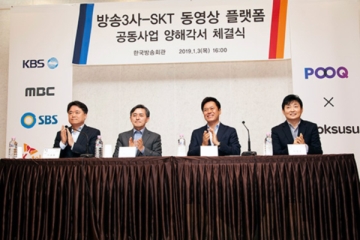
Dreaming of a Korean Netflix: The three major terrestrial broadcasters and SKT are launching an integrated OTT service.
KBS, MBC, SBS, and SK Telecom have signed an MOU regarding integrated OTT service cooperation. The domestic media platforms POOQ and oksusu will merge to foster the domestic media ecosystem and establish a foothold for overseas expansion. The companies reached consensus that in order to secure competitiveness against global media operators in the rapidly changing domestic media environment centered on OTT, they must establish a united front among domestic operators equipped with OTT business capabilities.
2019.01.05by 이수민 기자

Three major carriers for 2019 New Year's commitment, "Let's transform into platform operators through 5G" in unified voice
The heads of the three mobile carriers set each company's 2019 goals at New Year's events and encouraged the efforts of executives and employees. SK Telecom President Park Jung-ho revealed the New Year's goal to lead the 5G era. KT Chairman Hwang Chang-kyu expressed his determination to provide top-tier 5G services. LG U+ Vice Chairman Ha Hyun-hoe said they should lead 5G innovation by stepping away from the traditional telecommunications business perspective, proactively reading the direction of change, and turning crises into opportunities.
2019.01.07by 이수민 기자
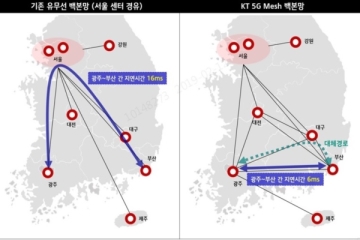
KT, the first in Korea to apply 'mesh structure' to 5G backbone network
KT has completed the domestic first application of a 'Mesh' structure that directly connects major cities nationwide to its 5G backbone network, in order to provide high-quality, ultra-low latency 5G services. In the existing wired and wireless communication backbone networks, including LTE, there were no direct connection paths between regions due to traffic processing architecture, requiring all inter-regional traffic to necessarily pass through the metropolitan center. To address this, the Mesh structure that KT applied to its 5G backbone network refers to a grid-type structure that directly interconnects major regional centers throughout the country.
2019.02.12by 이수민 기자
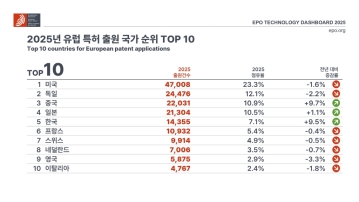
European Patent Applications Surpass 200,000 for the First Time… South Korea Maintains 5th Place, Led by Batteries and Telecommunications
According to the European Patent Office (EPO)'s 'Technology Dashboard 2025', European patent applications last year reached 201,974, surpassing 200,000 for the first time. Korean companies and inventors filed 14,355 applications, representing a 9.5% increase from the previous year and maintaining 5th place by country. Battery, digital communication, and semiconductor technologies led the growth, with Samsung ranking as the top EPO applicant for the second consecutive year and LG reaching 3rd place. The presence of major domestic cities such as Seoul, Suwon, and Yongin was also confirmed. It was also revealed that Korea's European patent strategy is expanding beyond individual technologies to span the entire industry.
2026.03.24by 명세환 기자

SK Telecom First Applies AI-Based Network Operations at Gwanghwamun K-Pop Concert
SK Telecom announced that it applied an AI-based network operation system for the first time at a large-scale K-pop concert held in the Gwanghwamun area of Seoul on March 21st, managing communication quality throughout the event. Mobile data usage during the three hours before and after the concert reached 12.15TB, approximately doubling compared to the same time slot the previous weekend. SK Telecom monitored traffic using the AI system 'A-One' in five-minute and 50-meter units to respond to potential overload situations, while also operating temporary communication facilities and on-site personnel in parallel. This case is interpreted as confirmation of the practical applicability of AI-based autonomous network operation in an environment where demand from dense events and foreign users increases simultaneously.
2026.03.23by 명세환 기자











