



KT to Build 5G Edge Communication Centers in Eight Cities Nationwide
 Published2019.03.06 11:05
| Latency reduced by 44% compared to existing LTE in Jeju.
| Implementing edge computing with CUPS architecture equipment, etc.
KT announced on the 6th that it has completed the construction of 5G Edge Communication Centers in eight major cities across the country for the first time to provide ultra-low latency 5G services.
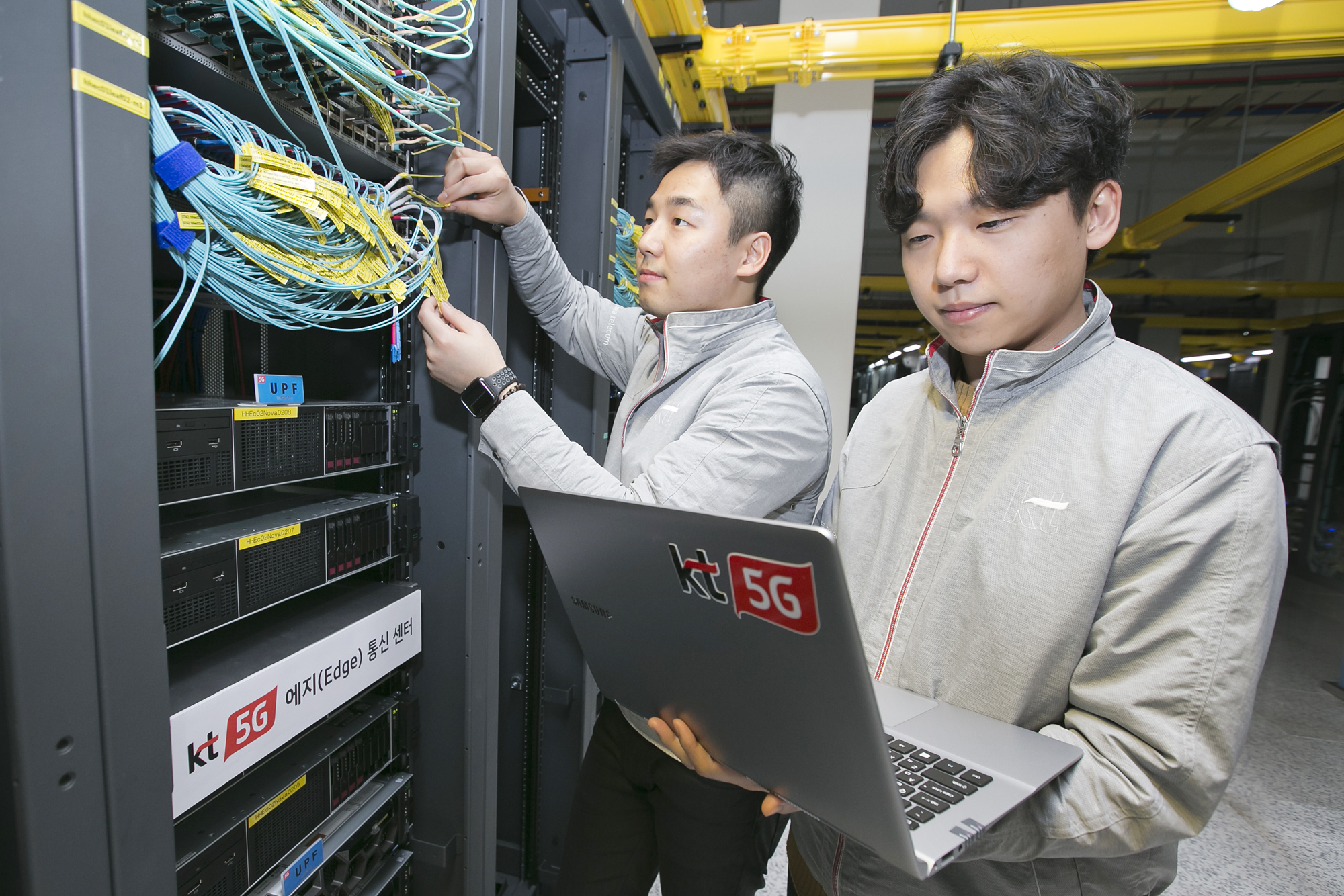
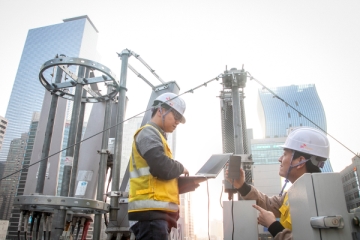
KT employees inspecting the KT 5G network at the 5G Edge Communication Center.
In 5G communication, it becomes possible to transmit data in a short time of 1 ms over the wireless section between the terminal and the base station. To fully utilize the ultra-low latency characteristics of 5G, mobile edge computing (MEC) technology is essential, as it processes data generated from user terminals as close to the user as possible.
KT has completed the construction of 5G edge communication centers that apply mobile edge computing technology in eight major cities across the country, including Jeju Island.
In the existing wireless data processing method, all data traffic from users across the country was transmitted to the central communications center in the metropolitan area for data processing, so delays were inevitable.
To minimize this delay, KT installed data processing devices in its 5G edge communication centers, enabling data traffic generated from users' terminals to be processed at nearby edge communication centers.
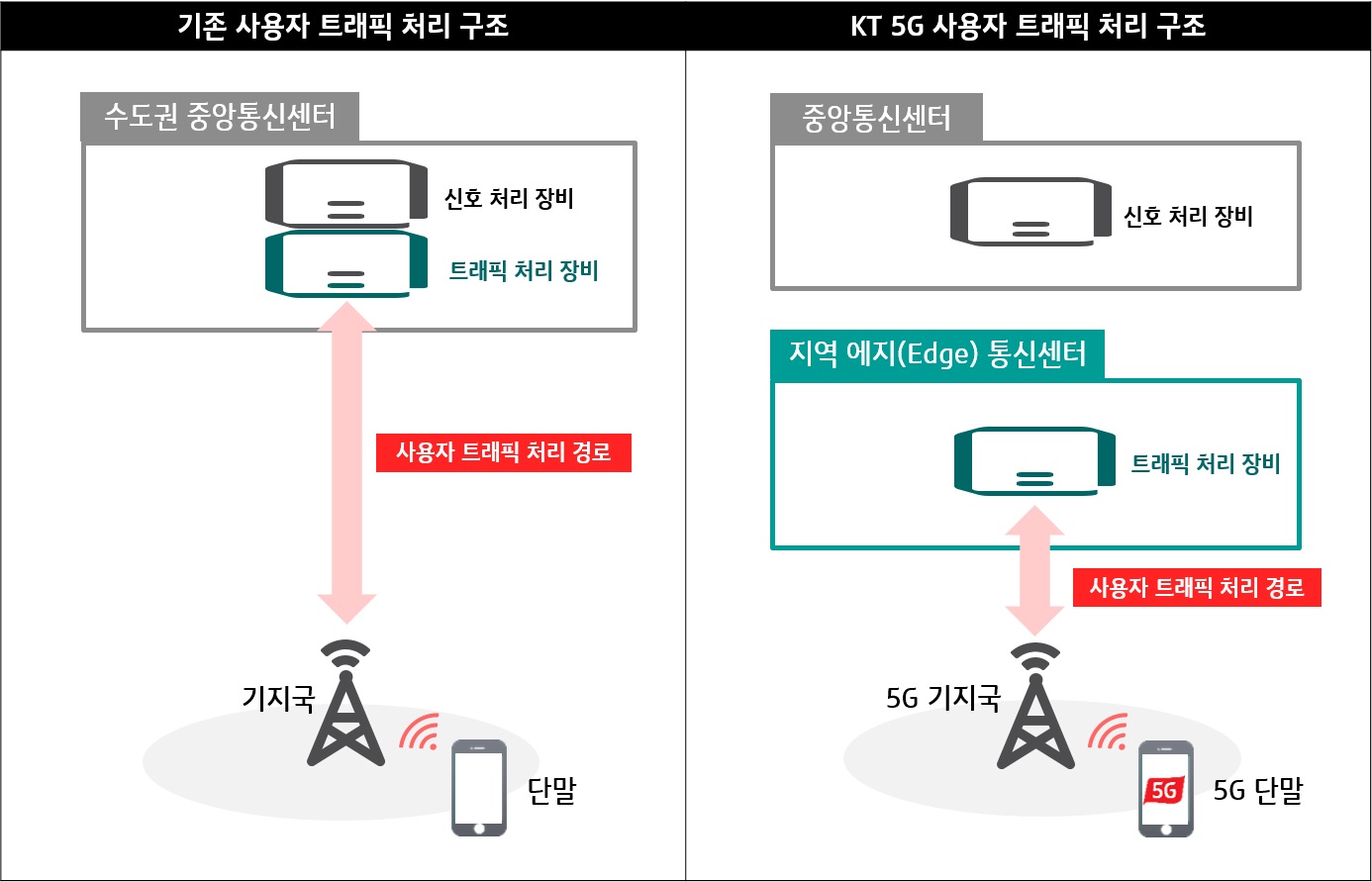
Comparison of the existing traffic processing structure and the traffic processing structure when using an edge communication center.
Delays in data processing are reduced because data traffic from users in the region can be processed locally without being transmitted to the metropolitan communications center. In fact, if you use KT 5G in Jeju Island, you can experience internet access service that is up to 44% faster than existing LTE through the edge communication center built in Jeju.
Last year, KT built an edge communications center by applying 5G core equipment with the CUPS (Control & User Plane Separation) structure, which it developed for the first time in Korea, and network virtualization technology.
CUPS technology is a technology that allows devices responsible for signal processing and user traffic processing to be built and expanded independently, separating them, and plays a key role in implementing 5G mobile edge computing technology, where independent large-scale data processing is important.
KT plans to leverage its 5G edge communications center to provide services requiring high-definition video transmission without delay, such as real-time broadcasting, e-sports broadcasting, and online gaming. The center will also be actively utilized for autonomous driving, smart factories, augmented reality, and virtual reality, which are expected to emerge as core 5G services.
“KT is making continuous efforts to provide customers with the highest quality 5G network,” said Lee Kwang-wook, managing director of KT’s network division and core network construction. “We will lead the 5G era by utilizing the edge communication center, which is where KT’s wired and wireless capabilities are concentrated, as the basic infrastructure for 5G.”
Comments
Related news
KT, the first in Korea to apply 'mesh structure' to 5G backbone network
KT has completed the domestic first application of a 'Mesh' structure that directly connects major cities nationwide to its 5G backbone network, in order to provide high-quality, ultra-low latency 5G services. In the existing wired and wireless communication backbone networks, including LTE, there were no direct connection paths between regions due to traffic processing architecture, requiring all inter-regional traffic to necessarily pass through the metropolitan center. To address this, the Mesh structure that KT applied to its 5G backbone network refers to a grid-type structure that directly interconnects major regional centers throughout the country.
2019.02.12by 이수민 기자
5G, with its ultra-high speed, ultra-low latency, and hyper-connectivity, is becoming the new wing of smart factories.
MWC19 was abuzz with interest in 5G. 5G possesses ultra-high speed, ultra-low latency, and hyper-connectivity characteristics that will transform environments not only in media but across all sectors. Domestic mobile carriers, three in total, successively unveiled smart factory solutions utilizing 5G, laying the groundwork for full-scale convergence between 5G and smart factories. SK Telecom's Supernova can analyze diverse content including video footage captured by cameras, existing media files, and images detected by sensors in industrial equipment. LG U+ unveiled 5G-based smart factory services. KT adopted O-RAN standards, an open 5G network standard. Through O-RAN specifications, telecommunications operators can construct networks with optimal base station equipment combinations tailored to their specific 5G network deployment scenarios.
2019.03.04by 이수민 기자
SKT Launches 1.2Gbps LTE Service: "16 Times Faster Than Initial LTE"
SK Telecom announced that it will provide 1.2Gbps LTE service with the launch of the Galaxy S10. This exceeds 1Gbps, the maximum LTE speed defined by the International Telecommunication Union. Following the launch of the 1Gbps LTE era in February 2018, SK Telecom has once again increased LTE speeds. The 1.2Gbps speed allows downloading a 2GB HD-quality movie in 13 seconds. This is more than 16 times faster than early LTE speeds from 2011. With the Galaxy S10 launch, SK Telecom will begin offering up to 1.15Gbps service in high-traffic areas across five cities: Seoul, Busan, Ulsan, Gwangju, and Daejeon.
2019.03.06by 이수민 기자
European Patent Applications Surpass 200,000 for the First Time… South Korea Maintains 5th Place, Led by Batteries and Telecommunications
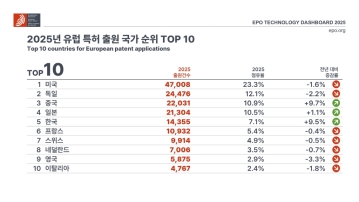
According to the European Patent Office (EPO)'s 'Technology Dashboard 2025', European patent applications last year reached 201,974, surpassing 200,000 for the first time. Korean companies and inventors filed 14,355 applications, representing a 9.5% increase from the previous year and maintaining 5th place by country. Battery, digital communication, and semiconductor technologies led the growth, with Samsung ranking as the top EPO applicant for the second consecutive year and LG reaching 3rd place. The presence of major domestic cities such as Seoul, Suwon, and Yongin was also confirmed. It was also revealed that Korea's European patent strategy is expanding beyond individual technologies to span the entire industry.
2026.03.24by 명세환 기자

SK Telecom First Applies AI-Based Network Operations at Gwanghwamun K-Pop Concert
SK Telecom announced that it applied an AI-based network operation system for the first time at a large-scale K-pop concert held in the Gwanghwamun area of Seoul on March 21st, managing communication quality throughout the event. Mobile data usage during the three hours before and after the concert reached 12.15TB, approximately doubling compared to the same time slot the previous weekend. SK Telecom monitored traffic using the AI system 'A-One' in five-minute and 50-meter units to respond to potential overload situations, while also operating temporary communication facilities and on-site personnel in parallel. This case is interpreted as confirmation of the practical applicability of AI-based autonomous network operation in an environment where demand from dense events and foreign users increases simultaneously.
2026.03.23by 명세환 기자











