



VMware Announces Cloud Portfolio Updates, Expanding the Definition of Hyper-Converged Infrastructure
 Published2019.03.22 11:04
| Existing full-stack HCI architecture
| Hybrid Cloud Infrastructure Stack Integration
Building a Fully Automated Desktop Virtualization Infrastructure
According to Gartner, 75% of enterprises are expected to adopt hybrid cloud or multi-cloud environments by 2020.

VMware
On the 21st, VMware announced major updates to its hybrid and multi-cloud portfolio to accelerate companies' digital transformation.
According to VMware research, 83% of cloud adopters say consistent infrastructure and operational practices are essential across their data centers and clouds.
“VMware helps enterprises leverage the cloud to deploy and operate the applications that drive their businesses,” said Ajay Patel, senior vice president and general manager of VMware’s Cloud Provider Software business unit. “VMware offers the broadest portfolio in the cloud industry.”
VMware continues to help companies operate multi-cloud seamlessly.“It provides a consistent infrastructure and operating environment, supports application requirements, and enables optimal resource utilization,” he said.
VMware Cloud Foundation Expands the Definition of Hyper-Converged
VMware Cloud Foundation expands the definition of Hyper-Converged Infrastructure (HCI) by integrating essential cloud infrastructure capabilities such as compute, storage, networking, and unified cloud management.
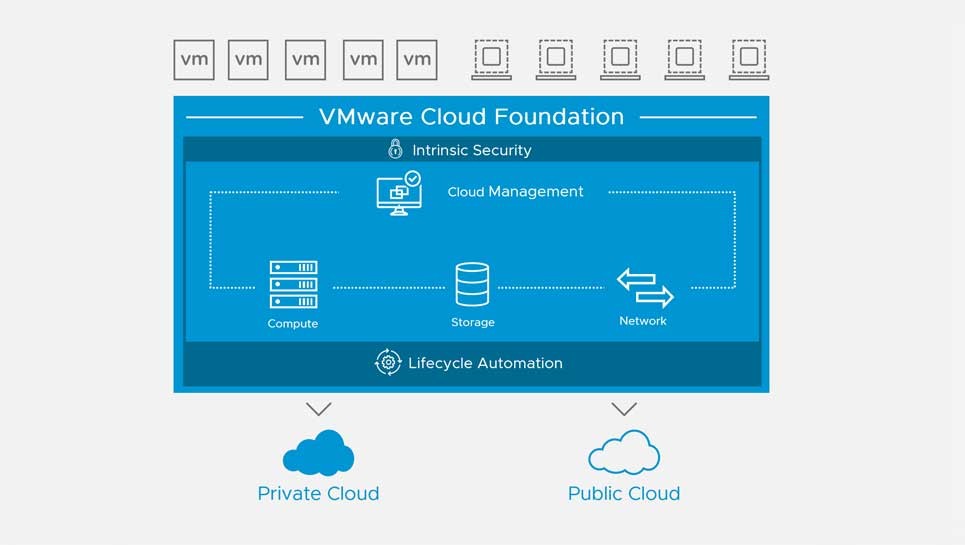
VMware Cloud Foundation
VMware Cloud Foundation is a full-stack solution that provides consistent infrastructure and operations, enabling enterprises to modernize their data centers and rapidly migrate applications and entire data centers to the cloud. It can scale to meet fluctuating demand, such as disaster recovery, global expansion, and usage spikes, and supports next-generation application deployments in a modern data center environment.
The newly updated VMware Cloud Foundation 3.7 will be supported on Dell EMC VxRail in Q1 FY2020. VMware and Dell EMC will integrate a jointly engineered hybrid cloud infrastructure stack with VMware's flexible full-stack HCI architecture to support business-specific applications.
VMware Cloud Foundation on Dell EMC VxRail demonstrates the collaboration between VMware and Dell EMC, streamlining operations through automated hardware and software management capabilities. It also supports full-stack, end-to-end lifecycle management.
Optimized for performance, scalability, user experience, and TCO reduction, VMware Cloud Foundation on Dell EMC VxRail supports business resiliency, sophisticated predictability, and ease of deployment. In addition to deployment options including appliance and integrated rack offerings, it will offer newly added networking flexibility and integration capabilities.
VMware Cloud Foundation 3.7 also supports fully automated deployment of VMware Horizon 7 Virtual Desktop Infrastructure (VDI). VMware Cloud Foundation provides complete infrastructure automation capabilities for VMware Horizon 7 environments, including Horizon 7, App Volumes, User Environment Manager, and Unified Access Gateway.
VMware Cloud Foundation connects ready-to-use infrastructure with business-specific application deployments, enabling enterprises to rapidly deliver infrastructure and applications to customers at cloud speed.
VMware Cloud Foundation is a cloud infrastructure foundation provided as a service by VMware and VMware Cloud Certified Partners. In the future, we plan to provide operation and management services that will enable companies to utilize Software Defined Data Centers (SDDCs) optimized for on-premises and edge environments.
CloudHealth by VMware Supports Enterprise Multi-Cloud Operations
CloudHealth by VMware is a platform that supports successful operation of multi-cloud environments for enterprises.
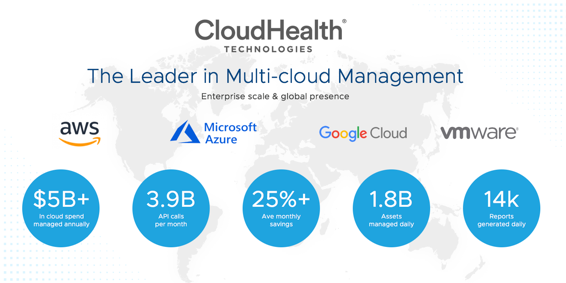
CloudHealth by VMware
By providing easy-to-understand information across the entire multi-cloud environment, companies can flexibly expand their multi-cloud environment according to business or market requirements.
Includes multi-cloud or multi-dimension reporting, automatic exchange of convertible reserved instances (RIs), container cluster visibility, and cross-family rightsizing for Amazon EC2.
Additionally, CloudHealth by VMware integrates with Wavefront by VMware, a cloud analytics, measurement, and monitoring platform, to measure costs incurred within multi-cloud environments in real time.
Enterprises can leverage cloud performance metrics provided by Wavefront by VMware to manage multi-cloud infrastructures such as Amazon Web Services (AWS), Microsoft Azure, and Google Cloud Platform (GCP). You can check the status and measure the cloud resource usage of each application to gain the insights needed for flexible budget management.
Meanwhile, CloudHealth was acquired by VMware in October 2018, and currently more than 4,000 companies worldwide are using CloudHealth by VMware.
Comments
Related news
VMware Introduces a Digital Workspace Solution that Transcends Devices, OS, Cloud, and Software
VMware has announced its vision of supporting all types of devices and applications across all clouds. VMware enables enterprises to achieve digital transformation optimized for rapidly changing business trends. The end-user computing strategy proposed by VMware is to implement a digital workspace—an environment that supports diverse business applications without being tied to specific devices. VMware Workspace ONE, an intelligence-based digital workspace platform built on VMware AirWatch technology, can easily and securely deliver and manage all applications across all devices.
2019.01.29by 이수민 기자
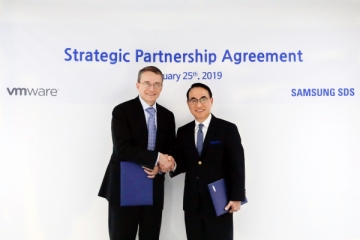
Samsung SDS and VMware Jointly Promote Digital Work Environment Innovation Project
Digital workplace transformation innovation enables enterprises to perform tasks anytime and anywhere using PCs and mobile devices by leveraging IT technologies such as cloud computing and virtualization, thereby improving work efficiency. Accordingly, Samsung SDS has established a strategic partnership with VMware to jointly develop digital workplace transformation projects. VMware is leading digital workplace transformation innovation with its Workspace ONE solution, which enables secure and flexible management of various mobile devices.
2019.02.26by 이수민 기자
VMware Unveils Service-Defined Firewall to Reduce Attack Surface in On-Premise and Cloud Environments
VMware has unveiled VMware Service Defined Firewall, which reduces attack surface in both on-premises and cloud environments. VMware Service Defined Firewall is characterized by combining high application visibility, understanding of normal application activity, and intelligent, automated adaptive firewall capabilities to provide enhanced protection for applications, data, and users. VMware's security strategy shifts focus from the conventional security model that emphasizes reducing attack surface and tracking abnormal activity rather than pursuing obscure threats, to ensuring normal activity.
2019.03.11by 이수민 기자
.jpg)
SalePoint Signs Multi-Year Partnership Agreement with AWS… Promoting Identity Security that Integrates Even AI Agents
Sailpoint has entered into a multi-year strategic partnership agreement with AWS and is moving forward with establishing an integrated governance system that manages both human and non-human identities together. The plan is to consistently manage access permissions in an environment where AI agents are increasing as work execution entities, while applying the principle of least privilege and automated policy enforcement. The two companies plan to jointly expand capabilities to manage the identities of various entities, including AI agents, within a single layer in the AWS environment. This collaboration is interpreted as a move to design security and governance together in corporate environments where AI adoption is expanding.
2026.03.26by 배종인 기자
.png)
Databricks Unveils Open AI Security Monitoring 'Lakewatch'
Databricks entered the security market on March 24 by unveiling LakeWatch, an open-source agentic SIEM. The core functionality of this product is to integrate and analyze security, IT, and business data in a single environment to support AI-based threat detection and investigation. The company explained that it reduces the limitations of existing security operations centers, which have had to forgo some data due to high cost structures, and enables large-scale data analysis and automation based on open formats and ecosystems. LakeWatch is currently offered as a private preview, with Adobe and Dropbox mentioned as early customers. Databricks also announced an expanded partnership with Anthropic as well as the acquisition of Antimatter and SiftD.ai.
2026.03.26by 배종인 기자











