



Maxim Launches Dual IO-Link Transceiver Integrating DC-DC Buck Regulator and Surge Protection
 Published2019.04.03 11:37
| 1/4 power loss with an 80% efficiency 300mA DC-DC regulator
| Operates in the range of -40°C to 125°C, provided in a 28-pin QFN package
As Industry 4.0 systems become smarter, sensors and actuators must be smaller and more powerful, and have low power loss to facilitate easy integration into manufacturing environments. Consequently, designers face difficulties in developing robust solutions to meet time-to-market schedules because they must integrate multiple individual solutions.
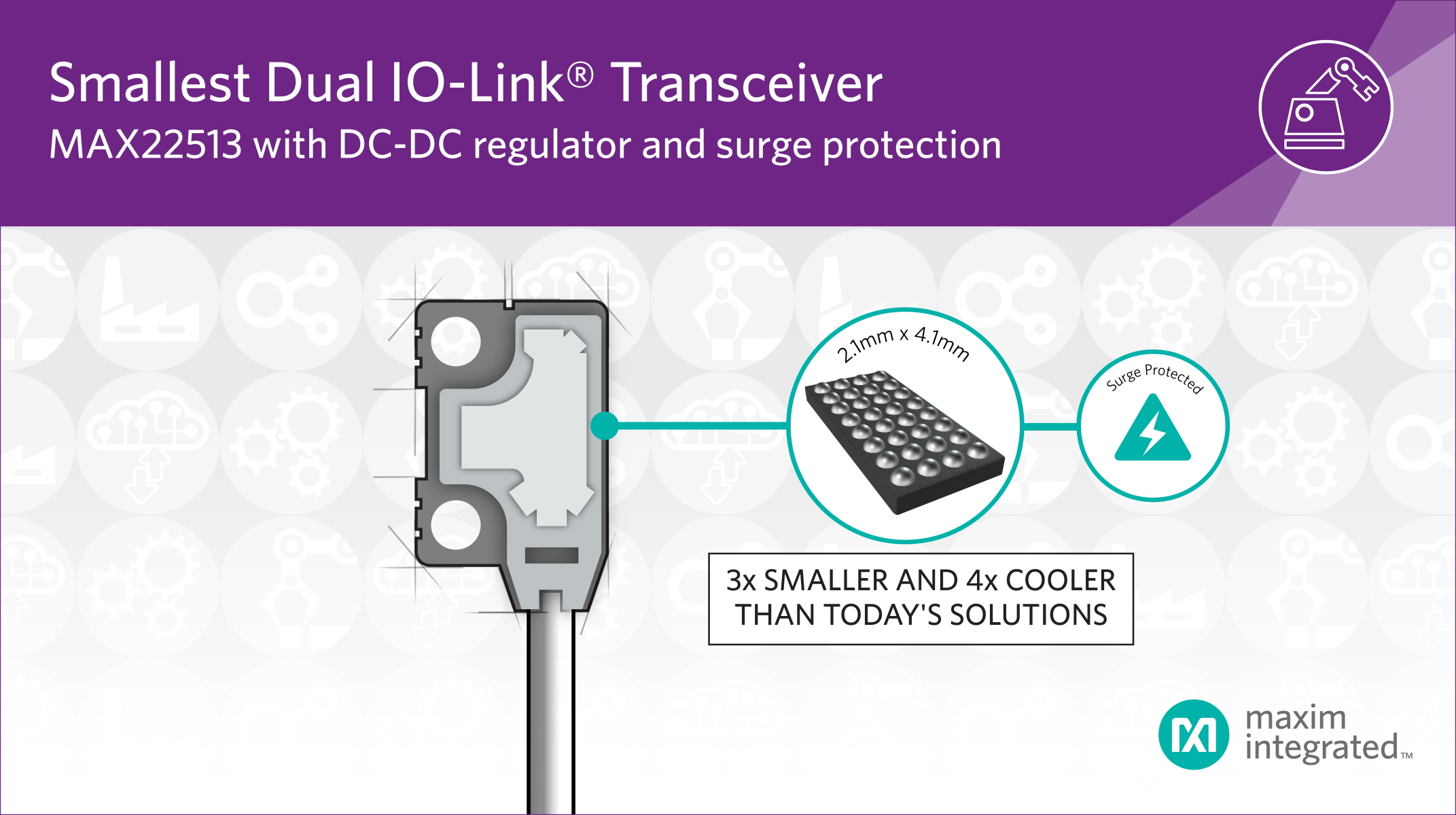
Accordingly, Maxim Integrated Korea announced on the 3rd that it has launched the 'MAX22513', a dual-IO link device transceiver with integrated DC-DC buck regulator and surge protection functions.
The MAX22513 is suitable for industrial IO-Link sensors and actuators, enabling smart digital factories. It integrates DC-DC regulators and surge protection while providing a solution three times smaller than competing solutions. Unlike previous solutions, four TVS (transient voltage suppression) diodes are not required due to the integrated surge protection.
The MAX22513 reduces power loss by four times with a low on-resistance (typ 2Ω) driver and an 80% efficient 300mA (max load) DC-DC regulator. All four IO pins provide robust communication with reverse voltage protection, short-circuit protection, and ±1kV/500Ω surge protection.
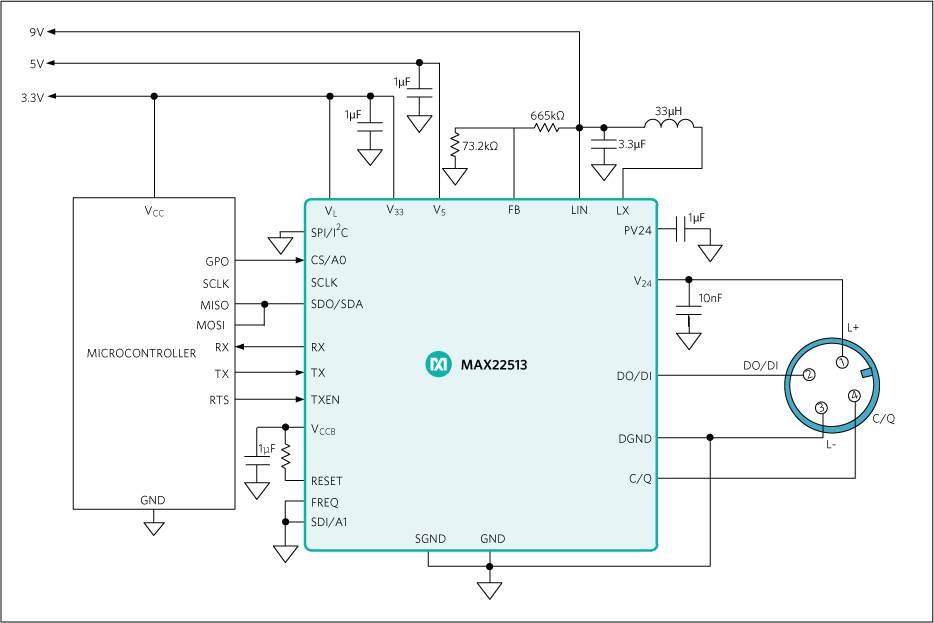
The MAX22513 accelerates the design process by ensuring robust communication even in extreme industrial environments through integrated surge protection and reverse polarity. This solution operates over a temperature range of -40°C to +125°C and is available in 28-pin QFN packages (3.5mm x 5.5mm) and WLP (4.1mm x 2.1mm).
Timothy Leung, Director of Industry and Healthcare at Maxim Integrated, said, “Maxim is focusing on providing highly integrated solutions with smaller size and lower power consumption needed for powerful, compact IO-Link designs.”
Comments
Related news
Maxim Launches "USB-C" 3A Switch-Mode Buck Charger That Does Not Require a 'Host Controller'
Maxim has launched the MAX77860, a 3A switch-mode charger that simplifies design and software development. Portable electronics designers working with lithium-ion battery-powered devices can use the MAX77860 to add USB Type-C (USB-C) charging systems to their products more simply and flexibly. Traditionally, a host microprocessor was required in the design to sense current levels and set charger input current limits. However, the MAX77860 integrates a USB-C port controller and charger, eliminating the need for a separate host controller.
2019.03.20by 이수민 기자
Infineon Launches Voltage Regulator Supporting Intel SVID and PMBus
The Infineon IR38x6x product family provides full SVID compatibility or 3-bit PVID flexibility, enabling easy design and support of Intel CPU and chipset POL rails in Intel systems. Additionally, certain products support PMBus functionality for POL rails that require control, telemetry, and voltage setting in applications such as telecom base stations, networks, and storage SSDs. This POL product family leverages the high efficiency of OptiMOS MOSFETs.
2019.03.26by 이수민 기자
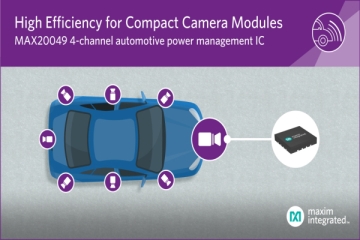
Maxim Launches MAX20049, a 4-Channel PMIC That Gives Automotive Camera Modules a Boost
Automotive camera modules require power solutions that integrate the necessary power and functionality in a compact form factor due to size constraints. To address this, Maxim has launched the MAX20049, an ultra-compact automotive 4-channel PMIC that integrates four power devices in a small space. The new product is approximately 30% smaller than average products in the market and offers the highest efficiency among comparable 4-channel PMICs in its class.
2019.03.27by 이수민 기자
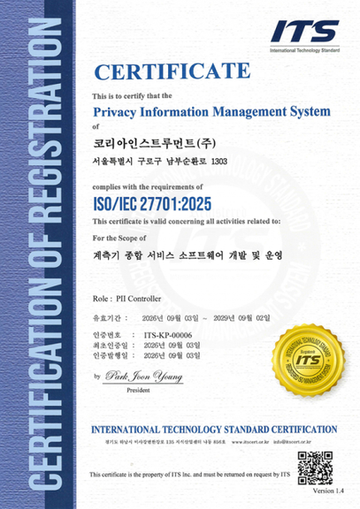
Korea Instrument, KOLAS Accredited Calibration Agency First to Simultaneously Acquire ISO/IEC 27,001·27,701
Korea Instrument has become the first among KOLAS accredited calibration agencies to simultaneously acquire ISO/IEC 27,001 and ISO/IEC 27,701 certifications. Through its proprietary platforms CWIZ Enterprise and CWIZ Partners, the company has embedded information security and personal data protection requirements across all business processes including customer information, equipment data, and calibration reports, with plans to continuously advance its management system through regular audits and security inspections.
2026.10.12by 배종인 기자
TeamViewer One, IT Incident Automation Workflow and Resolution Center Enhanced
TeamViewer has added IT incident automation capabilities and an advanced Resolution Center to its integrated digital workplace management platform 'TeamViewer ONE'. Recurrent service disruptions, configuration errors, and capacity shortages are automatically handled according to preset policies, and device status verification through script deployment can be managed in a unified interface, significantly reducing repetitive tasks for IT teams.
2026.10.12by 배종인 기자











