


Samsung Electronics Launches Total Modem Solution to Reduce 5G Device Size
 Published2019.04.04 11:25
| Exynos RF 5500, Exynos SM 5800
New semiconductor technology recognized at ISSCC 2019
Samsung Electronics announced on the 4th that it has launched a 5G total modem solution by mass-producing the 'Exynos Modem 5100', the radio frequency transceiver semiconductor 'Exynos RF 5500', and the power supply modulation semiconductor 'Exynos SM 5800'.
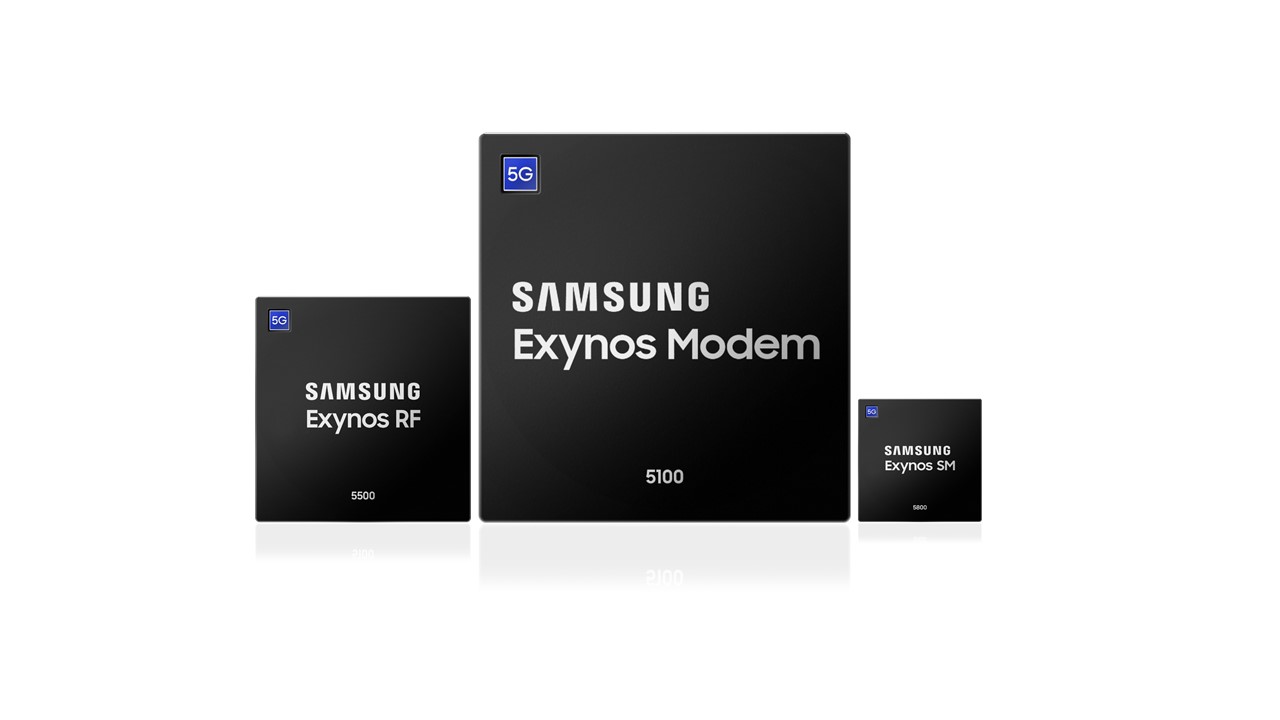
Samsung Electronics' 5G Total Modem Solution
Modems, RF chips, and SM chips are core semiconductors of wireless communication technology that enable ultra-high-speed data communication.
If the modem chip converts the voice and data information of the mobile phone into signals or converts external signals into voice and data, the RF chip plays a role in adjusting the signals so that they can be transmitted and received as radio waves. In this process, the SM chip adjusts the voltage so that the radio signal can be transmitted more efficiently.
The Exynos RF 5500 and Exynos SM 5800 technologies were selected as excellent product papers at the 'International Society for Semiconductor Technology (ISSCC) 2019' held in San Francisco, USA in February, and are scheduled to be installed in the next-generation 5G flagship smartphone along with the 'Exynos 5G modem'.
Exynos RF 5500, from 2G to 5G in a single chip
An RF transceiver (Radio Frequency Transceiver) is a semiconductor that converts voice and data signals from a modem into a frequency that can be transmitted externally and transmits data between mobile devices and base stations.
The Exynos RF 5500 is characterized by being able to support 5th generation communication standards up to 6 GHz with a single chip, which has the advantage of reducing the space burden when designing terminals.
To improve data transmission speed, Samsung Electronics applied '4x4 MIMO technology' that allows simultaneous use of four antennas and '256QAM (Quadrature Amplitude Modulation)' technology, a frequency modulation method, to 'Exynos RF 5500'.
Exynos SM 5800, optimized for battery consumption
In order for RF to transmit data to a communication base station, a process of amplifying the signal using power amplifier semiconductors is required. Power supply modulation semiconductors (SMs) efficiently manage battery consumption by controlling the voltage required for signal amplification.
The Exynos SM 5800 supports wireless bandwidths of up to 100 MHz, enabling efficient data transmission even in 5G communications with high data transmission volumes.
In particular, it optimizes the required voltage based on distance information between the mobile device and the communication base station, improving battery consumption in the terminal by up to 30%.
“Samsung’s Exynos 5G solution will provide powerful performance and power efficiency while supporting mobile communication standards for each generation, providing uninterrupted connectivity anywhere,” said Kang In-yup, President and Head of System LSI Business at Samsung Electronics.
Samsung Electronics is pursuing the commercialization of RF transceivers and phase array products that support ultra-high frequency bands above 24 GHz, i.e., mmWave, while also planning to introduce next-generation 5G semiconductors that integrate modems into processors in the future.
Comments
Related news
Samsung Electronics Develops World's First Third-Generation 10nm-Class DRAM
Samsung Electronics has developed third-generation 10-nanometer-class (1z) 8Gb DDR4 DRAM just 16 months after mass-producing second-generation 10-nanometer-class (1y) DRAM. The third-generation 10-nanometer-class (1z) DRAM improved productivity by more than 20% compared to the existing 10-nanometer-class (1y) DRAM without using expensive EUV equipment, and power efficiency was also enhanced through increased speed. Samsung Electronics has also completed approvals from major global CPU vendors in all evaluation categories for PC DDR4 modules based on third-generation 10-nanometer-class (1z) DRAM, enabling the company to significantly expand demand from global IT customers.
2019.03.21by 이수민 기자
Samsung Electronics Maximizes 5G Mobile Experience with the Galaxy S10 5G, Featuring the Largest Display in Series History
Samsung Electronics will launch the Galaxy S10 5G, a 5G smartphone, in Korea on the 5th. The Galaxy S10 5G supports 5G mobile communications characterized by transmission speeds up to 20 times faster than existing LTE, ultra-low latency, and hyper-connectivity, enabling users to download various multimedia content more rapidly. Additionally, video calls can be enjoyed comfortably in clear 4K quality. Equipped with a 6.7" Infinity-O display, the largest screen in the Galaxy S series, the Galaxy S10 5G allows users to freely view high-end games as well as VR and AR content.
2019.04.01by 이수민 기자

The era of 5G mobile communications opens in Korea for the first time in the world
The Ministry of Science and ICT announced that on the 3rd at 11 PM, the three mobile carriers simultaneously activated 5G mobile communication smartphones for their first subscriber in each company, officially launching the 5G service. Since December 1st of last year, Korea initially launched 5G service targeting corporate customers through dongle terminals by the three carriers simultaneously with 5G spectrum transmission. With the launch of 5G smartphones ahead of any other country in the world this time, Korea has achieved the world's first smartphone-based 5G commercialization. The industry had anticipated that 5G service would begin on the 5th; however, commercialization preparations including 5G smartphone launch and preparation of service terms and conditions were completed ahead of schedule, allowing the launch to be accelerated by two days from the original plan. Similar to the early 4G rollout, the three mobile carriers are initially launching 5G service primarily in densely populated areas of major cities including Seoul, the Seoul metropolitan area, and some metropolitan cities. Subsequently, the carriers plan to continuously expand 5G network construction so that 5G service can be provided in densely populated areas of 85 cities nationwide by the end of this year.
2019.04.04by 이수민 기자

Intel Unveils Next-Generation 'Core Ultra Series 3' and vPro Platform for Enterprise PCs
Intel has officially unveiled the "Intel Core Ultra Series 3" for next-generation enterprise PCs and the latest vPro platform, addressing a wide range of demands from enterprise notebooks to high-performance workstations.
2026.03.26by 배종인 기자

ROHM Launches ESD Protection Diode Compatible with High-Speed Interfaces of 10Gbps or Higher
Semiconductor specialist ROHM has developed the 'RESDxVx series' of ESD (electrostatic discharge) protection diodes capable of responding to next-generation high-speed data communication environments exceeding 10Gbps, simultaneously enhancing both signal quality maintenance required in high-speed interfaces and IC protection performance.
2026.03.26by 배종인 기자











