


ON Semiconductor Launches RSL10 Multi-Sensor Platform Powered by Solar Cells
 Published2019.04.13 07:01
| RSL10 radio, integrated antenna, all passive components
| Providing rapid prototyping programs for IoT
ON Semiconductor announced on the 11th that it has launched the 'RSL10 Multi-Sensor Platform' that is powered solely by solar cells.
The new solution collects and transmits data using 'Bluetooth Low Energy' without the need for batteries or other forms of non-renewable energy. This supports the development of IoT sensors that use solar energy harvesting.
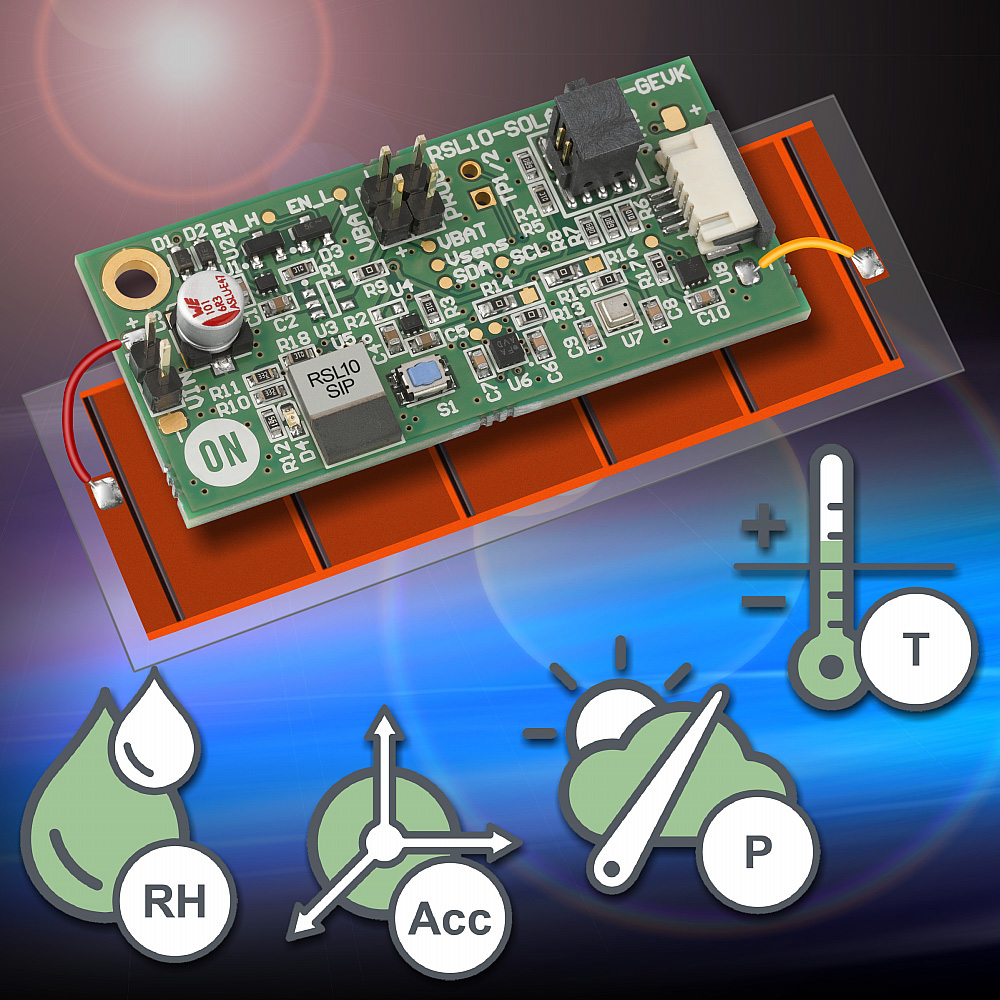
The combination of ultra-low-power wireless communications, small form-factor solar cells, and low-duty-cycle sensing applications helps develop and deploy maintenance-free IoT sensor nodes.
The 'RSL10 Solar Cell Multi-Sensor Platform' is implemented as a SiP solution, the RSL10 SIP, featuring the RSL10 radio, integrated antenna, and all passive components.
The platform integrates low-power sensors from Bosch Sensortec, including the RSL10 SIP and the BME280 all-in-one environmental sensor for pressure, temperature and humidity, the BMA400 ultra-low-power 3-axis accelerometer, and solar cells.
Developers and manufacturers can use this platform to build IoT nodes that run solely on renewable energy or energy harvested from the surrounding sensors.
A growing number of IoT sensor applications have low enough duty cycles to support intermittent communications, allowing the energy needed to support operation to be harvested using renewable energy sources. The highly efficient power management system and ultra-low-power sensors implemented on the RSL10 platform enhance the platform's energy efficiency.
The platform is expected to enable applications in smart homes and building automation, including HVAC control, window/door sensors, and air quality monitoring. Asset tracking applications, such as package open/close detection, shock monitoring, and temperature and humidity data logging, are also possible.
The new platform provides all design files and customizable source code as part of the CMSIS software package, supporting easy development. The RSL10 solar cell multi-sensor platform is available from ON Semiconductor.
We also offer several energy-efficient rapid prototyping programs for IoT, including the Energy Harvesting Bluetooth Low Energy Switch, which was selected by China Electronics Magazine as the most competitive IoT solution in China in 2018.
“The BMA400 is the first truly ultra-low-power acceleration sensor without compromise,” said Peter Weigand, Vice President of Marketing at Bosch Sensortec. “In combination with the BME280 integrated environmental sensor, it provides a comprehensive sensing solution for IoT applications such as temperature control, intrusion detection, and asset tracking.”
“To support the growth of IoT, manufacturers are actively investing in alternative energy sources to power their designs, reducing environmental impact and lowering manufacturing and maintenance costs,” said Wiren Perera, general manager, IoT at ON Semiconductor. “This solution, built around the RSL10 Bluetooth low energy radio, demonstrates that a battery-free and maintenance-free approach to smart sensor development is not only possible, but can also help manufacturers improve their designs.”
Comments
Related news
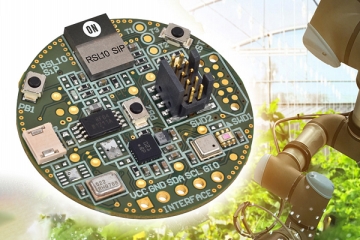
ON Semiconductor Launches RSL10 Sensor Development Kit for IoT Applications
ON Semiconductor is launching the RSL10 Sensor Development Kit, which is based on Bluetooth Low Energy wireless technology. Designed for engineering professionals, this development kit provides a comprehensive platform for developing IoT applications with advanced smart sensor technology. The RSL10 Sensor Development Kit comes with the highly integrated RSL10 System-in-Package and a range of advanced low-power sensors from Bosch Sensortec.
2019.02.14by 이수민 기자
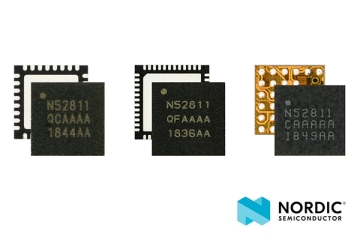
Nordic Launches SoC with Bluetooth 5.1 Direction Finding Support
Nordic Semiconductor has launched the nRF52811 SoC, a connectivity solution that supports Bluetooth 5.1 direction finding capabilities and various general-purpose low-power wireless protocols for applications such as smart home gateways and industrial products. The nRF52811 SoC is a new product in Nordic's nRF52 series platform that combines the cost-effectiveness of the lower-tier nRF52810 SoC with the multi-protocol support capabilities of the mid-range nRF52832 and advanced nRF52840 SoC. The nRF52811 SoC features a 64MHz, 32-bit Arm Cortex M4 processor along with 192kB flash and 24kB RAM memory, in addition to multi-protocol 2.4GHz wireless. The nRF52811 SoC also includes a wide range of analog and digital interfaces.
2019.02.26by 이수민 기자

Nordic Semiconductor Fully Supports Bluetooth 5.1, Improves Location Services with Direction Finding
Until now, Bluetooth location services have used signal strength to determine indoor positioning between devices and calculate distances. On January 28th, the Bluetooth SIG announced Bluetooth Core Specification version 5.1, which supports direction finding functionality. By utilizing the direction finding feature, devices can determine not only distance information but also the signal direction of other Bluetooth devices, thereby improving location accuracy. A Nordic representative stated that all of Nordic's Bluetooth devices will fully support the new Bluetooth 5.1 specification.
2019.03.04by 이수민 기자
Korea Instrument, KOLAS Accredited Calibration Agency First to Simultaneously Acquire ISO/IEC 27,001·27,701
Korea Instrument has become the first among KOLAS accredited calibration agencies to simultaneously acquire ISO/IEC 27,001 and ISO/IEC 27,701 certifications. Through its proprietary platforms CWIZ Enterprise and CWIZ Partners, the company has embedded information security and personal data protection requirements across all business processes including customer information, equipment data, and calibration reports, with plans to continuously advance its management system through regular audits and security inspections.
2026.10.12by 배종인 기자

TeamViewer One, IT Incident Automation Workflow and Resolution Center Enhanced
TeamViewer has added IT incident automation capabilities and an advanced Resolution Center to its integrated digital workplace management platform 'TeamViewer ONE'. Recurrent service disruptions, configuration errors, and capacity shortages are automatically handled according to preset policies, and device status verification through script deployment can be managed in a unified interface, significantly reducing repetitive tasks for IT teams.
2026.10.12by 배종인 기자











