


5G commercialization 2 weeks later… LTE slowed down because of 5G?
 Published2019.04.22 17:44
| 5G-LTE, sharing backbone network may slow down speeds
| Need to expand infrastructure and gain experience in network operation
It was exactly two hours early.

South Korea launched the world’s first 5G commercial service at 11 p.m. on the 3rd, two hours ahead of the United States. But being world’s first is not synonymous with being world’s best. Users have expressed their dissatisfaction. The dissatisfaction first came from LTE users, not 5G users.
Since 5G became commercialized, it is not hard to find people everywhere who have experienced slow LTE connections. KakaoTalk, which had been working fine, has stopped working, and Netflix has become unavailable. Smartphones have been frequently trying to connect to LTE and failing again.
Even now, there are still many people criticizing this in Internet communities and news comment sections. There are three reasons for the public opinion.
First, carriers deliberately slowed down LTE speeds to increase 5G subscribers. Second, carriers pulled LTE resources to increase 5G speeds. Third, the service was launched hastily in an attempt to claim the world's first title despite the poor 5G infrastructure.
If we really analyze the causes of public opinion, some are true and some are not.
Did they intentionally make LTE slow?
First of all, it is inconsistent to slow down LTE speeds to make 5G stand out more. Current 5G services are based on 5G NSA (Non-Standalone). 5G NSA is a standard technology that 3GPP has established to use LTE networks as well as 5G networks in preparation for data interruptions. Therefore, 5G cannot operate without LTE assistance. If LTE speeds are deliberately slowed down, 5G will also slow down.
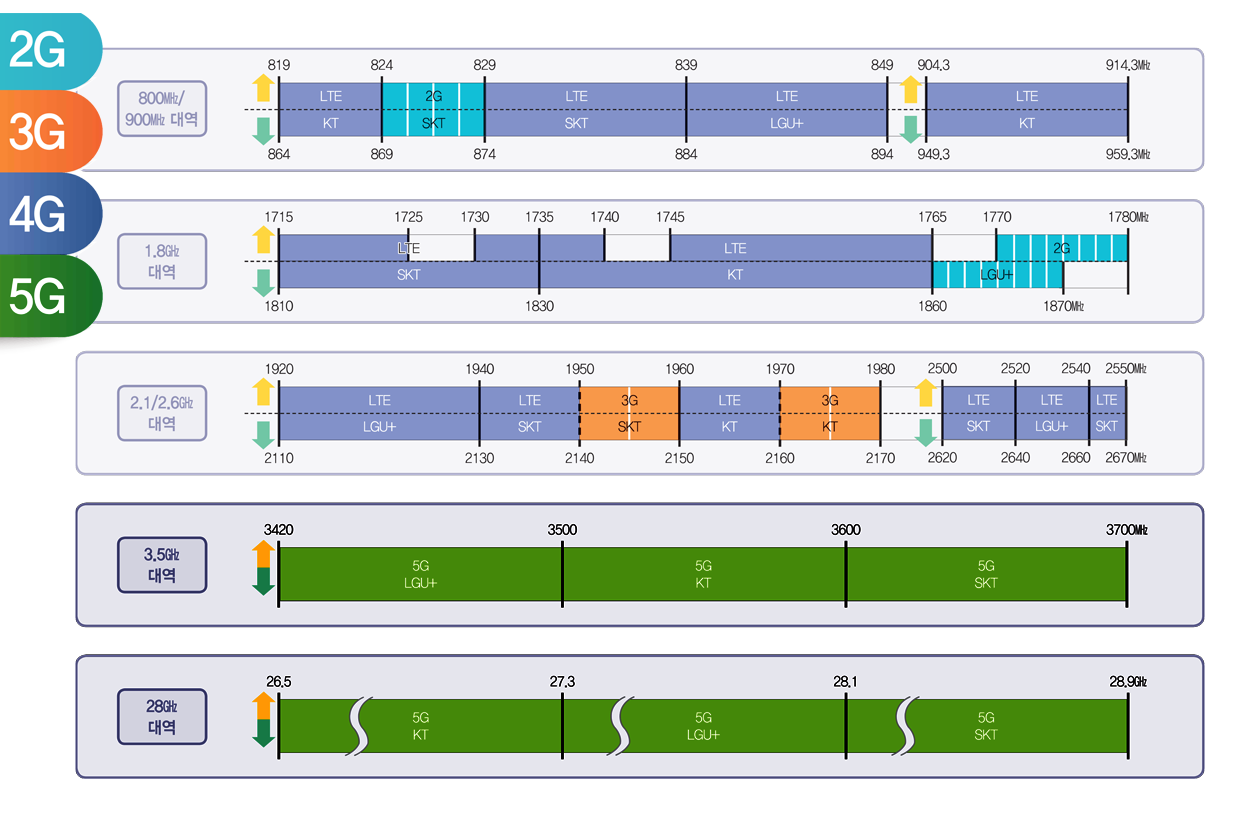
Then, the second guess that it is using LTE resources seems correct. However, it is not. It is true that it uses the LTE network, but 5G does not overlap with LTE in frequency band. The LTE frequency band is from 850㎒ to 2.6㎓. 5G uses the 3.5㎓ and 28㎓ bands. In other words, only 5G users can use the LTE network. Also, the number of LTE subscribers is much larger than 5G subscribers. LTE technology development is still ongoing. In fact, LTE speeds in 2019 are 16 times faster than in its early days in 2011.
So what is the real cause? KT, which had been silently denying this, explained on the 19th that the LTE disconnection phenomenon was a failure that occurred during the process of optimizing the 5G network. During the 5G base station update process, an error occurred in the LTE phone receiving the 5G signal, and conversely, the 5G phone connected to the LTE signal and the signal did not disconnect, resulting in a kind of overload. KT stated that it had resolved this through a software update.
We can't be sure. 5G and LTE are clearly different in many ways. They use different frequencies and have different base stations and equipment. However, the current 5G network and LTE network share a backbone network that connects to base stations. This means that LTE speeds may be slow.
There is only one conclusion that can be drawn. It is true that LTE speeds are slow and 5G speeds are unsatisfactory, but it is not intentional. It is excessive. The three mobile carriers did not slow down LTE for 5G. However, it is also true that there are some parts that are a bit unreasonable in order to claim the title of world's first.
We need to expand infrastructure and improve operational capabilities.
5G has a high frequency band and short transmission distance, so the number of base stations must be absolutely large. Building this is a task that takes time.
According to the Ministry of Science and ICT’s 5G base station status, there were 85,261 5G base stations installed nationwide as of early April. Of these, SK Telecom had 38,213, KT had 35,264, and LG U+ had 11,784. This is about 1/10 of the 832,380 LTE base stations. Of these, 54,899 base stations were installed in the metropolitan area. The industry estimates that 120,000 base stations are needed to build a nationwide network, which is expected to be completed next year.
In addition to the number of base stations, 5G operational experience is also important. The 5G frequency band is highly linear, so if there is an obstacle, the radio waves cannot reach. Even if the base stations are densely located, the quality may deteriorate if the coverage overlaps. It is also not usable indoors or underground.
Although work is continuing to expand 5G’s external coverage and secure indoor quality, the industry predicts that a significant improvement will be difficult within this year. In addition, 5G services are currently only available in the 3.5 GHz band. The 28 GHz band, which can handle larger amounts of traffic, has stronger straightness and shorter range than the 3.5 GHz band, so more effort must be put into solving the aforementioned problems.
The start was fast. But the start is not half the battle. The start is the start. 5G has just taken its first steps. There is still a long way to go.
Comments
Related news

Keysight 5G Summit 2019 to be held… A look at the latest 5G technologies and trends.
Keysight Korea hosted the 'Keysight 5G Summit 2019 Seoul' and shared comprehensive 5G test solutions along with the latest wireless technologies and industry trends. The 5G Summit began with a welcome address by Chun-ho Choi, President and CEO of Keysight Korea, emphasizing the potential of 5G technology in the East Asia region, followed by a keynote speech by Kailash Narayanan, Vice President of Keysight's Wireless Test Division, highlighting that 5G technology can be utilized across various fields beyond mobile communications. This was followed by special lectures on 5G trends from SK Telecom and Qualcomm representatives, as well as introductions and usage guidelines for various test solutions and explanations of updated standards.
2019.04.17by 이수민 기자
Public-Private Joint Task Force for 5G Service Inspection Operates Permanently
To stabilize commercial 5G mobile communication services and improve quality, a joint public-private task force for 5G service inspections has been established, comprising the Ministry of Science and Technology, telecom operators, and manufacturers. The public-private task force plans to address public inconvenience from 5G mobile communication services by discussing service coverage expansion and resolving technical issues such as service interruptions, and will enhance public communication by disclosing key outcomes.
2019.04.22by 이수민 기자

Korea and Uzbekistan Share 5G Experience and Sign MOU in Space and ICT Sectors
South Korea and Uzbekistan announced through a summit declaration that they will share Korea's experience as the world's first country to commercialize 5G and cooperate in jointly responding to the Fourth Industrial Revolution era and expanding opportunities for inclusive innovative growth. Minister You Young-min of the Ministry of Science and ICT signed an MOU on space cooperation with Uzbekistan's Ministry of Information Technologies and Communications Development, and an MOU on science and technology cooperation with the Ministry of Innovative Development, respectively. This MOU was concluded in the presence of both leaders as part of the three Central Asian countries' state visit for the promotion of the New Northern Policy. Based on this, both countries plan to activate mutual cooperation in the space, science and technology, and ICT sectors.
2019.04.22by 이수민 기자
European Patent Applications Surpass 200,000 for the First Time… South Korea Maintains 5th Place, Led by Batteries and Telecommunications
According to the European Patent Office (EPO)'s 'Technology Dashboard 2025', European patent applications last year reached 201,974, surpassing 200,000 for the first time. Korean companies and inventors filed 14,355 applications, representing a 9.5% increase from the previous year and maintaining 5th place by country. Battery, digital communication, and semiconductor technologies led the growth, with Samsung ranking as the top EPO applicant for the second consecutive year and LG reaching 3rd place. The presence of major domestic cities such as Seoul, Suwon, and Yongin was also confirmed. It was also revealed that Korea's European patent strategy is expanding beyond individual technologies to span the entire industry.
2026.03.24by 명세환 기자

SK Telecom First Applies AI-Based Network Operations at Gwanghwamun K-Pop Concert
SK Telecom announced that it applied an AI-based network operation system for the first time at a large-scale K-pop concert held in the Gwanghwamun area of Seoul on March 21st, managing communication quality throughout the event. Mobile data usage during the three hours before and after the concert reached 12.15TB, approximately doubling compared to the same time slot the previous weekend. SK Telecom monitored traffic using the AI system 'A-One' in five-minute and 50-meter units to respond to potential overload situations, while also operating temporary communication facilities and on-site personnel in parallel. This case is interpreted as confirmation of the practical applicability of AI-based autonomous network operation in an environment where demand from dense events and foreign users increases simultaneously.
2026.03.23by 명세환 기자











