


Microchip Launches TimeProvider 4100 Release 2.0 for Mass Synchronization of 5G Base Stations
 Published2019.05.19 09:59
One of the biggest challenges in building 5G networks is synchronizing large, densely packed base stations.
Another challenge is to provide continuous service even when the Global Navigation Satellite System (GNSS) experiences momentary failures due to vulnerabilities such as jamming, spoofing, and signal loss.
Microchip Technology, through its subsidiary Microsemi, announced today the addition of new products to its Precision Time Protocol (PTP) PackeTime portfolio, including the TimeProvider 4100 Release 2.0, to address these network-related challenges.
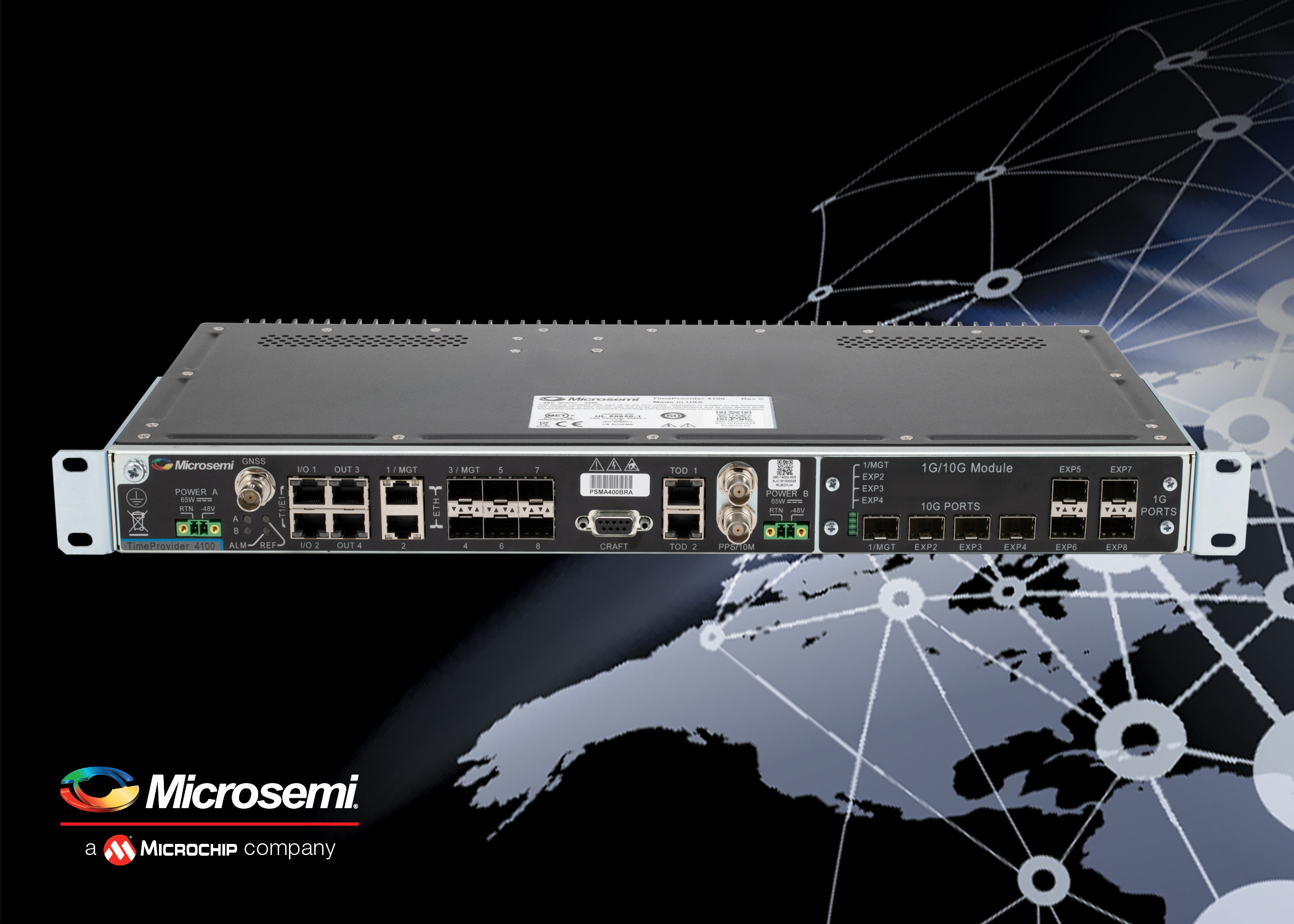
TimeProvider Release 2.0 adds 10 Gigabit Ethernet (GE) support, a Boundary Clock operating mode for cost savings, and other enhancements to improve how timing flows are distributed from multiple sources to network base stations and other endpoints.
SK TelecomTo provide world-class 5G services in the metropolitan area and Chungcheong Province, the company adopted the TimeProvider 4100 2.0 with a built-in 10 GE expansion module.
Extending the gateway clock operating mode of the TimeProvider 4100 2.0 to Microchip's High-Performance Boundary Clock (HP-BC) operating mode enables support for the latest high-accuracy ITU-T Class C and Class D boundary clock standards.
Because this standard requires accurate time transmission in optical networks, operators can utilize dense wavelength division multiplexing (DWDM) technology rather than dedicated fiber optic lines.
Release 2.0 addresses the increasing bandwidth requirements of next-generation network devices with an optional expansion module that provides 10 GE interfaces.
Extended monitoring capabilities enable service providers to understand how network elements impact time and phase performance.
PTP client capacity is expanded to 790, providing significant scalability for deployments on mobile network aggregation layers and new DOCSIS 3.1 Remote-PHY cable architectures.
For service providers who need to deploy the more compact PTP 1588 v2 Grandmaster closer to the network edge and in fewer base stations, Microchip has also introduced Release 3.0 to its Integrated GNSS Master (IGM) family.
IGM 3.0 combines an IEEE-1588v2 PTP grandmaster with a GNSS receiver and antenna to simplify indoor and outdoor installations.
These three IGM 3.0 add-ons each use improved oscillators and GNSS receivers to deliver accurate time and phase, as well as new features based on the IGM Plus hardware models.r />
A newly added oscillator option extends timekeeping holdover performance, while an enhanced receiver increases satellite signal acquisition speed and security by accessing more GNSS constellations simultaneously.
Receiver upgrade options support GPS, Galileo (Europe), QZSS (Japan), GLONASS, and Beidou. IGM 3.0 software provides IPv6 support for traffic and management flows, and PTP capacity has been increased to 60 clients.
TimeProvider 4100 Release 2.0 and IGM Release 3.0 are managed by TimePictra, a unified, centralized management platform for Microchip's family of precision timing systems.
Microchip's TimeProvider 4100 2.0 and IGM 3.0 1588v2 PTP Grandmasters are available now. The TimeProvider 4100 2.0 expansion module and three IGM Plus models (with enhanced features) can be ordered separately.
Customers with a valid annual maintenance and support contract can load and upgrade software options for TimeProvider 4100 2.0 onto their existing hardware models.
Microchip also offers a range of support services, including hardware and software repair, maintenance, updates and upgrades, along with the option to add new features through hardware modules and licensed software.
For more information, including pricing, contact your local Microchip sales representative or visit the Microchip subsidiary Microsemi website to find an Empower channel partner in your area. The above products are available through Microchip Empower channel partners.
“Microchip is committed to helping service providers navigate the increasingly challenging challenges of accurate time delivery and synchronization while migrating to new networks,” said Randy Brudzinski, vice president and general manager of Microchip’s frequency and time business unit. “We address these challenges with maximum flexibility and scalability.”
“Whether service providers need to distribute timing flows to endpoints with the TimeProvider 4100 Release 2.0 with Grandmaster, Gateway Clock and HP-BC operation modes, or synchronize devices at the network edge with the scalable and easy-to-deploy IGM Grandmaster, Microchip’s goal is to help them get the most out of their existing investments as they roll out 5G, IoT, DOCSIS 3.1 cable, video and other services,” he added.
Comments
Related news

Microchip Launches New Dual- and Single-Core dsPIC DSCs for High-End Embedded Control Application Design
System developers designing high-end embedded control applications require flexible options that provide scalability as project complexity increases. In response to these needs, Microchip Technology has introduced new dual-core and single-core dsPIC33C digital signal controller products with additional options to meet changing application requirements in terms of memory, temperature, and functional safety. The dsPIC33CH512MP508 dual-core DSC supports applications with larger program memory requirements, while the dsPIC33CK64MP105 single-core DSC offers a cost-optimized version targeting applications with smaller memory and footprint requirements. Developers can easily expand their product lines by leveraging these new devices, which offer pin-to-pin compatibility within the dsPIC33CH and dsPIC33CK product families.
2019.03.17by 이수민 기자

Microchip Identifies Four Key Growth Factors for Automotive Semiconductor Market and Announces Response Strategies
Microchip Technology held a press conference and presented its automotive solutions. Through continuous mergers and acquisitions, Microchip is expanding its influence in the semiconductor market. MicroSemi, which was acquired in March last year, played a major role in expanding Microchip's automotive business. Microchip was able to strengthen its portfolio in areas such as PCIe switches, inductive sensor interfaces, FPGAs, SiC diodes, MOSFETs, and SBDs. Last year, Microchip recorded revenue of 6 billion dollars, equivalent to approximately 7.092 trillion won. Among this, the automotive business accounted for 17% of total revenue. This is the second largest segment after the industrial business, which represents 27%.
2019.05.09by 이수민 기자

Public-private meeting held to discuss fostering 5G V2X, autonomous vehicles, and smart cities
Vice Minister Moon Won-gi of the Ministry of Science and ICT held a private-public consultation meeting on fostering measures for 5G V2X among the 10 core industries of the 5G+ strategy and autonomous vehicles and smart cities among the 5 core services. This consultation meeting was a follow-up measure to the 5G+ strategy announced on April 8th, and was prepared to strengthen private-public cooperation for securing technological and service competitiveness in the 5G V2X, autonomous vehicles, and smart cities sectors based on on-site opinions. The consultation meeting proceeded in the order of first presenting the progress of 5G+ strategy implementation and policies related to 5G V2X, autonomous vehicles, and smart cities, progress in 5G convergence services (autonomous driving, smart cities), and measures to activate 5G-based smart cities, followed by hearing field opinions and difficulties related thereto.
2019.05.22by 이수민 기자
European Patent Applications Surpass 200,000 for the First Time… South Korea Maintains 5th Place, Led by Batteries and Telecommunications
According to the European Patent Office (EPO)'s 'Technology Dashboard 2025', European patent applications last year reached 201,974, surpassing 200,000 for the first time. Korean companies and inventors filed 14,355 applications, representing a 9.5% increase from the previous year and maintaining 5th place by country. Battery, digital communication, and semiconductor technologies led the growth, with Samsung ranking as the top EPO applicant for the second consecutive year and LG reaching 3rd place. The presence of major domestic cities such as Seoul, Suwon, and Yongin was also confirmed. It was also revealed that Korea's European patent strategy is expanding beyond individual technologies to span the entire industry.
2026.03.24by 명세환 기자

SK Telecom First Applies AI-Based Network Operations at Gwanghwamun K-Pop Concert
SK Telecom announced that it applied an AI-based network operation system for the first time at a large-scale K-pop concert held in the Gwanghwamun area of Seoul on March 21st, managing communication quality throughout the event. Mobile data usage during the three hours before and after the concert reached 12.15TB, approximately doubling compared to the same time slot the previous weekend. SK Telecom monitored traffic using the AI system 'A-One' in five-minute and 50-meter units to respond to potential overload situations, while also operating temporary communication facilities and on-site personnel in parallel. This case is interpreted as confirmation of the practical applicability of AI-based autonomous network operation in an environment where demand from dense events and foreign users increases simultaneously.
2026.03.23by 명세환 기자











