



Reducing Hidden Costs When Designing Next-Generation Insulation Solutions
 Published2019.06.04 10:34
Demand for next-generation insulation solutions for stability is rising
EMC Certified, Solved with Isolated DC-DC Converters
Electronic device systems are becoming increasingly smaller and lighter. The electrification of automobiles is a prime example.
According to PwC, hybrid electric vehicles (HEVs) and pure electric vehicles (EVs) are expected to account for 40% of global car sales by 2024.
As the electrification of automobiles progresses rapidly, the need for insulation between various electronic devices and systems is also increasing.
This is especially true in terms of safety, as electric vehicles equipped with 400V DC battery stacks are becoming commonplace.
Increased demand for insulation in electronic devices
To provide next-generation insulation solutions, new challenges must be addressed.
Isolation requires a complex architecture and process, which reduces agility and flexibility and makes design changes difficult.
As global competition intensifies, Time to Market (TTM) and Return on Investment (ROI) have become increasingly important for companies. This also means that the development team must handle the tight schedule without making mistakes.
Design and development resources are limited, and there is a shortage of personnel with sufficient experience.
To maximize ROI, repetitive tasks must be minimized, and to break ahead in fierce competition, performance must be constantly improved to differentiate products.
To meet new regulations or requirements, additional application testing or certification must be passed.
The requirements are increasing and the risks are rising.
Understanding Insulated Design
In an insulated design, insulation is naturally essential, but designing it is not easy.
Many things must be considered, ranging from determining the required level of insulation to providing isolated power via isolated data paths and fitting the solution within a given space.
Each project must also meet its own unique design goals.
Only by examining various factors such as technical difficulties, similarity to previous designs, schedules, and available resources can one determine how much of the previous design can be reused and how much of the completely new design should be included.
Reusing previous designs or architectures with minimal changes can lower design risks and accelerate development speed.
However, in many cases, the need arises to review new techniques to introduce new features or improve performance.
In addition, to develop additional features for differentiation, new and improved technologies must be evaluated with limited development resources.
Limitations of the existing method
Many of these problems can be easily solved by using a compact and easy-to-use integrated isolated DC-DC converter that includes comprehensive documentation regarding safety certification.
For example, let's assume there is a new project that aims to upgrade the previous design to higher performance by adding new features.
The development team is eager to get to work immediately, but the project manager has more than a few things to worry about. This is because they have to develop increasingly complex designs under tighter budgets and tight schedules.
One of the things a project manager needs to pay attention to is the increasingly stringent electromagnetic compatibility (EMC) regulations. Emerging applications and markets must meet numerous EMC requirements, and as performance improves, these requirements are becoming increasingly stringent.
Existing discrete solutions, such as isolated flyback converters, have the advantage of lowering bill of materials (BOM) costs, but they also have disadvantages.
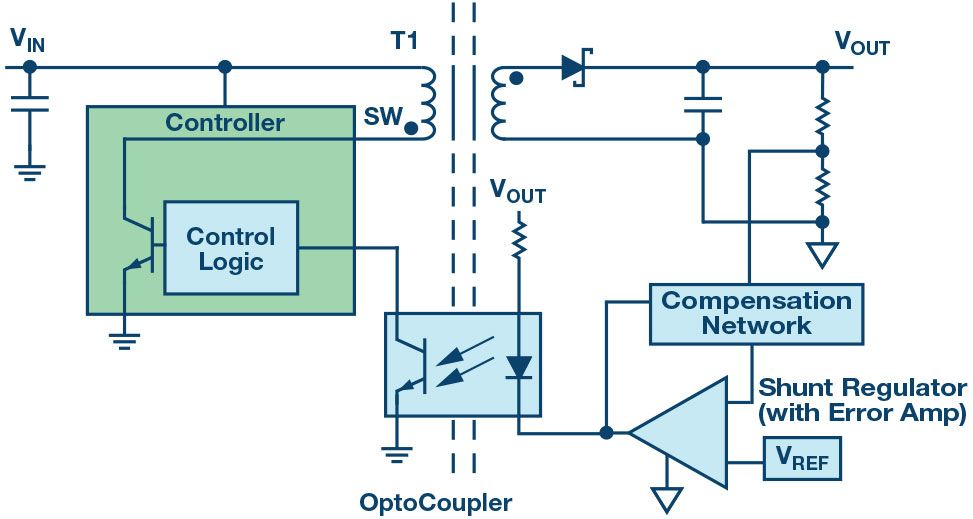
A typical flyback product consists of a controller to drive an isolation transformer, rectification and filtering on the secondary side, and an optical isolation feedback network.
Significant engineering work must be invested in the error amplifier to develop a correction network for stabilizing the voltage loop, and this is influenced by the performance of the optocoupler.
Optocouplers, which are considered inexpensive insulators for use in power supplies, have a variable current transfer ratio (CTR), which limits voltage feedback performance and the effective operating temperature range.
CTR is the ratio of input LED current to output transistor current, and it is non-linear and can vary significantly from unit to unit. Typically, optocouplers have an initial CTR ambiguity of 2:1. Then, when used in a high-temperature environment like a high-power, high-density power supply, the CTR can drop by up to 50% after several years.
Therefore, from the project manager's perspective, while the discrete flyback technique may seem advantageous in terms of cost, a trade-off must be considered between the required engineering work and technical risks.
Another difficulty when using discrete techniques is meeting safety regulations.
Since safety testing agencies scrutinize discrete designs more closely, it may be necessary to perform the required work multiple times to obtain the necessary certifications with a discrete design.
Complexity is added by power supply devices for insulation.
Even for non-isolated designs, input and output voltage ranges, maximum load current, noise and ripple, transient performance, and startup characteristics must be met.
However, since it is inherently difficult to monitor input and output conditions simultaneously with insulating walls, achieving the desired performance is somewhat more challenging.
In addition, each separated ground domain forms a bipolar antenna, and any common mode current transmitted through the insulating wall forms a magnetic field on both poles, which can generate unwanted radiated energy.
EMC Certification Test Procedure
To pass EMC certification with a discrete power design, it may be necessary to perform the work multiple times.
It takes a lot of time to prepare for and monitor tests conducted by external EMC compliance bodies.
If a problem occurs, you must return to the laboratory to make corrections and resolve the issue, perform a re-analysis of the characteristics with the modified results, and then take it to an EMC agency to undergo testing again.
The final step is obtaining safety certification. This test, conducted by an external safety agency, also requires time and cost.
The design team must prepare comprehensive documentation, and the relevant institution carefully reviews it.
Since new parts are inspected more thoroughly, it is advantageous to reuse previously certified circuits.
If the inspection agency determines that safety requirements are not met, the discrete isolated power supply design must be modified.
After that, you must perform a characteristic analysis again and undergo EMC testing again.
Improved solution
These concerns can be resolved by using integrated components that have obtained safety certifications and include comprehensive documentation regarding EMC performance. The ADuM5020/ADuM5028 isolated DC-DC converter products, featuring isoPower technology, are exactly such a solution.
These converter products provide up to 0.5W of isolated power with a 5V DC power supply and operate in the range of -40°C to 125°C.
It has also obtained various safety certifications at the system and component level, such as UL, CSA, and VDE. In addition, the simple 2-layer PCB meets the CISPR 22/EN 55022 Class-B radiation requirements under full load conditions.
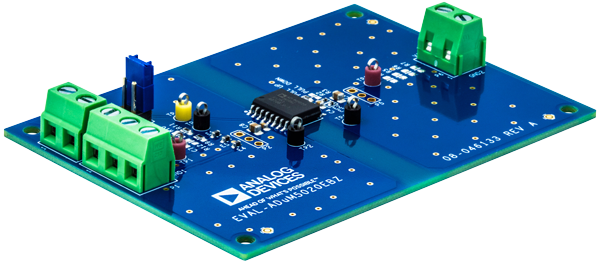
These products utilize small packages (16-pin and 8-pin wide SOIC) to occupy only a small PCB area and do not require the use of safety capacitance to meet radiation requirements.
Therefore, it is possible to design smaller and cheaper isolated power circuits compared to discrete techniques such as embedded stitching capacitors, which require four or more layers to achieve appropriate capacitance.
Meets insulation requirements without increasing complexity
As electrification progresses rapidly in automobiles and other fields, the demand for insulation is increasing.
Along with this, the pressure to lower costs and accelerate product launches to stay ahead in fierce competition is also intensifying.
In addition, regulatory body regulations are becoming increasingly strict, and the insulated design itself entails complexity.
It is difficult to meet these requirements with existing approaches to insulation.
These concerns can be resolved by using a highly integrated isolated DC-DC converter that has obtained safety certification and includes comprehensive documentation regarding EMC performance.r />
Using these products significantly reduces design complexity and makes it easier to pass EMC testing.
You do not have to waste time modifying the design, redoing characteristic analysis, and undergoing re-inspection, and you can save board space, reduce risk, lower costs, and shorten development time.
This article is a summary of "Avoiding the Hidden Costs of Isolation Design - How to Manage Project Risk with Next-Generation Solutions" by David Carr, Application Engineering Manager of the Interface and Isolation Group at Analog Devices.
Comments
Related news
Mouser Supplies Maxim 'MAX5995B' PMIC Compliant with IEEE Standards
Mouser Electronics supplies Maxim's PMIC MAX5995B. The MAX5995B features the interface required for PD and delivers performance compliant with IEEE 802.3af/at/bt standards in PoE devices. The MAX5995B provides PD with integrated isolated power switch performance equipped with detection signature, classification signature, and inrush current control functionality. It supports multiple event classification methods in accordance with IEEE 802.3bt standard and provides signaling that identifies PSE from Type 1 through Type 4.
2019.04.15by 이수민 기자
Institute for Basic Science Successfully Synthesizes 2D White Graphene "Path Opened to Commercialization of Rollable Displays"
The Feng Ding Group Leader team at the Institute for Basic Science's Multidimensional Carbon Materials Research Unit has developed key technology for commercializing low-power, high-performance rollable displays that roll up like newspapers, in collaboration with research teams from China and Switzerland. The research team has successfully manufactured single-crystal 2D white graphene, which previously had a manufacturing limit of just a few square millimeters, at a large area of up to 100 cm². This is a size that can be directly applied to semiconductor manufacturing processes. 2D white graphene is a 2D material with a thickness of 1-2 atomic layers in which boron and nitrogen atoms are arranged in a triangular form. Unlike graphene, it possesses insulating properties and can be applied as a 2D insulator. The Ministry of Science and ICT and the Institute for Basic Science announced that the research results were published online in Nature, the world's most prestigious academic journal, on May 23.
2019.05.23by 이수민 기자
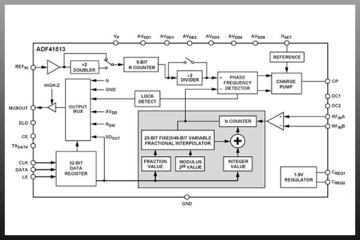
ADI Unveils Two New Products in May… Ultra-Low Noise Frequency Synthesizer ADF41513 and PMU ADP1031
ADI has unveiled two new products in May. The ADF41513 is an ultra-low noise frequency synthesizer that can be used to implement local oscillators at high frequencies up to 26.5GHz in the up-conversion and down-conversion regions of wireless receivers and transmitters. This product is suitable for applications such as test and measurement equipment, wireless infrastructure, microwave P2P, and multipoint RF. The ADP1031 is a high-performance isolated micro PMU that combines an isolated flyback DC/DC regulator, an inverting DC/DC regulator, and a buck DC/DC regulator to deliver three isolated power rails. Additionally, the ADP1031 includes four high-speed SPI isolated channels and three general-purpose isolators for channel-to-channel applications requiring low heat dissipation and compact solution size. Key applications include industrial automation, process control, instrumentation, data acquisition systems, and data and power isolation.
2019.05.27by 이수민 기자

Intel Unveils Next-Generation 'Core Ultra Series 3' and vPro Platform for Enterprise PCs
Intel has officially unveiled the "Intel Core Ultra Series 3" for next-generation enterprise PCs and the latest vPro platform, addressing a wide range of demands from enterprise notebooks to high-performance workstations.
2026.03.26by 배종인 기자

ROHM Launches ESD Protection Diode Compatible with High-Speed Interfaces of 10Gbps or Higher
Semiconductor specialist ROHM has developed the 'RESDxVx series' of ESD (electrostatic discharge) protection diodes capable of responding to next-generation high-speed data communication environments exceeding 10Gbps, simultaneously enhancing both signal quality maintenance required in high-speed interfaces and IC protection performance.
2026.03.26by 배종인 기자











