


Tektronix Strengthens Next-Generation Midrange Oscilloscope Portfolio with the Launch of the 3 Series MDO and 4 Series MSO
 Published2019.06.04 11:46
New product, 6 series MDO UI introduced
Using the TekVPI probe interface
On the 3rd, Tektronix launched the next-generation mid-range oscilloscopes, the '3 Series MDO' and '4 Series MSO'.
The two new products adopt the UI introduced in the '5 Series MSO' in 2017 and the '6 Series MSO' in 2018.
So, by placing the main controls close to the touchscreen and front panel, you can simply double-tap the readout or measurement displayed on the screen without having to dig through multiple menus to set it up.
Tektronix's latest portfolio offers a wide range of performance options and advanced measurement and analysis capabilities, along with a variety of application options.
The 4 Series MSO can convert from one analog channel to eight digital channels.
The 4 Series MSO uses a 13.3-inch display with 1920x1080 HD resolution. The bandwidth is up to 1.5 GHz and the 12-bit ADC vertical resolution is also high.
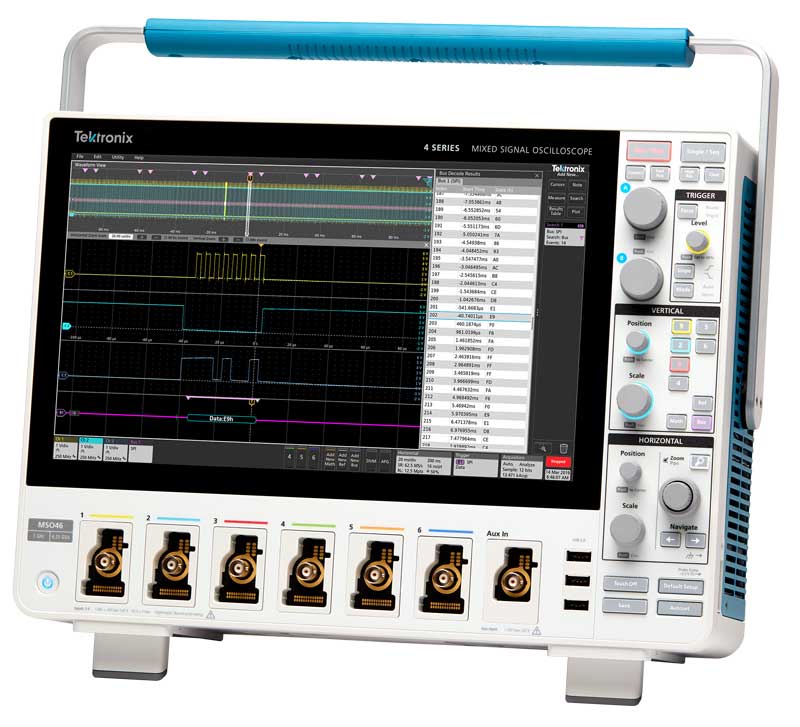
Tektronix 4 Series MSO
It supports up to 6 input channels, and by applying FlexChannel technology, the input channel can be converted from 1 analog channel to 8 digital channels by simply connecting the device to a logic probe.
To meet the broad needs of diverse applications, the 4 Series MSOs start at 200 MHz in bandwidth and support options such as serial decode and analysis, arbitrary/function generators, and DVM/frequency counters.
The new Spectrum View feature enables time-correlated frequency domain analysis with independent spectrum controls.
Power analysis packages that automate AC line, switching device, ripple, and sequence measurements are also available.
Both bandwidth and options are field upgradeable.
The sampling rate is the same for all models, both analog and digital, at 6.25 Gs/s. The standard record length is 31.25 Mpoints, with 62.5 Mpoints available as an option.
The 3 Series MDO offers a spectrum analyzer that rivals standalone analyzers.
The 3 Series MDO was developed with the goal of being a compact, multi-functional test instrument that would be found on any engineer's desk.
.jpg)
Tektronix 3 Series MDO
It boasts an 11.6-inch display with Full HD resolution, and offers the same intuitive user interface with a similar knob and button layout as other models, yet takes up no more than 6 inches of bench space.
The 3 Series MDO handles a wide range of debugging and verification tasks.
Built-in spectrum analyzer up to 3 GHz with separate RF input, performance is similar to that of a standalone analyzer.
These capabilities enable engineers to quickly debug wireless components in their designs and quickly trace sources of unwanted EMI emissions without using separate equipment.
Additionally, 16 digital input channels are available for mixed-signal analysis.
Extensive serial protocol debugging and triggering options, power measurement and AFG options set a new standard for versatility. DVM/Frequency Counter is provided free of charge when you register your product.
The bandwidth of the 3 Series MDO extends from a minimum of 100 MHz to a maximum of 1 GHz.
Analog sampling rates are available in two models: 2.5 GS/s or 5 GS/s, while digital channels support up to 8.25 GS/s with a timing resolution of 121.2 pc. The standard record length is 10 Mpoints. For investment protection, bandwidth and options are all upgradeable.
Probe, using the TekVPI probe interface
The distance from the front of the oscilloscope to the device under test is the most critical factor in identifying the problematic circuit.
The 3 Series MDO and 4 Series MSO use the TekVPI probe interface to connect to a wide range of Tektronix differential voltage probes, active voltage probes, current probes, and recently introduced power rail probes and optically isolated differential probes.
“We’ve had more than 100 meetings with engineers around the world to develop and test early prototypes of new features and designs,” said Chris Witt, vice president and general manager of the Time Domain Business Unit at Tektronix. “Our top priority is to build versatility and ease-of-use into our products so engineers can spend their time innovating and solving challenging development challenges, not learning how to use an oscilloscope.”
Comments
Related news
.jpg)
Teledyne LeCroy Launches 16-Bit Arbitrary Waveform Generator
Teledyne LeCroy has launched 16-bit arbitrary waveform generators. The T3AWG3252 (250MHz) and T3AWG3352 (350MHz) dual-channel arbitrary waveform generators offer maximum output voltage ranges of ±24V and 16-bit vertical voltage resolution. In addition to arbitrary waveform generation, Teledyne Test Tools (T3) provides function generator or digital pattern generator capabilities. These instruments can be used alongside Teledyne LeCroy's high-resolution 12-bit oscilloscopes in stress testing and response testing applications to specific signals in automotive, component/semiconductor testing, aerospace/defense, physics, research, and university laboratory environments.
2018.11.16by 이수민 기자
'One Serving That's Like Two' Keysight Launches High-Performance Entry-Level Oscilloscope
Keysight Technologies has announced a new 200 MHz, 4-channel Infiniium X-Series oscilloscope. The Infiniium 1000 X-Series oscilloscope provides professional-grade measurement and functionality at a reasonable price, including 4-wire SPI decode and remote connectivity via LAN. It uses the same user interface and measurement technology as the higher-end Keysight Infiniium oscilloscopes.
2019.02.12by 이수민 기자
Tektronix AFG31000 Redefines the Concept of Arbitrary Function Generators
Despite arbitrary function generators being widely utilized in electronic device testing and similar applications, their usability has lagged behind other test equipment due to limitations such as small display screens and other challenges in learning and operation. In response, Tektronix has introduced the AFG31000 series arbitrary function generator. The AFG31000 features an intuitive touchscreen and a new user interface. Additionally, equipped with multiple advanced measurement functions, it satisfies engineers and researchers who must address increasingly complex test scenarios for debugging, troubleshooting, analysis, and verification of target devices.
2019.04.15by 이수민 기자

Intel Unveils Next-Generation 'Core Ultra Series 3' and vPro Platform for Enterprise PCs
Intel has officially unveiled the "Intel Core Ultra Series 3" for next-generation enterprise PCs and the latest vPro platform, addressing a wide range of demands from enterprise notebooks to high-performance workstations.
2026.03.26by 배종인 기자

ROHM Launches ESD Protection Diode Compatible with High-Speed Interfaces of 10Gbps or Higher
Semiconductor specialist ROHM has developed the 'RESDxVx series' of ESD (electrostatic discharge) protection diodes capable of responding to next-generation high-speed data communication environments exceeding 10Gbps, simultaneously enhancing both signal quality maintenance required in high-speed interfaces and IC protection performance.
2026.03.26by 배종인 기자











