



Smart city spending in the Asia-Pacific region excluding Japan is expected to reach $35.4 billion by 2022.
 Published2019.06.06 07:01
Korea Creates Diverse IoT-Centric Citizen Experience Services
In its Global Smart City Spending Guide report, IDC Korea forecasts that spending on smart city initiatives in the Asia Pacific region (excluding Japan) will reach $35.4 billion by 2022, a 16.8% increase from the 2018 forecast. Furthermore, IDC projects that spending on smart city programs in Singapore, Beijing, Shanghai, and Seoul will exceed $4 billion this year.
“Prior to 2018, cloud solutions were a must-have for driving smart cities through digital transformation,” said Gerald Wang, head of public sector research at IDC Asia Pacific. “As governments shift their strategies from digitizing siloed, cloud-first transformation efforts to implementing integrated, cross-agency hubs, interconnected ecosystems such as transportation and public safety are increasingly required.”
He also said, “The intelligent edge will be the next stage in the development of mature smart cities,” adding, “As edge-based smart solutions acquire more powerful computing capabilities, cloud platforms can be utilized as grid computing architectures to coordinate and optimize different computing power across cities, facilitating automation within cities.”
By sector, hardware accounted for 40% of smart city spending in 2019, the largest category. Services, software, and connectivity followed. The spending sector with the highest five-year compound annual growth rate (CAGR) is services, which is expected to surpass hardware spending by 2022, reaching a CAGR of 17.9%.
Strategic priorities related to data-driven public safety, renewable energy and infrastructure, and intelligent transportation are expected to account for the largest portion of smart city services spending in 2019.
The top five strategic priorities driving smart city investment are fixed visual surveillance, improved public transportation, intelligent traffic management, non-revenue water (NRW) management, and smart outdoor lighting.
These use cases are projected to account for 40.7% of total investment in 2019. Connected offices and smart kiosks are also expected to see significant investment, as key use cases in economic development, citizen engagement, sustainable planning, and administration.
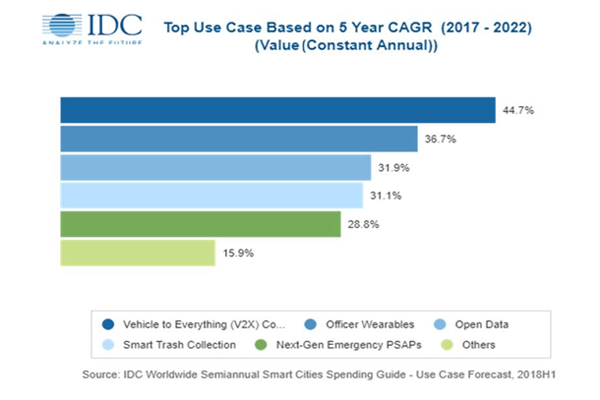
China is projected to account for the majority of smart city technology investment spending in the Asia-Pacific region. Most of this spending in 2019 is expected to come from fixed visual surveillance. This is because there is a growing demand for video information sources to track and monitor citizen activity.
A real-world example from the IDC report reveals that Singapore is building its own digital twin, and South Korea ranks among the countries with the highest IoT implementation rates. Other countries, such as China, India, Australia, and Indonesia, are also taking steps to adopt IoT. India is also expected to see increased demand for technology investment due to its growing urban population.
Kim Kyung-min, a senior researcher in charge of smart city research at IDC Korea, said, “Domestic smart cities are evolving from being network and hardware infrastructure-centered to service-centered, accelerating the adoption of various next-generation technologies such as IoT, AI, and blockchain.” He added, “In particular, as stable connectivity between various endpoints in the city is secured based on mature network infrastructure, an environment conducive to IoT adoption is being created, and various citizen-experience or administrative services centered on IoT are being created.”
He continued, "If collaboration between siloed organizations and the participation of private companies are added to this, domestic smart cities will develop into a more mature model and contribute to solving various social problems."
Comments
Related news

Public-private meeting held to discuss fostering 5G V2X, autonomous vehicles, and smart cities
Vice Minister Moon Won-gi of the Ministry of Science and ICT held a private-public consultation meeting on fostering measures for 5G V2X among the 10 core industries of the 5G+ strategy and autonomous vehicles and smart cities among the 5 core services. This consultation meeting was a follow-up measure to the 5G+ strategy announced on April 8th, and was prepared to strengthen private-public cooperation for securing technological and service competitiveness in the 5G V2X, autonomous vehicles, and smart cities sectors based on on-site opinions. The consultation meeting proceeded in the order of first presenting the progress of 5G+ strategy implementation and policies related to 5G V2X, autonomous vehicles, and smart cities, progress in 5G convergence services (autonomous driving, smart cities), and measures to activate 5G-based smart cities, followed by hearing field opinions and difficulties related thereto.
2019.05.22by 이수민 기자
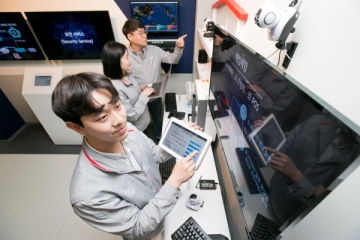
KT Strengthens IoT Terminal Security in the 5G Era with 'Fusion Security Verification Center'
In the hyper-connected 5G era, numerous IoT terminals including various sensors are connected to networks and operate for the implementation of smart homes, smart cities, and smart factories. In such network environments, IoT terminals are exposed to numerous security threats such as hacking and DDoS attacks, making terminal security itself increasingly important. To provide IoT terminals with pre-validated security in response to these security threats, KT opened a Convergence Security Demonstration Center at KT Gwacheon Tower. At the Convergence Security Demonstration Center, rigorous security validation can be performed at the design and pre-launch stages of wired and wireless IoT terminals, including products from small and medium-sized enterprises.
2019.05.25by 이수민 기자
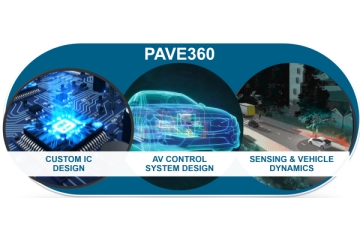
Siemens Announces PAVE360, New Validation Program to Lead the Popularization of IC Design and Development for Autonomous Vehicles
Siemens introduced PAVE360, a pre-silicon autonomous validation program designed to accelerate the development of autonomous vehicle platforms. PAVE360 provides a comprehensive collaborative environment that enables multiple suppliers to work together across the automotive industry ecosystem to develop next-generation automotive chips. PAVE360 extends beyond processors to enable digital twin simulation that spans automotive hardware and software subsystems, complete vehicle models, sensor data fusion, traffic flow, and ultimately smart city simulation in which autonomous vehicles will operate.
2019.05.29by 이수민 기자
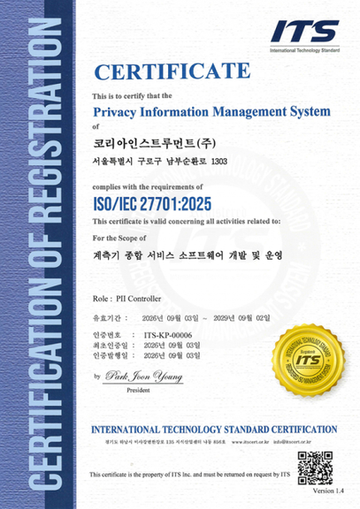
Korea Instrument, KOLAS Accredited Calibration Agency First to Simultaneously Acquire ISO/IEC 27,001·27,701
Korea Instrument has become the first among KOLAS accredited calibration agencies to simultaneously acquire ISO/IEC 27,001 and ISO/IEC 27,701 certifications. Through its proprietary platforms CWIZ Enterprise and CWIZ Partners, the company has embedded information security and personal data protection requirements across all business processes including customer information, equipment data, and calibration reports, with plans to continuously advance its management system through regular audits and security inspections.
2026.10.12by 배종인 기자

TeamViewer One, IT Incident Automation Workflow and Resolution Center Enhanced
TeamViewer has added IT incident automation capabilities and an advanced Resolution Center to its integrated digital workplace management platform 'TeamViewer ONE'. Recurrent service disruptions, configuration errors, and capacity shortages are automatically handled according to preset policies, and device status verification through script deployment can be managed in a unified interface, significantly reducing repetitive tasks for IT teams.
2026.10.12by 배종인 기자











