


AI device operating at the speed of light has been developed
 Published2019.06.08 07:01
Development of hardware-simulated AI neuromorphic chips is essential
Unit neuron computational function utilizing metamaterials
Successfully simulated and reproduced using optical signal processing
Domestic researchers have succeeded in designing a neuromorphic optical neuron device for AI implementation.
The Ministry of Science and ICT announced on the 4th that a research team led by Professor Park Nam-kyu, Dr. Sun Sun-kyu, and Dr. Park Hyun-hee of Seoul National University succeeded in mimicking the operation of neurons, the basic units of the brain, using the flow of light to implement high-speed computing AI.
Neurons in the human brain can be described as the unit processors of the nervous system, acting like transistors in electronic circuits. The brain's learning and memory abilities are realized through the interconnected signal processing functions of individual neurons via a complex neural network.
Deep learning-based AI technology is a software simulation of the brain's neural network through computer programs. To implement AI stably and efficiently, in addition to a software approach, it is essential to develop AI-dedicated neuromorphic chips that hardware-simulate the operation of neurons and the network itself.
Neuromorphic technology refers to a technology that simulates signal processing in biological nervous systems through hardware systems in fields such as semiconductors and optics.
As nano-processing in semiconductor electronic circuits has recently been miniaturized to the nanometer level, limitations in heat generation and speed are becoming fundamental constraints on the performance improvement of semiconductor devices, and this is expected to become an ultimate limiting factor in the implementation of neuromorphic semiconductor electronic circuits.
On the other hand, neuromorphic devices that perform computations using light rather than electrons are being researched at research institutions around the world, including MIT and Stanford University, because they enable low-power and ultra-high-speed operation without heat generation.
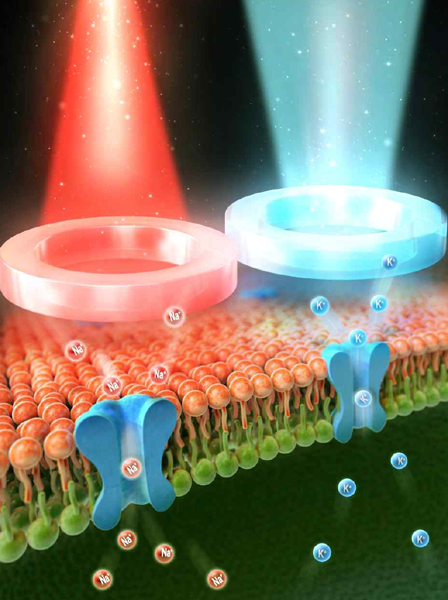
(Top) The principle of light-driven optical neurons
The research team utilized a metamaterial that adds nonlinearity controlling time symmetry to an amplification and loss material satisfying a peculiar physical symmetry called parity-time symmetry, We succeeded in simulating and reproducing the various computational functions of a unit neuron using optical signal processing.
Parity-time symmetry is a symmetry that describes a system that remains the same as the original system when simultaneously subjected to spatial inversion and temporal reversal. It is known that if this symmetry is satisfied, the overall energy state can remain stable even if there are energy gains or losses within the system.
Nonlinearity is a characteristic in which the input and output values are not in a proportional relationship. Light has linear characteristics according to Maxwell's equations, which determine the characteristics of electromagnetic waves, but it can have nonlinearity depending on the characteristics of the light propagation medium and the intensity of the light.
Metamaterials are materials designed to possess properties not found in nature through the arrangement of artificial media structures, and are applied in applications such as invisibility cloaks.
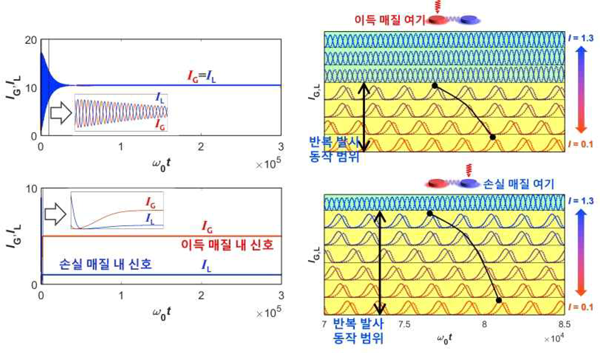
The research team developed a metamaterial with nonlinearity in which input and output values change depending on the intensity of light, and by correlating it with sodium and potassium channels similar to neurons in the brain, they succeeded in implementing neural signal processing in neuromorphic optical devices at the speed of light.
It was also theoretically confirmed that various functions required for neuromorphic and brain-mimicking memory devices, such as electrical signals maintaining stable strength without fluctuation despite external noise, can be implemented using the flow of light; this establishes the design concept for an ultra-high-speed neuron-mimicking optical device capable of operating at the speed of light for the first time in the world.
Professor Park Nam-kyu, who led the research, stated, “In this study, we applied a multidisciplinary approach to interpret the operating principles of biological structures through physical symmetry and design new optical devices using this.”
Furthermore, “By enabling the functions of neurons, the unit elements of neuromorphic circuits, to be driven using light as a signal carrier, it serves as a turning point in the development of ultra-high-speed neuromorphic devices and AI.” "Of course, each implemented function can also be applied to lasers with high stability," they stated.
Comments
Related news
Promoting collaboration between industry, academia, and research institutes to develop next-generation core technologies for system semiconductors and cultivate high-quality human resources.
The Ministry of Science and Technology and Communications will implement follow-up measures to the "System Semiconductor Vision and Strategy" announced jointly with the Ministry of Trade, Industry and Energy, including the development of novel semiconductor device fundamental technologies and integration/verification technologies, and the cultivation of advanced professionals in convergence-type system semiconductors. The Ministry plans to concentrate particularly on mid to long-term investment in human resources and technology to enable Korea to advance beyond its global top position in memory semiconductors to become a comprehensive semiconductor powerhouse, through developing novel device fundamental technologies, fostering advanced convergence-type system semiconductor professionals, supporting fabless companies through public nanofabs, establishing research hubs based on public-private collaboration, and strengthening the role of government research institutes' semiconductor research platforms.
2019.05.09by 이수민 기자
ETRI develops gallium oxide MOSFET capable of withstanding 2300V high voltage.
The Korea Electronics and Telecommunications Research Institute has developed a power semiconductor transistor capable of withstanding 2300V high voltage for the first time in the world using gallium oxide. While conventional power semiconductor devices were manufactured by designing devices on silicon, gallium nitride, or silicon carbide substrates followed by patterning, etching, and deposition processes to create transistors, this technology is differentiated by its use of gallium oxide instead of existing semiconductor materials. Gallium oxide has a wider energy band gap than conventional semiconductor materials, enabling it to maintain semiconductor properties even at high temperatures and voltages, making chip miniaturization and high efficiency possible. This technology is expected to be used in power conversion modules for electronic products requiring high voltage, electric vehicles, wind power generation, and locomotives, enabling it to function as a robust semiconductor capable of withstanding high voltage and power conditions.
2019.05.19by 이수민 기자
ETRI Develops Hologram 250 Times Sharper Than 8K
Hologram display primarily uses spatial light modulation technology based on liquid crystals. This method creates images by applying voltage to liquid crystals to change the phase of light. To enhance the image quality and viewing angle of hologram displays, the key is to reduce the pixel pitch in the liquid crystal devices. The Electronics and Telecommunications Research Institute announced on the 23rd that it has developed a new pixel structure technology that significantly reduces both pixel size and pixel pitch to the micrometer level, enabling a 30-degree viewing angle and substantially improved image quality. With this technology, it is expected that panel development implementing 72K resolution using the world's smallest 1㎛ pixel pitch device will become possible.
2019.05.26by 이수민 기자

[e4ds Tech Day 2026 ⑨] Sim Sang-gyu, Autocrypt CTO: "In the Physical AI Era, Automotive Security Must Extend Beyond the Vehicle"
At e4ds Tech Day 2026, Sim Sang-gyu, CTO of Autocrypt, explained automotive cybersecurity strategies in the era of Physical AI and SDV (Software-Defined Vehicle). Automobiles are evolving as part of an ecosystem connected to AI, cloud, chargers, IoT, and robots, and he emphasized that the scope of security must expand beyond the vehicle interior to the entire connected environment. In particular, AI model tampering, adversarial attacks, OTA updates, and EV charger hacking were identified as major threats. He explained that response measures require zero trust, AI model integrity protection, intrusion detection, Security by Design and Default, and full lifecycle security management, and that proactive security system establishment beyond regulatory compliance is critical for securing future mobility competitiveness.
2026.10.12by 배종인 기자

NVIDIA to Invest $1 Billion in U.S. Science Over Next Five Years
NVIDIA has announced plans to invest $1 billion over the next five years to strengthen U.S. scientific and technological competitiveness. The company will enhance cutting-edge artificial intelligence research and development capabilities in key areas including quantum computing, healthcare, and energy security, while expanding support for higher education research institutions and cloud service providers. NVIDIA is participating as a major industry partner in the White House Office of Science and Technology Policy's Genesis Mission, and is promoting supercomputer construction in collaboration with national laboratories including Argonne and Los Alamos.
2026.10.12by 배종인 기자











