


Domestic quantum cryptography technology is on the verge of adoption as an ITU international standard.
 Published2019.07.01 12:29
| Preliminary approval as international standard ITU-T Y.3800
SK Telecom Develops Quantum Cryptography Switching Technology
Quantum cryptography technology is a next-generation communication security technology that makes wiretapping and eavesdropping impossible.
Quantum cryptography technology is also called 'quantum key distribution technology', which safely distributes an encryption key, or a one-time random number table, between a sender and a receiver in real time based on the laws of quantum mechanics, such as the impossibility of quantum cloning.
Recently, the three major domestic mobile carriers have shown a clear trend toward developing quantum cryptography technology.
The three major mobile carriers recently ushered in the 5G era. While 5G boasts ultra-high speeds, ultra-low latency, and hyper-connectivity, its structure, which processes data even at the base station level, presents security vulnerabilities. This problem will become more serious with 6G, which will be released within 10 years.
Accordingly, the three mobile carriers appear to have chosen quantum cryptography as a security measure.
Domestic quantum cryptography technology receives preliminary approval as an ITU international standard.
KT and LG Uplus announced on the 1st that one recommendation for a cryptographic communication network framework was tentatively approved as an international standard (ITU-T Y.3800) at the International Telecommunication Union Telecommunication Standardization Sector Study Group (ITU-T SG13) international conference held in Geneva, Switzerland from June 17th to 28th.
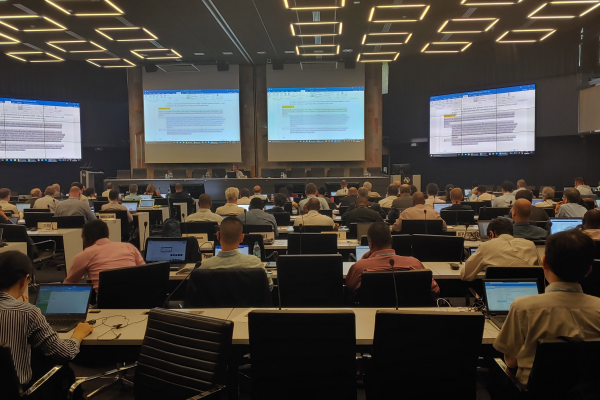
This is the world's first standard adopted in the field of quantum cryptography communication within the ITU, and it is expected to be circulated among member countries and ultimately adopted if there are no objections.
This standardization is the result of seven domestic organizations and approximately 20 member companies around the world actively participating in standardization activities following the proposal and development by KT, LG U+, the Korea Institute of Science and Technology (KIST), and the Electronics and Telecommunications Research Institute (ETRI).
The approved standard defines the layer model and functional components required to configure a quantum cryptography communication network, and is significant in that it sets a new standardization standard by considering all areas from the perspectives of operators and manufacturers in the still controversial field of quantum cryptography communication.
Through this standard development, we have confirmed the patent aspect and resolved the technological monopoly, thereby shifting the leadership in international standardization in the field of quantum cryptography from existing foreign equipment manufacturers to telecommunication service providers, thereby leading the market.
/> Accordingly, it is expected that domestic companies will be able to secure a technological advantage in competition with large overseas companies in the quantum cryptography communication market and also expand into overseas markets.
Future ITU standardizations will be based on this framework, with the ITU-T Y.QKDN_Arch (detailed structure), ITU-T Y.QKDN_KM (key management), ITU-T Y.QKDN_CM (network management/control), and ITU-T Y.QKDN_SDNC (SDN controller) tasks scheduled to be standardized by September 2021.
At this ITU-T SG13 meeting, a new standardization project (Y.QKDN_CM: Quantum Cryptography Communication Control and Management) jointly proposed by KT and ETRI was also approved.
Based on the quantum cryptography communication network configuration technology stipulated in Y.3800, a new standard is expected to be developed to ensure the stable supply and high-quality operation and management of quantum cryptography services.
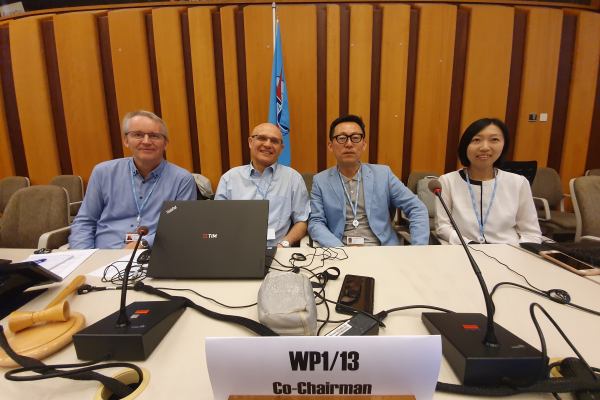
ITU Working Party Chairs
KAIST Professor Choi Jun-gyun said, “This is a significant achievement in that Korea has taken the lead in standardizing quantum cryptography technology, so that the AI-based intelligent cyber society that will emerge in the future can move toward a safe and trustworthy cyber ecosystem.”
KT Convergence Technology Research Center Vice President Jeon Hong-beom said, “KT has been pushing for the reflection of domestic technology in international standards to achieve the world’s first ITU standard approval for this quantum cryptography communication network technology,” adding, “It will be one of the future technologies.”“We will continue to work to develop quantum cryptography network technology, a new security platform,” he said.
LG Uplus NW Development Group Leader Park Song-cheol said, “LG Uplus has presented a new network model for quantum information communication in collaboration with businesses, industries, and research institutes. We will continue to strive to secure a win-win ecosystem to provide better services to our customers.”
SK Telecom Completes Development of Quantum Cryptography Switching Technology
On June 28, SK Telecom, along with ID Quantique (IDQ), a quantum information and communication specialist, and the Institute for Information and Communications Technology Planning and Evaluation (IITP), completed the national quantum cryptography test network project, “Development of key elements for reliability verification technology and advanced distribution of quantum cryptography networks.”
Through this project, SK Telecom developed a quantum cryptography key "switching" technology. Switching technology transfers quantum cryptography keys in the opposite direction when a network failure occurs.
We have also successfully applied the quantum cryptography key 'routing' function to equipment connecting multiple networks. Routing is a function that sets one of several paths, and you can freely set the path through which the quantum cryptography key is transmitted.
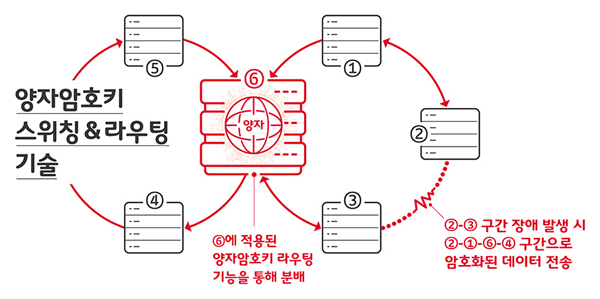
Quantum cryptography key switching and routing technology developed by SK Telecom
SK Telecom completed the application of quantum cryptography technology to its 362km-long, figure-of-eight test network this year. This technological development suggests that quantum cryptography can be applied to networks of all structures.
In addition, SK Telecom passed the technical contents to be reflected in the standard, such as ▲ matters to consider in terms of encryption key request and transmission reliability when connecting quantum cryptography networks and existing communication networks ▲ contents related to automatic operation when quantum cryptography equipment is restarted, in the 'Quantum Cryptography Communication Network Framework', which is undergoing international standardization work at ITU-T SG13.
Park Jin-hyo, head of SK Telecom's ICT Technology Center, said, "SK Telecom is working with global operators and vendors such as IDQ, Telefónica, BT, and Toshiba to create a global quantum cryptography ecosystem," and added, "We will continue to participate in the global standardization of quantum cryptography centered around the ITU-T to increase the completeness of the standards."
What is the future of quantum cryptography technology in Korea?
The importance of communication network security is growing day by day in terms of protecting national, corporate, and financial confidential information and protecting individual privacy.
Quantum information processing and quantum information communication technologies, which began to be studied in earnest in the mid-1980s, can perform various tasks previously thought impossible with existing technologies by directly expressing and processing information in quantum states.
Among quantum information and communication technologies, quantum cryptography is the most fundamental and technologically mature. Currently, active research is being conducted globally, primarily in major countries like the US, Europe, and Japan. Now, we can look forward to the activities of Korean institutions and companies as well.
Comments
Related news
SK Telecom Protects 5G Network with Quantum Cryptography
SK Telecom announced that it will establish a secure 5G infrastructure by introducing quantum key distribution (QKD) technology to its 5G communication network. Quantum key distribution is a communication technology that prevents eavesdropping by utilizing quantum properties to generate encryption keys that only the sender and receiver can decrypt. Starting this month, SK Telecom has applied IDQ's quantum random number generator to its 5G subscriber authentication server. The quantum random number generator is a device that uses quantum properties to generate random numbers that are inherently immune to pattern analysis, thereby completely blocking the risk of hacking through communication networks. Additionally, in April, SK Telecom will integrate IDQ's quantum key distribution technology on the Seoul-Daejeon section, a critical transmission segment for national data traffic, to strengthen security for 5G and LTE data transmission and reception.
2019.03.20by 이수민 기자
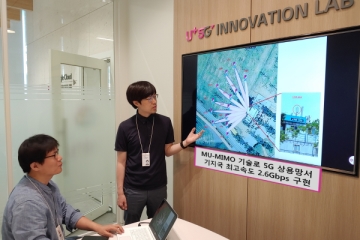
LG U+ Achieves Highest Speeds at 5G Base Stations with MU-MIMO
LG U+ has implemented MU-MIMO, a core 5G technology, in its commercial 5G network to achieve maximum base station speeds. LG U+ measured simultaneous connection speeds using 13 or more 5G terminals in Yeouido, Seoul, and achieved AAU speeds of 2.6 Gbps or higher. MU-MIMO is one of the core 5G technologies that prevents speed degradation even when multiple terminals are simultaneously connected. Through beamforming, radio waves are shaped and transmitted as desired to their target locations, thereby reducing radio interference and improving perceived customer speeds while increasing AAU data processing capacity. By utilizing multiple antenna elements, channel capacity can be increased several times over without separately boosting output power, which enhances AAU capacity and increases the number of terminals accommodated within base station coverage as well as perceived speeds.
2019.06.10by 이수민 기자
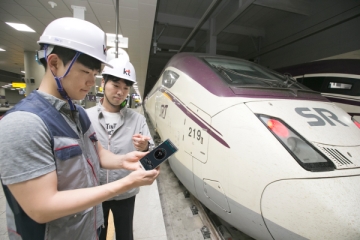
KT to Significantly Expand 5G In-Building Coverage to 1,000 Locations
KT announced that it will launch 5G services in large buildings such as major KTX stations and Gimpo Airport that are frequented by many customers. Since February 2018, KT has been preparing 5G in-building repeater equipment with domestic small and medium-sized partner companies, and completed the development for the first time in the country last January after approximately 10 months. Subsequently, KT will begin full-scale equipment deployment after undergoing thorough quality verification processes with small and medium-sized partners and major equipment developers. In-building services require equipment installation in complex building interiors with limited space, so infrastructure construction is generally carried out jointly through consultation among the three telecommunications carriers. To date, 119 in-building locations have been confirmed for joint construction by the three carriers and are currently under development, with KT overseeing 95 of these, which represents 80%.
2019.06.24by 이수민 기자
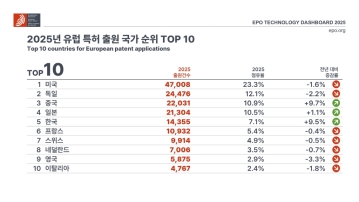
European Patent Applications Surpass 200,000 for the First Time… South Korea Maintains 5th Place, Led by Batteries and Telecommunications
According to the European Patent Office (EPO)'s 'Technology Dashboard 2025', European patent applications last year reached 201,974, surpassing 200,000 for the first time. Korean companies and inventors filed 14,355 applications, representing a 9.5% increase from the previous year and maintaining 5th place by country. Battery, digital communication, and semiconductor technologies led the growth, with Samsung ranking as the top EPO applicant for the second consecutive year and LG reaching 3rd place. The presence of major domestic cities such as Seoul, Suwon, and Yongin was also confirmed. It was also revealed that Korea's European patent strategy is expanding beyond individual technologies to span the entire industry.
2026.03.24by 명세환 기자

SK Telecom First Applies AI-Based Network Operations at Gwanghwamun K-Pop Concert
SK Telecom announced that it applied an AI-based network operation system for the first time at a large-scale K-pop concert held in the Gwanghwamun area of Seoul on March 21st, managing communication quality throughout the event. Mobile data usage during the three hours before and after the concert reached 12.15TB, approximately doubling compared to the same time slot the previous weekend. SK Telecom monitored traffic using the AI system 'A-One' in five-minute and 50-meter units to respond to potential overload situations, while also operating temporary communication facilities and on-site personnel in parallel. This case is interpreted as confirmation of the practical applicability of AI-based autonomous network operation in an environment where demand from dense events and foreign users increases simultaneously.
2026.03.23by 명세환 기자











