This page was machine-translated and may differ from the original. View original
The autonomous vehicle market is expected to reach $1.12 trillion by 2035.
ADAS sensor sales are expected to reach $16.8 billion in 2023.
- 0% domestic production rate of sensor components for autonomous vehicle development
At the Sangam Autonomous Driving Festival held in Sangam-dong last June, a 5G autonomous driving bus carrying Minister of Land, Infrastructure and Transport Kim Hyun-mee, Seoul Mayor Park Won-soon, and Seoul citizens crossed the center line and set off a road control rubber cone just 10 minutes into operation, creating a terrifying moment. An SK Telecom representative for the vehicle that drove that day stated, "The GPS signal was momentarily weak, which caused the problem," adding that there were no issues in the 13 other trips.
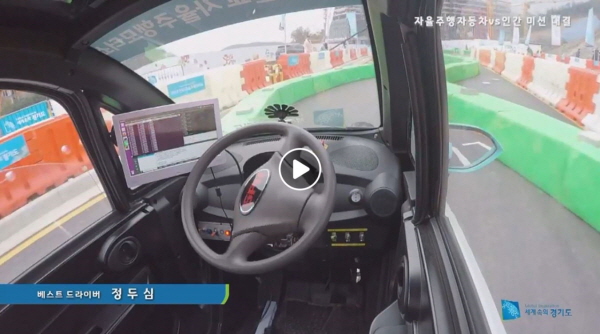
At the 2017 Pangyo Motor Show, a vehicle collides with the left guard during a driving competition.
In 2017, the first Pangyo Autonomous Driving Motor Show took place in Pangyo, Gyeonggi Province. A similar situation occurred during the "Human vs. Autonomous Driving Competition" held that day. The car failed to follow the designated course and crashed into a safety guard. An industry insider who developed the autonomous vehicle explained that the GPS was not functioning properly due to weather conditions, and the vehicle's lidar scan of the ramp identified it as a wall.
- Core components of autonomous vehicles
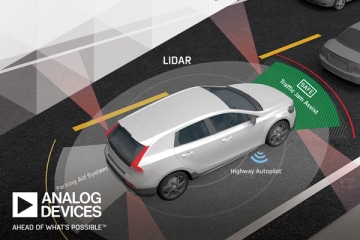
Autonomous driving largely consists of three stages: perception, judgment, and control. Among them, perception technology is key and essential to all autonomous driving. Cognitive technology also consists of automotive sensors for recognizing the external environment, HD Maps, a precision map that secures a margin of error of within 1 cm, GPS for positioning while the vehicle is moving, and V2X communications for vehicle-to-vehicle communication. Among these, the core sensors of autonomous vehicles are arguably cameras, radar, and lidar.
Looking at it this way, the driving error in Sangam-dong last June was due to an error in GPS, which is a core cognitive technology, and the Pangyo Autonomous Driving Motor Show held in 2017 can be seen as an error in GPS and LiDAR, so it is difficult to deny that the technology is somewhat lacking when calling it the world's first future transportation "5G convergence autonomous driving car."
- Localization rate of parts
The current commercialization level of autonomous vehicles in Korea is currently Level 2. This means Level 3 autonomous vehicles are currently under development. Considering the error at the Sangam Autonomous Driving Festival, which occurred during development, this level of technology represents significant advancement. However, the fact that most of the recognition sensors currently being developed are imported, resulting in a near-zero domestic production rate, provides a glimpse into the technological advancement of domestic autonomous vehicles.
Japan's decision to completely halt exports of three key raw materials essential to Korean semiconductor companies has left both Korean companies and the government on edge. While the Deputy Prime Minister for Economic Affairs has stated that he has already considered this scenario and made extensive preparations, the fact that a company CEO is rushing to Japan suggests the situation is not one to be taken lightly.
In 2015, M-City, an autonomous driving experimental city in the United States, was created, and soon after, a 5G mobile communications convergence urban autonomous driving test bed was created in Korea. Although it appears to be following global technological trends, no one can guarantee that unless domestic production of core components is achieved, a situation similar to the current ban on exports of semiconductor raw materials, resulting in a decline in industrial competitiveness, will not arise.
The Society of Automotive Engineers (SAE) predicts that fully autonomous vehicles, Level 5, will be completed by 2035. Currently, the number of sensors used in domestic Level 2 vehicles is approximately 17, and the number of sensors in autonomous vehicles that reach Level 5 is approximately 28 to 32. According to Strategy Analytics, an analysis firm, “The market size of ADAS (Advanced Driver Assistance Systems) is expected to reach $43.8 billion in 2023, and sales of sensors for ADAS in the same year will reach $16.8 billion.”
- Status of autonomous vehicle development
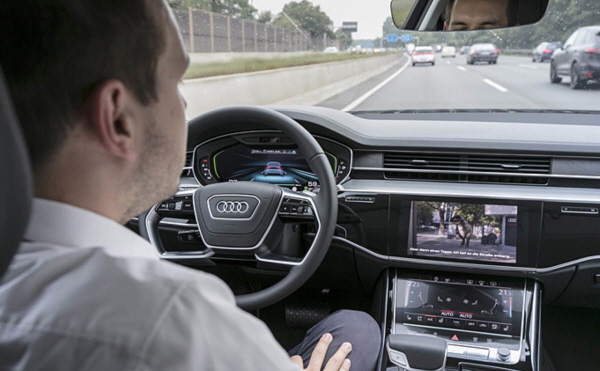
Last June, Audi introduced the Audi 5th generation A8 flagship model along with a Level 3 autonomous driving model at the Busan Motor Show. The Audi AI Traffic Jam Pilot technology, the central driver assistance system (zFAS), and the laser scanner are designed to allow the vehicle to control starting, acceleration, steering, and braking when driving at a slow speed of 60 km/h or less.

Audi's fifth-generation A8 flagship model with Level 3
However, this model is still restricted from operation in Korea as it does not fall under the scope of domestic autonomous vehicle operation-related laws.
Waymo, the autonomous vehicle division of Google's parent company Alphabet, launched the world's first commercial self-driving car service in Phoenix, Arizona, on December 5th of last year. Waymo, which developed and owns its own LiDAR sensor, boasts a 95-degree vertical field of view and a 360-degree horizontal field of view, enabling it to obtain the information necessary for autonomous vehicle operation with a single sensor. Furthermore, by emitting different pulses of light, it can detect the location and shape of other objects.
.jpg)
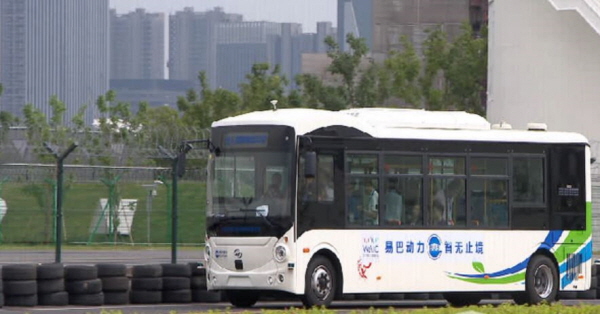
In Suzhou, China, road tests of an 8-meter-long mass-produced driverless autonomous bus developed and manufactured by Suzhou Higer Bus began last year. In addition to the cognitive sensors required for existing autonomous driving, facial recognition AI technology for passengers will be integrated, enabling ticketless boarding. Furthermore, along with the construction of a dedicated highway for autonomous vehicles, the world's first city dedicated to autonomous vehicles will be created, slated for completion by 2035.
China's "Suzhou Haiger" autonomous driving bus
In Korea, the K-City testbed and Cooperative Intelligent Transport Systems (C-ITS) smart road system are under construction, aiming for the commercialization of Level 3 vehicles by 2020. Furthermore, the government aims to develop a real-world HD map, a road map that will integrate GPS and 5G, by 2022. Furthermore, the government is pursuing the development and commercialization of precision GPS technology to ensure an accuracy of less than 1 meter.
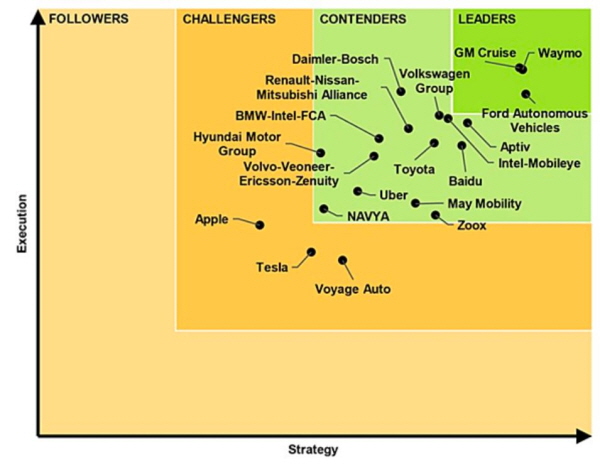
Among domestically produced vehicles, Hyundai Motor Company unveiled and tested the "Ioniq Self-Driving Vehicle," which meets SAE Level 4 safety standards, at the 2016 LA Auto Show. However, according to Navigant Research, a US technology research firm, Hyundai Motor Company's autonomous driving commercialization ranking fell outside the top 10, with Google's Waymo in first place, GM Cruise in second, and Ford Autonomous Vehicles in third. Hyundai Motors remained in 15th place this year. 
Navigant Research's autonomous driving commercialization ranking.
Hyundai remains in the Contenders segment.
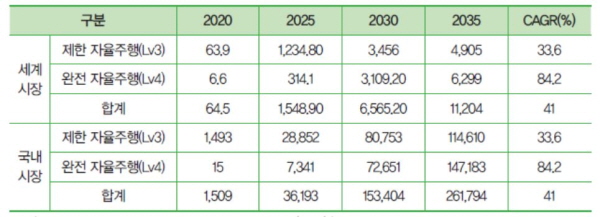
Much time has passed since the era of autonomous vehicles was first discussed. With the advent of 5G, the ultra-high-speed communication technology required to achieve Level 5, a dedicated 5G-integrated autonomous driving test site has been established. HDMap, a high-precision map capable of controlling autonomous vehicles with an error margin of less than 1 cm, is expected to be completed by 2022. With the new administration in place, the legal framework for autonomous vehicles is also rapidly changing. According to SPRi, a domestic software policy research institute, "The autonomous vehicle market is projected to reach $6.4 billion in 2020 and grow by 41% annually, reaching $1.12 trillion by 2035."
Domestic and international autonomous vehicle market outlook (unit: billion dollars, billion won)
The domestic and international economy is struggling, and there are no new growth engines. The semiconductor market is at rock bottom, and domestic and international conditions are challenging. They say you can't chew with your gums if you don't have teeth, but sometimes it's hard to even think about whether you have gums. Witnessing Japan's economic retaliation, we need to reexamine what technologies and values we need to proactively develop and fundamentally possess in autonomous vehicles.
ADAS sensor sales are expected to reach $16.8 billion in 2023.
- 0% domestic production rate of sensor components for autonomous vehicle development
At the Sangam Autonomous Driving Festival held in Sangam-dong last June, a 5G autonomous driving bus carrying Minister of Land, Infrastructure and Transport Kim Hyun-mee, Seoul Mayor Park Won-soon, and Seoul citizens crossed the center line and set off a road control rubber cone just 10 minutes into operation, creating a terrifying moment. An SK Telecom representative for the vehicle that drove that day stated, "The GPS signal was momentarily weak, which caused the problem," adding that there were no issues in the 13 other trips.
At the 2017 Pangyo Motor Show, a vehicle collides with the left guard during a driving competition.
In 2017, the first Pangyo Autonomous Driving Motor Show took place in Pangyo, Gyeonggi Province. A similar situation occurred during the "Human vs. Autonomous Driving Competition" held that day. The car failed to follow the designated course and crashed into a safety guard. An industry insider who developed the autonomous vehicle explained that the GPS was not functioning properly due to weather conditions, and the vehicle's lidar scan of the ramp identified it as a wall.
- Core components of autonomous vehicles
Autonomous driving largely consists of three stages: perception, judgment, and control. Among them, perception technology is key and essential to all autonomous driving. Cognitive technology also consists of automotive sensors for recognizing the external environment, HD Maps, a precision map that secures a margin of error of within 1 cm, GPS for positioning while the vehicle is moving, and V2X communications for vehicle-to-vehicle communication. Among these, the core sensors of autonomous vehicles are arguably cameras, radar, and lidar.
Looking at it this way, the driving error in Sangam-dong last June was due to an error in GPS, which is a core cognitive technology, and the Pangyo Autonomous Driving Motor Show held in 2017 can be seen as an error in GPS and LiDAR, so it is difficult to deny that the technology is somewhat lacking when calling it the world's first future transportation "5G convergence autonomous driving car."
- Localization rate of parts
The current commercialization level of autonomous vehicles in Korea is currently Level 2. This means Level 3 autonomous vehicles are currently under development. Considering the error at the Sangam Autonomous Driving Festival, which occurred during development, this level of technology represents significant advancement. However, the fact that most of the recognition sensors currently being developed are imported, resulting in a near-zero domestic production rate, provides a glimpse into the technological advancement of domestic autonomous vehicles.
Japan's decision to completely halt exports of three key raw materials essential to Korean semiconductor companies has left both Korean companies and the government on edge. While the Deputy Prime Minister for Economic Affairs has stated that he has already considered this scenario and made extensive preparations, the fact that a company CEO is rushing to Japan suggests the situation is not one to be taken lightly.
In 2015, M-City, an autonomous driving experimental city in the United States, was created, and soon after, a 5G mobile communications convergence urban autonomous driving test bed was created in Korea. Although it appears to be following global technological trends, no one can guarantee that unless domestic production of core components is achieved, a situation similar to the current ban on exports of semiconductor raw materials, resulting in a decline in industrial competitiveness, will not arise.
The Society of Automotive Engineers (SAE) predicts that fully autonomous vehicles, Level 5, will be completed by 2035. Currently, the number of sensors used in domestic Level 2 vehicles is approximately 17, and the number of sensors in autonomous vehicles that reach Level 5 is approximately 28 to 32. According to Strategy Analytics, an analysis firm, “The market size of ADAS (Advanced Driver Assistance Systems) is expected to reach $43.8 billion in 2023, and sales of sensors for ADAS in the same year will reach $16.8 billion.”
- Status of autonomous vehicle development
Last June, Audi introduced the Audi 5th generation A8 flagship model along with a Level 3 autonomous driving model at the Busan Motor Show. The Audi AI Traffic Jam Pilot technology, the central driver assistance system (zFAS), and the laser scanner are designed to allow the vehicle to control starting, acceleration, steering, and braking when driving at a slow speed of 60 km/h or less.
Audi's fifth-generation A8 flagship model with Level 3
However, this model is still restricted from operation in Korea as it does not fall under the scope of domestic autonomous vehicle operation-related laws.
Waymo, the autonomous vehicle division of Google's parent company Alphabet, launched the world's first commercial self-driving car service in Phoenix, Arizona, on December 5th of last year. Waymo, which developed and owns its own LiDAR sensor, boasts a 95-degree vertical field of view and a 360-degree horizontal field of view, enabling it to obtain the information necessary for autonomous vehicle operation with a single sensor. Furthermore, by emitting different pulses of light, it can detect the location and shape of other objects.
.jpg)
Waymo's self-driving taxis in the US
In Suzhou, China, road tests of an 8-meter-long mass-produced driverless autonomous bus developed and manufactured by Suzhou Higer Bus began last year. In addition to the cognitive sensors required for existing autonomous driving, facial recognition AI technology for passengers will be integrated, enabling ticketless boarding. Furthermore, along with the construction of a dedicated highway for autonomous vehicles, the world's first city dedicated to autonomous vehicles will be created, slated for completion by 2035.
China's "Suzhou Haiger" autonomous driving bus
In Korea, the K-City testbed and Cooperative Intelligent Transport Systems (C-ITS) smart road system are under construction, aiming for the commercialization of Level 3 vehicles by 2020. Furthermore, the government aims to develop a real-world HD map, a road map that will integrate GPS and 5G, by 2022. Furthermore, the government is pursuing the development and commercialization of precision GPS technology to ensure an accuracy of less than 1 meter.
Among domestically produced vehicles, Hyundai Motor Company unveiled and tested the "Ioniq Self-Driving Vehicle," which meets SAE Level 4 safety standards, at the 2016 LA Auto Show. However, according to Navigant Research, a US technology research firm, Hyundai Motor Company's autonomous driving commercialization ranking fell outside the top 10, with Google's Waymo in first place, GM Cruise in second, and Ford Autonomous Vehicles in third. Hyundai Motors remained in 15th place this year.
Navigant Research's autonomous driving commercialization ranking.
Hyundai remains in the Contenders segment.
Much time has passed since the era of autonomous vehicles was first discussed. With the advent of 5G, the ultra-high-speed communication technology required to achieve Level 5, a dedicated 5G-integrated autonomous driving test site has been established. HDMap, a high-precision map capable of controlling autonomous vehicles with an error margin of less than 1 cm, is expected to be completed by 2022. With the new administration in place, the legal framework for autonomous vehicles is also rapidly changing. According to SPRi, a domestic software policy research institute, "The autonomous vehicle market is projected to reach $6.4 billion in 2020 and grow by 41% annually, reaching $1.12 trillion by 2035."
Domestic and international autonomous vehicle market outlook (unit: billion dollars, billion won)
The domestic and international economy is struggling, and there are no new growth engines. The semiconductor market is at rock bottom, and domestic and international conditions are challenging. They say you can't chew with your gums if you don't have teeth, but sometimes it's hard to even think about whether you have gums. Witnessing Japan's economic retaliation, we need to reexamine what technologies and values we need to proactively develop and fundamentally possess in autonomous vehicles.
본 기사에 대한 정정·반론·추후보도 청구는 보도 청구 안내를, 그간 게재된 보도문은 정정·반론보도 모아보기를 참고해 주세요.


도움이 됩니다.