



Global IT spending in 2019 will increase compared to 2018 despite the recession.
 Published2019.07.11 09:01
Economic uncertainty remains high, but spending remains robust.
Cloud plays a big role in extending the lifespan of consumer devices.
Gartner has released its latest forecast for global IT spending in 2019.

According to Gartner, global IT spending is expected to total $3.74 trillion in 2019, a 0.6% increase from 2018. This figure is slightly lower than the previous quarter's forecast of 1.1%.
“Despite growing uncertainty due to recession rumors, Brexit, trade wars and tariffs, IT spending is expected to remain flat in 2019,” said John-David Lovelock, research vice president at Gartner.
“While there are significant differences in country-by-country figures, virtually every country Gartner surveyed will see IT spending increase in 2019,” he said. “Despite the ongoing tariff war, North American IT spending is expected to grow 3.7% in 2019, while China’s IT spending is expected to grow 2.8%.”
He also said, “While the likelihood of a recession in 2019 or 2020 is low, the risk is high enough that we must prepare and plan for it,” adding, “Technical executives and product managers should plan in advance to optimally deploy their product portfolios through a product mix and operating model when a recession hits.”
Meanwhile, the enterprise software market is expected to see the strongest growth in 2019, reaching $457 billion, up 9% from $419 billion last year.
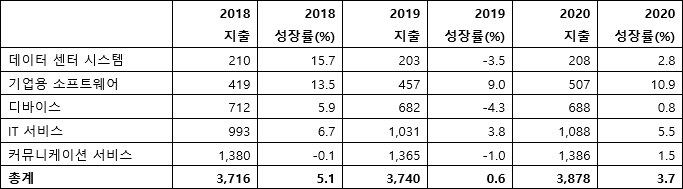
Source: Gartner (July 2019)
CIOs are shifting from internal to external capabilities. We are continuously rebalancing our technology portfolio as we shift our investments.
Meanwhile, spending on IT products and services in Korea is expected to reach 78 trillion won in 2019, a 3.5% increase from the previous year, and is projected to reach 88 trillion won in 2022.
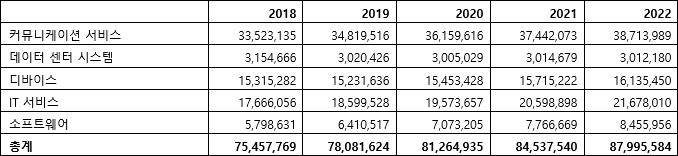
2018-2022 (unit: million won)
Source: Gartner (July 2019)
Cloud computing is expected to become mainstream within the next few years, exerting a greater influence on corporate IT decision-making than ever before. This will particularly impact system infrastructure. Prior to 2018, cloud computing was relatively widely used for application software and business process outsourcing. However, as this forecast develops, the cloud's influence will expand to include application software, encompassing office suites, content services, and collaboration services.
“Spending on older technology segments like data centers will continue to decline,” Lovelock said.
Globally, consumer spending as a percentage of total spending is declining year over year in all regions. This is especially due to the saturation and proliferation of PC, laptop and tablet devices.
Cloud applications allow new software to run on lower-performance devices, extending the life of these devices.
As a result, the device market is expected to see the largest decline, with spending expected to drop 4.3% year-over-year to $682 billion in 2019.
“There will be few new buyers in the device market, meaning the market is largely driven by replacements and upgrades,” said Lovelock. “Consumer technology spending will continue to decline as devices age longer and smart home technologies and the Internet of Things (IoT) become more prevalent.”
Comments
Related news

Smart city spending in the Asia-Pacific region excluding Japan is expected to reach $35.4 billion by 2022.
IDC's Global Smart City Spending Guide report forecasts that the smart city market spending in the Asia Pacific region, excluding Japan, will reach 35.4 billion dollars in 2022. This represents a 16.8% increase compared to the 2018 forecast. Additionally, smart city program spending in Singapore, Beijing, Shanghai, and Seoul is expected to exceed 4 billion dollars this year. Gerald Wang, who oversees IDC Asia Pacific public sector research, stated, "Prior to 2018, cloud solutions were essential for advancing smart cities through digital transformation," and added, "As governments shift their strategy from siloed cloud-first transformation efforts focused on digitalization to the implementation of integrated inter-agency hubs, interconnected ecosystems such as transportation and public safety are increasingly being demanded."
2019.06.06by 이수민 기자
Ixia Expands Hybrid Network Collaboration with Symantec
As enterprises migrate network resources to the cloud, they frequently experience a lack of visibility into cloud assets. Gartner noted in August of last year that when IT operations organizations adopt the cloud, they lose equal access to the infrastructure and networks that form the foundation of services, which can create monitoring challenges. In response, Keysight Ixia's Solutions Division is expanding its collaboration with Symantec to improve hybrid network security. Through the integration of Ixia's cloud solution CloudLens and Symantec Security Analytics, a threat detection and forensics solution, Symantec customers can now secure real-time visibility into their hybrid cloud environments.
2019.06.28by 이수민 기자
MEC technology, the key to implementing ultra-low latency 5G smart factories
With the commercialization of 5G network services, rapid processing of large-scale data is becoming increasingly demanded. However, cloud computing alone has limitations in handling large volumes of data concentrated in data centers. Consequently, a movement has begun to process data at the point where it is generated. MEC technology is a distributed cloud technology designed to provide consumer-customized services based on fast and stable communication environments at locations physically close to wireless base stations. MEC minimizes congestion in telecommunications operators' mobile core networks and reduces network expansion costs, thereby improving service quality. Additionally, it provides service providers with opportunities to create new local services and expand their business areas.
2019.07.01by 이수민 기자
Nvidia invests $5 billion in Intel
NVIDIA and Intel, leaders in global AI computing technology, are now forging ahead in providing cutting-edge solutions through NVLink-based architecture integration. NVIDIA and Intel have officially announced a strategic partnership and stated that they will jointly develop customized data center and personal computing products to accelerate diverse applications and workloads ranging from hyperscale to enterprise and consumer markets, thereby laying the foundation for the next generation computing era.
2025.09.22by 배종인 기자
.jpg)
Applied Materials Launches Environmental Protection Campaign to Mark World Cleanup Day
Applied Materials Korea (CEO Park Kwang-seon) is carrying out environmental cleanup activities with employees and their families around the Dongtan Sinricheon area on the occasion of World Cleanup Day, evolving into a company that engages with the local community beyond technological innovation.
2025.09.22by 명세환 기자











