


Korean researchers successfully implement ternary semiconductors using the values 0, 1, and 2.
 Published2019.07.17 09:01
Ternary semiconductors offer the advantages of ultra-low power consumption, high performance, and miniaturization.
| A reverse approach to utilizing leakage current information processing
Semiconductors that use not only 0 and 1 but also 2 are emerging.
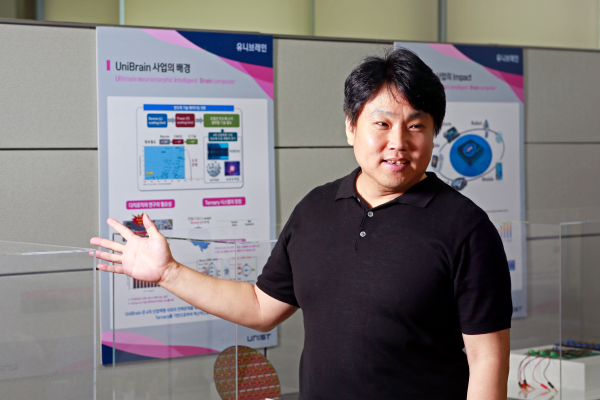
A research team led by Professor Kyung-Rok Kim of the Department of Electrical, Electronic and Computer Engineering at UNIST (Ulsan National Institute of Science and Technology) has succeeded in implementing an ultra-low-power 'Ternary Metal-Oxide-Semiconductor' on a large-area silicon wafer.
The results of this study were published in the academic journal 'Nature Electronics' on the 15th (UK local time).
The semiconductor industry has been reducing the size of semiconductor devices and increasing integration to create high-performance semiconductors that quickly process large amounts of information, such as those for AI, autonomous driving, and the Internet of Things.
The industry has been working to solve the problem of reducing the time it takes to process information in binary-based semiconductors and reducing power consumption that increases as performance increases.
Ternary semiconductors are attracting attention as a way to solve these problems.
The ternary semiconductor developed by Professor Kim Kyung-rok's research team processes information using the values 0, 1, and 2. Ternary semiconductors require less information to process, resulting in faster calculations and lower power consumption. They also offer advantages in miniaturizing semiconductor chips.
For example, to express the number 128, 8 bits (binary units) are required in binary, but only 5 trits (ternary units) are required to store it in ternary.
Currently, the size of semiconductor devices needs to be reduced to increase integration per unit area, effectively processing the rapidly increasing amount of information. However, miniaturization of these devices exacerbates the quantum mechanical tunneling phenomenon, leading to increased leakage current. Furthermore, this also leads to a significant increase in power consumption.
Professor Kim Kyung-rok's research team is using leakage current, a major cause of rapidly increasing power consumption, to implement information processing in semiconductor devices through a paradigm shift. The team implemented a ternary-based system that processes information based on the amount of leakage current.
Through this research, Professor Kim Kyung-rok's team has raised expectations for commercialization by implementing ternary semiconductors in semiconductor processes currently widely used in industry.
Professor Kim Kyung-rok said, “The results of this research are very significant in that they not only implemented ultra-low-power ternary semiconductor devices and integrated circuit technology using existing binary semiconductor device process technology, but also demonstrated the possibility of commercializing ternary semiconductors by manufacturing them on a large area.” He added, “It will lead the future semiconductor paradigm shift across all areas of process, device, and design for memory and system semiconductors, moving from the existing binary system-centered semiconductor process to the ternary system.”
Meanwhile, Samsung Electronics is verifying the implementation of ternary semiconductors using microfabrication processes at its foundry division's FAB to support Professor Kim Kyung-rok's research team. Samsung Electronics has been supporting this research since September 2017, when it was selected as a Samsung Future Technology Promotion Project theme.
Comments
Related news
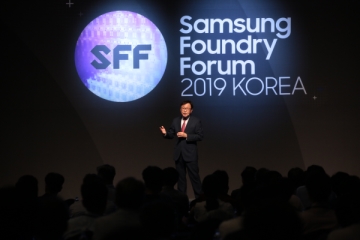
Samsung Electronics Leads the Domestic System Semiconductor Ecosystem
Samsung Electronics held the Samsung Foundry Forum 2019 Korea, where it announced its commitment to growing together with domestic fabless companies and foundry partners based on its foundry technology capabilities. The forum was attended by over 500 fabless customers and foundry partners, representing approximately 40% growth compared to the previous year. The number of companies participating in exhibition booths also increased by roughly twofold. Samsung Electronics announced its Semiconductor Vision 2030 in April of this year, committing to achieve the global top position in system semiconductors by 2030 through an investment of 133 trillion won and the creation of 15,000 jobs.
2019.07.04by 이수민 기자
Global Semiconductor Equipment Market to Snag This Year but Gain Momentum Next Year
SEMI forecasted that the global semiconductor equipment market revenue in 2019 would decline approximately 18.4% from $64.5 billion in 2018 to $52.7 billion. However, the global semiconductor equipment revenue in 2020 is expected to increase by 11.6% to $58.8 billion. This forecast reflects downward adjustments in investment due to regional political issues and market uncertainty. SEMI forecasted that the semiconductor equipment market would recover in 2020 due to rising memory consumption and China's semiconductor rise.
2019.07.11by 이수민 기자

R&D cooperation system established in the field of materials to respond to Japan's export regulations
Kim Sung-soo, Director of the Science and Technology Innovation Division at the Ministry of Science and ICT, convened a science and technology field policy advisory forum with participation from industry, academia, and research experts to review R&D response directions regarding Japan's export restrictions on semiconductor materials. In particular, the forum identified the localization feasibility and urgency of key items and strategic technologies related to Japanese export restrictions, as well as the demand technologies of companies requiring urgent solutions. Discussions were held on establishing collaborative frameworks among industry, academia, and research institutions, including R&D support measures and organic win-win cooperation methods between demand companies such as large enterprises and development companies. Additionally, various opinions were gathered on mid- to long-term response plans for securing foundational technologies in the materials and equipment sector including raw materials, fostering specialized workforce, and fundamental structural improvements to the national R&D system.
2019.07.11by 이수민 기자

Intel Unveils Next-Generation 'Core Ultra Series 3' and vPro Platform for Enterprise PCs
Intel has officially unveiled the "Intel Core Ultra Series 3" for next-generation enterprise PCs and the latest vPro platform, addressing a wide range of demands from enterprise notebooks to high-performance workstations.
2026.03.26by 배종인 기자

ROHM Launches ESD Protection Diode Compatible with High-Speed Interfaces of 10Gbps or Higher
Semiconductor specialist ROHM has developed the 'RESDxVx series' of ESD (electrostatic discharge) protection diodes capable of responding to next-generation high-speed data communication environments exceeding 10Gbps, simultaneously enhancing both signal quality maintenance required in high-speed interfaces and IC protection performance.
2026.03.26by 배종인 기자











