


Mouser now stocks TI's OPA855 8GHz uncompensated amplifier.
 Published2019.08.01 11:01
Mouser Electronics will begin stocking Texas Instruments (TI)'s uncompensated amplifier 'OPA855' on the 1st.
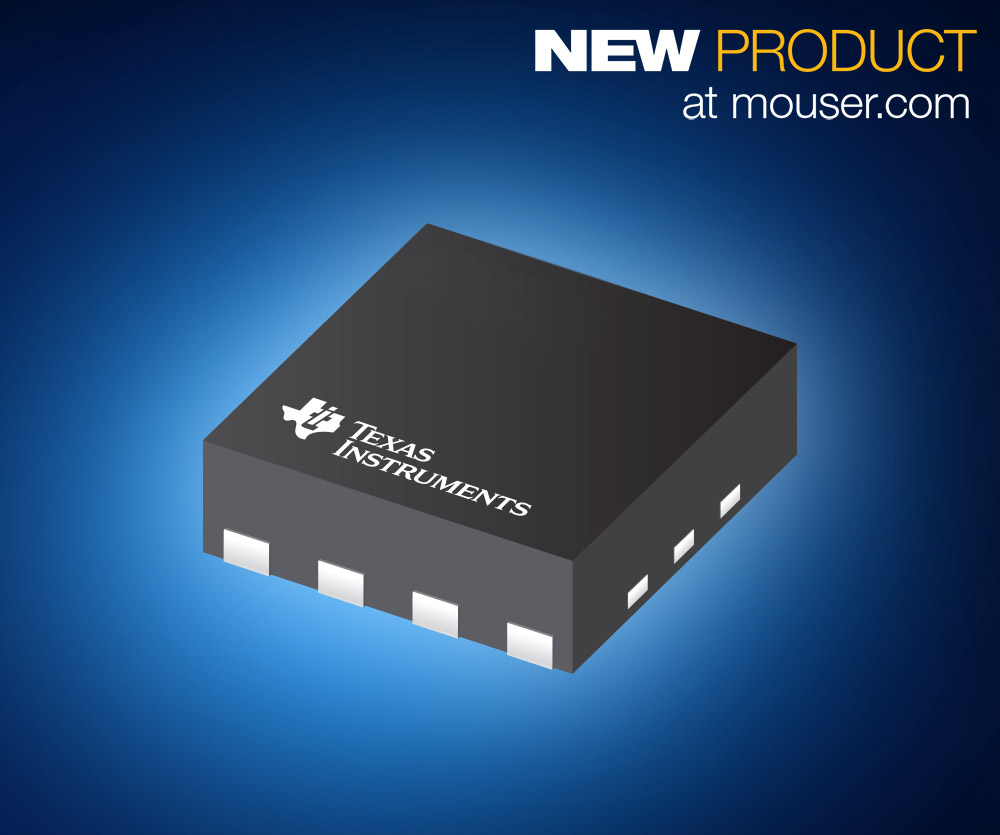
The OPA855, a wideband, low-noise, bipolar input operational amplifier, excels in high-bandwidth transimpedance and voltage amplifier applications.
The OPA855 features an 8GHz Gain–Bandwidth Product (GBWP) feature, allowing it to be configured for high gain while maintaining wide closed-loop bandwidth.
Low input voltage noise of 0.98 nV/√Hz minimizes amplifier noise, and a high slew rate of 2,750 V/µs enables a wide output voltage range.
With an input capacitance of only 0.8 pF, the OPA855 can minimize total circuit input capacitance and improve circuit speed when designing transimpedance amplifier (TIA) applications.
The OPA855 has a unique package pinout that simplifies the layout of the feedback network.At the same time, it isolates pin-to-pin capacitance between input and feedback connections.
Designing a circuit with this pin layout reduces the total parasitic capacitance around the amplifier's feedback network, allowing for the design of high-gain TIAs and wide bandwidth.
TIIA applications using the OPA855 include optical time-of-flight (ToF) systems with time-to-digital converters such as TI's TDC7201.
The OPA855 can also be used to drive high-speed analog-to-digital converters (ADCs) in high-resolution LIDAR systems featuring differential output amplifiers such as TI's THS4541 and LMH5401.
The OPA855 is the latest member of TI's ultra-wideband operational amplifier family, which also includes the FET-input OPA858 and OPA859 devices.
This family of amplifiers can be used in a wide range of applications, including wideband transimpedance circuits, high-speed data acquisition systems, and low-noise front ends.
The device is supported by a dedicated operational amplifier evaluation module OPA855DSGEVM and a universal unmounted evaluation board DEM-OPA-WSON8-EVM.
Comments
Related news
KETI Develops Broadband-Ultra-Small Power Conversion Circuit for Piezoelectric Energy Harvesting: "Will Contribute to Revitalizing IoT Market"
The Electronics and Telecommunications Research Institute (ETRI) announced that through joint research with Université Paris-Sud in France, it has developed an ultra-compact, broadband power conversion circuit for piezoelectric energy harvesting that can accommodate various frequencies and amplitudes without requiring a separate algorithm. Piezoelectric energy harvesting technology is a technique for securing energy from ambient vibrations and pressure changes, and is a core technology essential for IoT sensors that require periodic battery replacement. The power conversion circuit developed this time does not require impedance matching because it extracts energy by utilizing the characteristics of a buck-boost type power conversion circuit in which impedance is maintained constant at the maximum power extraction point.
2019.05.22by 이수민 기자
Mouser supplies Infineon ultra-compact three-phase inverter modules
Mouser Electronics supplies the 'CIPOS Tiny' three-phase inverter module from Infineon Technologies. CIPOS Tiny is the latest generation of Infineon's IPM product line, providing high power density for variable-speed motor drives in products such as washing machines, range hoods, indoor air conditioning, commercial and industrial fans. The CIPOS Tiny three-phase inverter module uses Infineon's latest TRENCHSTOP IGBT 6, reducing installation footprint by 33% compared to the CIPOS Mini series. The module incorporates one three-phase, level-shifting high-voltage driver IC and is compatible with controller outputs as low as 3.3V.
2019.07.19by 이수민 기자
TI Launches AC/DC Linear Regulator for Smart Grids and Buildings
Texas Instruments has launched the TPS7A78, a smart AC/DC linear regulator. The newly unveiled smart AC/DC linear regulator offers 75% higher efficiency compared to competing products and 2x improved power density, achieving a balance between ultra-low noise and high efficiency despite reducing the power supply size. The TPS7A78 linear regulator utilizes a proprietary switched-capacitor architecture, eliminating the need for separate components including external inductors and transformers, thereby enabling smaller form factors for circuit breakers and interrupters. It is particularly well-suited for anti-counterfeiting design in applications including electrical metering in the power grid infrastructure and building automation sectors.
2019.07.31by 이수민 기자

Intel Unveils Next-Generation 'Core Ultra Series 3' and vPro Platform for Enterprise PCs
Intel has officially unveiled the "Intel Core Ultra Series 3" for next-generation enterprise PCs and the latest vPro platform, addressing a wide range of demands from enterprise notebooks to high-performance workstations.
2026.03.26by 배종인 기자
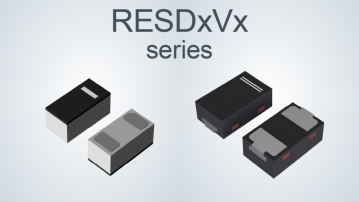
ROHM Launches ESD Protection Diode Compatible with High-Speed Interfaces of 10Gbps or Higher
Semiconductor specialist ROHM has developed the 'RESDxVx series' of ESD (electrostatic discharge) protection diodes capable of responding to next-generation high-speed data communication environments exceeding 10Gbps, simultaneously enhancing both signal quality maintenance required in high-speed interfaces and IC protection performance.
2026.03.26by 배종인 기자











