


Arm Announces Pelion Connectivity Management 2.0: "Accelerates IoT Connectivity Management Automation"
 Published2019.08.04 07:33
| Providing an advanced automation engine for IoT expansion
Automatically manage millions of devices
The scale of IoT device management automation is growing larger.
Arm announced on the 2nd Pelion Connectivity Management 2.0, which supports IoT expansion through automation.
With the spread of digital transformation, automation has emerged as a key driver for increased productivity, reduced costs, and the creation of new opportunities. However, from an IoT perspective, current manual processes cannot meet the demands of a world where billions to trillions of devices are connected and managed.
Mobile carriers have consistently emphasized that automation is a key factor in removing connectivity barriers necessary for IoT expansion. Reflecting these opinions, Arm introduced Pelion Connectivity Management 2.0, featuring a new advanced automation engine.
Mobile carriers are already experiencing the simplicity of a single platform for managing IoT connectivity across the entire device lifecycle provided by Pelion Connectivity Management.
With the newly released Pelion Connectivity Management 2.0, mobile carriers can expect to generate additional revenue by providing enterprise customers with the ability to automatically configure IoT devices.
These new automation features significantly enhance the reliability of IoT services, speed, and connectivity that mobile carriers provide to customers. This improves features such as the provisioning of new devices and the ability to ensure monthly fees do not exceed a set range.
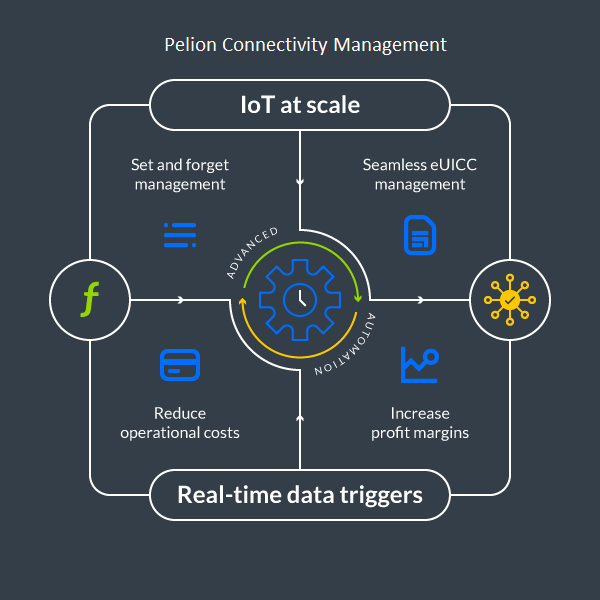
The automation features currently available in Pelion Connectivity Management 2.0 are as follows.
First, it generates rules triggered by events occurring in the physical environment using real-time data triggers. Next is seamless eSIM provisioning management. When a device moves to a different country, the automation engine ensures appropriate services and commercial settings. Finally, there is business process automation. This reduces operating costs during IoT deployment and increases profitability for mobile carriers providing IoT services.
These new automation features directly reflect the requirements of mobile operators. They also served as a factor in facilitating the new collaboration between NOS, Portugal's largest telecommunications and entertainment group, and Arm.
NOS plans to monetize IoT connectivity using Pelion Connectivity Management 2.0 and expand its services beyond Portugal. NOS believed that the ability to seamlessly integrate new automation engines and services into existing networks and systems would create immediate value.
NOS plans to migrate its entire IoT subscriber base to Pelion Connectivity Management 2.0 to analyze network performance and device authorization settings, and automate processes and settings based on a certain amount of data usage or specific time periods.
In addition to providing new automation capabilities for mobile operators, Arm is the first among virtual mobile operators (MVNOs) to directly provide automation engines to global companies.
The new automation engine feature is built into Pelion Connectivity Management 2.0. Mobile carriers worldwide can use the feature immediately. Enterprise customers can access the beta version of the feature.
Nigel Chadwick, Vice President and General Manager of Arm Pelion Connectivity Management, said, “Arm can provide significant assistance in overcoming the challenges companies face in scaling IoT projects from a pilot level to a global scale.”
"He continued, 'As IoT expands to thousands of devices, diverse countries, and different mobile networks, it becomes impossible for companies to manually manage every single device.' Pelion Connectivity Management resolves these management challenges by providing significant automation through a single pane of glass."
Comments
Related news
"The era of supercomputers capable of 100 quadrillion calculations per second has arrived." NVIDIA provides AI and HPC software stacks to Arm.
Nvidia is advancing work to provide its entire AI and HPC software stack to the Arm ecosystem by the end of this year. The stack includes Nvidia CUDA-X AI in its entirety, HPC libraries, GPU-accelerated AI frameworks, and software development tools such as the PGI compiler with OpenACC support and profiler. Upon completion of stack optimization work, Nvidia will be capable of accelerating all major CPU architectures, including x86, Power, and Arm.
2019.06.18by 이수민 기자
Arm-based SoC development now possible without a license.
A path is now open for companies to start projects without purchasing IP licenses when designing Arm-based SoCs. Arm has introduced a new contract model called Flexible Access, further expanding the ways existing and new partners can access and license Arm technology for semiconductor design. With Flexible Access, SoC design teams can start projects without having purchased IP licenses, and then pay only for the IPs actually used at the time of production. Through Flexible Access, companies can support design teams in experimenting, evaluating, and innovating more freely.
2019.07.22by 이수민 기자
Nuvoton Launches Arm Cortex-M23-Based IoT Security MCU
Nuvoton introduces FreeRTOS kernel functionality through its M2351 series. The M2351 is the first Arm Cortex-M23 based MCU currently available on the market. Nuvoton provides relevant examples necessary to run FreeRTOS on the Armv8-M architecture, which officially supports embedded developers. In early 2019, the M2351 series obtained Arm Platform Security Architecture Level 1 certification and Platform Security Architecture capability certification. Nuvoton verifies the latest level standards in real-time and provides IoT security MCUs that meet the required specifications necessary to obtain Arm Platform Security Architecture certification.
2019.07.23by 이수민 기자
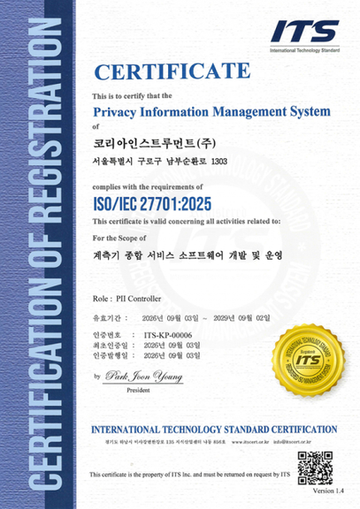
Korea Instrument, KOLAS Accredited Calibration Agency First to Simultaneously Acquire ISO/IEC 27,001·27,701
Korea Instrument has become the first among KOLAS accredited calibration agencies to simultaneously acquire ISO/IEC 27,001 and ISO/IEC 27,701 certifications. Through its proprietary platforms CWIZ Enterprise and CWIZ Partners, the company has embedded information security and personal data protection requirements across all business processes including customer information, equipment data, and calibration reports, with plans to continuously advance its management system through regular audits and security inspections.
2026.10.12by 배종인 기자
TeamViewer One, IT Incident Automation Workflow and Resolution Center Enhanced
TeamViewer has added IT incident automation capabilities and an advanced Resolution Center to its integrated digital workplace management platform 'TeamViewer ONE'. Recurrent service disruptions, configuration errors, and capacity shortages are automatically handled according to preset policies, and device status verification through script deployment can be managed in a unified interface, significantly reducing repetitive tasks for IT teams.
2026.10.12by 배종인 기자











