


Measures to Strengthen Competitiveness of Materials, Parts, and Equipment Industry Targeting Japan Announced: "Breaking Away from Externally Dependent Industrial Structure"
 Published2019.08.05 12:25
| Establishing a cooperation model between supply and demand firms
| Establishment of Competitiveness Committee, complete overhaul of special act
The materials, parts, and equipment industry is the backbone of the manufacturing sector. Leadership in the Fourth Industrial Revolution also depends on materials, parts, and equipment. Since the enactment of the Special Act on Materials and Parts in 2001, the materials, parts, and equipment industry has established a foundation for quantitative growth, leading to significant expansion in scale, including a threefold increase in production and a fivefold increase in exports.
However, due to a catch-up strategy focused on general-purpose products and compressed growth, the country has faced problems such as continued chronic dependence on foreign sources for key strategic items, increased global competition, and stagnation of added value. On top of this, Japan is imposing economic sanctions for political reasons, including export restrictions on semiconductor materials and the removal of South Korea from its whitelist.
In particular, while semiconductors are a foundational industry in Korea, the level of self-sufficiency is only 27% due to a focus on a stable supply chain.
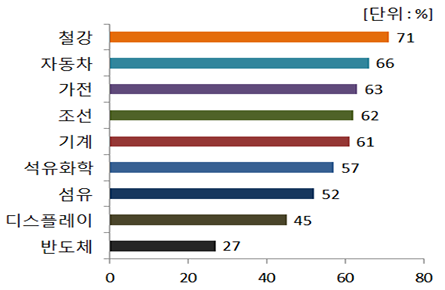
Although Japan has a small market size, it has a structure that holds high market shares across numerous product categories through long-term technological accumulation. In contrast, while Korea has a large market, it has grown primarily through general-purpose products with relatively low technological difficulty. In 2018, the deficit in materials, parts, and equipment accounted for the majority of the total trade deficit of $24.1 billion at $22.4 billion, and Japan is the only country with a long-term trade deficit.
To address this situation, the government announced on the 5th that it has prepared 'Measures to Strengthen the Competitiveness of Materials, Parts, and Equipment' to resolve structural vulnerabilities in the materials, parts, and equipment industry, such as high dependence on specific countries, particularly Japan.
Since the second half of last year, the government has established a basic framework by gathering opinions from relevant demand and supply companies, associations and organizations, public research institutes, and private experts.
Although past policies established a foundation for quantitative growth, there were limitations, such as a lack of cooperation between supply and demand firms, a disconnect between technology development and production, and insufficient securing of technology for core strategic items due to a rigid R&D system.
This measure focused on establishing cooperation models between companies, promoting a ladder policy that leads from development to mass production, diversifying methods for timely intensive investment and technology acquisition, and providing package support that enables rapid production and facility investment.
There are three key points.
First is securing early supply stability for 100 items. The government selected 100 items from among Japan's strategic materials (1,194 items) and all materials, parts, and equipment items (4,708 items), taking into account national security and industrial importance, substitutability, technological level, dependence on specific countries, and the impact on production in key industries and new industries.
The goal is to stabilize the supply of 20 items that are immediately needed within one year, and 80 items that require a long time to develop within five years. The government has decided to make large-scale investments in key items by prioritizing and concentrating available budgets. Accordingly, 7.8 trillion won in government funds will be injected into the R&D sector and more than 2.5 trillion won into M&A.
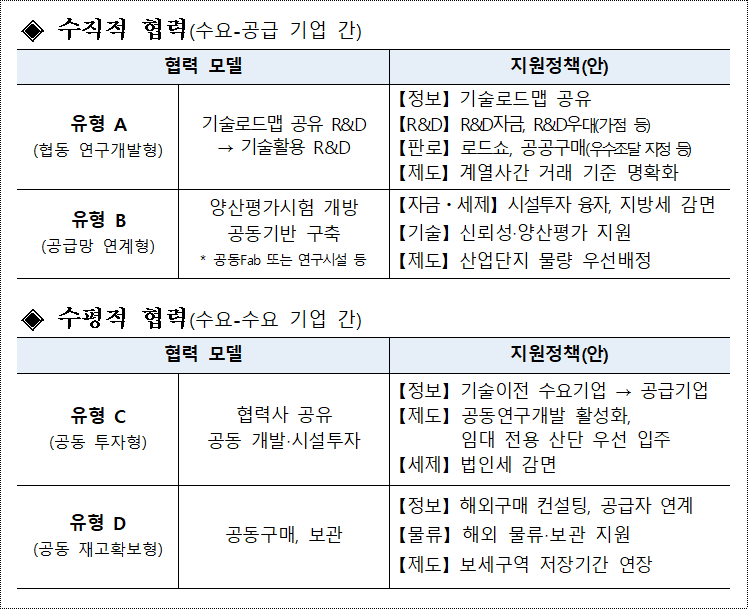
The next step is to establish healthy cooperation models between supply and demand companies and between demand companies. The government has decided to provide package support, including funding, tax incentives, and deregulation, for four cooperation models, such as vertical cooperation between supply and demand companies regarding key items and horizontal cooperation among demand companies.
In addition, it was decided to significantly expand demonstration and mass production testbeds to connect the technology development of suppliers with the production stages of demand companies, and to introduce risk diversification systems such as reliability assurance, while strengthening comprehensive and customized support, including close support for private investment, increased supply of investment funds, and supply of specialized personnel.
Finally, it involves comprehensive support through a robust implementation system. To this end, it is backed by the establishment of a Competitiveness Committee and a complete overhaul of the Special Act on Materials, Parts, and Equipment to pursue extraordinary measures alongside one-stop troubleshooting.
A government-wide Materials and Components Supply Chain Response Support Center, led by the Ministry of Trade, Industry and Energy, will be established to provide a one-stop service for resolving difficulties. The process involves the Ministry designating reported issues as materials, parts, or equipment eligible for emergency support and assigning a dedicated officer for each category. A committee on the competitiveness of materials, parts, and equipment will also be established.
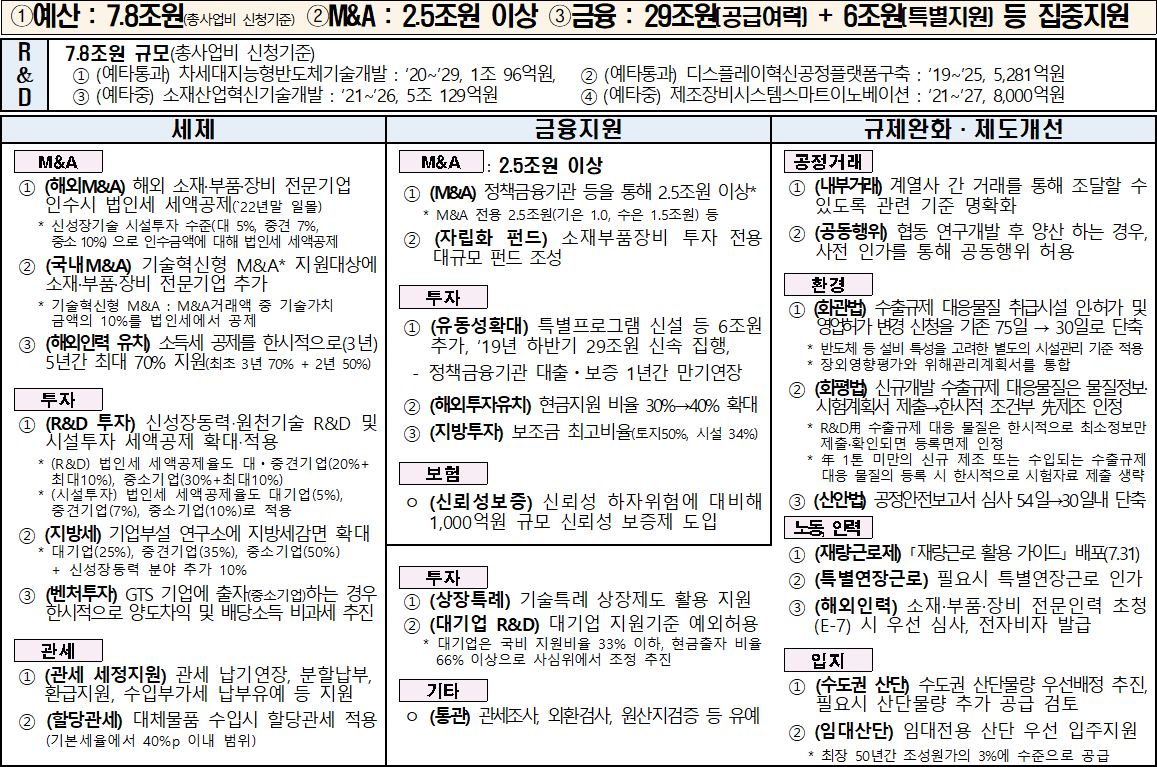
(Opens in a new window to enlarge)
In a modern democratic nation with a clear separation of powers, Japan launched an economic attack on South Korea for the reason that the executive branch did not put the brakes on a decision by the judiciary. These sanctions by Japan are a blow not only to South Korea but also to numerous Japanese companies that supplied high-quality products to the country.
The government has decided to turn this crisis into an opportunity to strengthen the competitiveness of the materials, parts, and equipment industry. Japan has fired the signal for the localization of core materials, which had previously been advocated only in words.
The growing pains are inevitable. However, if we overcome them, it will strengthen our industrial structure. Now more than ever, the roles of the government and the National Assembly are crucial.
Comments
Related news

R&D cooperation system established in the field of materials to respond to Japan's export regulations
Kim Sung-soo, Director of the Science and Technology Innovation Division at the Ministry of Science and ICT, convened a science and technology field policy advisory forum with participation from industry, academia, and research experts to review R&D response directions regarding Japan's export restrictions on semiconductor materials. In particular, the forum identified the localization feasibility and urgency of key items and strategic technologies related to Japanese export restrictions, as well as the demand technologies of companies requiring urgent solutions. Discussions were held on establishing collaborative frameworks among industry, academia, and research institutions, including R&D support measures and organic win-win cooperation methods between demand companies such as large enterprises and development companies. Additionally, various opinions were gathered on mid- to long-term response plans for securing foundational technologies in the materials and equipment sector including raw materials, fostering specialized workforce, and fundamental structural improvements to the national R&D system.
2019.07.11by 이수민 기자

The Ministry of SMEs and Startups will provide relief to small and medium-sized enterprises affected by Japan's export restrictions.
The Small and Medium Business Administration is promoting support measures for small and medium-sized enterprises affected by Japan's export restrictions, as concerns grow over potential damage to SMEs resulting from Japan's export controls. Since the announcement of Japan's export restrictions, the Small and Medium Business Administration has been operating a "Japan Export Restriction Response Task Force" involving related government agencies and private organizations from the 9th, and plans to establish and operate Japan Export Restriction Grievance Reporting Centers at 12 regional offices nationwide starting from the 15th. When damage status, difficulties, and suggestions from small and medium-sized enterprises in the field are reported to the "Grievance Reporting Centers," the Small and Medium Business Administration and the pan-government task force will develop measures to resolve these difficulties and help companies overcome their challenges. For enterprises that have suffered damage due to Japan's export restrictions, support such as emergency management stabilization funds and short-term consulting will be provided to minimize damage.
2019.07.15by 이수민 기자

Ministerial Meeting Held to Address Japan's Export Restrictions
Deputy Prime Minister and Minister of Strategy and Finance Hong Nam-ki convened an inter-agency meeting in response to Japan's export restrictions. The government stated that through the meeting, it is closely sharing developments related to Japan's export restrictions among relevant ministries, while carefully reviewing necessary measures and response situations to minimize potential damage to Korean companies as circumstances evolve. At today's meeting, the government comprehensively reviewed the situation to date and potential future developments, as well as both short-term and fundamental response strategies related to Japan's measures.
2019.07.20by 이수민 기자

Nvidia invests $5 billion in Intel
NVIDIA and Intel, leaders in global AI computing technology, are now forging ahead in providing cutting-edge solutions through NVLink-based architecture integration. NVIDIA and Intel have officially announced a strategic partnership and stated that they will jointly develop customized data center and personal computing products to accelerate diverse applications and workloads ranging from hyperscale to enterprise and consumer markets, thereby laying the foundation for the next generation computing era.
2025.09.22by 배종인 기자
.jpg)
Applied Materials Launches Environmental Protection Campaign to Mark World Cleanup Day
Applied Materials Korea (CEO Park Kwang-seon) is carrying out environmental cleanup activities with employees and their families around the Dongtan Sinricheon area on the occasion of World Cleanup Day, evolving into a company that engages with the local community beyond technological innovation.
2025.09.22by 명세환 기자











