


2019 Global Autonomous Driving Industry Outlook Report Released
 Published2019.08.26 08:42
Frost & Sullivan Korea released its 2019 Global Autonomous Driving Industry Outlook Report.
If 2018 was a year of significant technological advancements in the autonomous driving (AD) market, focusing on shared mobility platforms, electrical/electronic (E/E) architecture integration, and AD and AI integration, 2019 will be a year of significant progress in autonomous driving technology, with improvements in sensor solutions, L2+ implementation, and remote operation development.
However, with L4 and L5 development and launch expected to take some time, OEMs and Tier 1 suppliers are strengthening L2+ features that can add value to the ADAS market, and at the same time, by 2030, L4 will be driving growth, with one in four cars sold globally expected to be autonomous (L3 or higher).
“Sensor fusion will play a key role in the development of autonomous vehicles, and the transition from individual sensor processing to sensor fusion will be achieved through raw sensors or smart sensors based on E/E architecture,” said Jinhan Shim, Director of Frost & Sullivan Korea.
He also noted that the introduction of L2+ and L3 capabilities will create opportunities to integrate multi-core ADAS domain controllers.
This can reduce the amount of wiring, facilitate high-speed communication and data transmission, and reduce structural complexity and chassis weight.
Frost & Sullivan Korea recently announced the '2019 GlobalThe 'Global Autonomous Driving (AD) Industry Outlook, 2019' highlights key market and technology trends that will shape the future outlook.
From a business perspective, the study delves into the impact of autonomous driving, focusing on data monetization and personalization as industrial evolution evolves. From a technical perspective, the study focuses on the development requirements from a platform perspective for sensory data fusion and the establishment of a computational ecosystem. Furthermore, it forecasts vehicle market share by autonomous driving level.
Director Shim Jin-han stated, "Autonomous driving will not only focus on generating revenue through new downstream services, but will also impact existing business models by introducing mobility platforms. As it evolves to Level 5 autonomous driving, the industry will shift its focus from car owners to car users. Going forward, vehicle platforms must be designed with mechanical and electrical redundancy in mind to facilitate easy expansion to Level 4/L5."

Comments
Related news
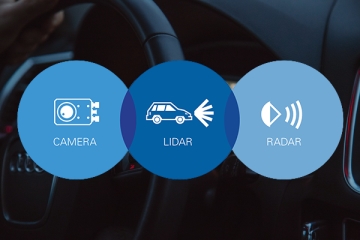
How to Realize Safe Autonomous Driving Functions? A Compromise Between Cost, Technology, and Strategy Is Necessary
According to the World Health Organization, more than 1.25 million people die annually in traffic accidents, and prevention and recovery costs account for approximately 3% of GDP. To enhance driving safety while ultimately providing autonomous driving capabilities, ADAS integrates sensors, processors, and software. As a result, it is delivering meaningful achievements. According to a 2016 IIHS study, automatic braking systems reduced rear-end collisions by approximately 40%, while collision warning systems reduced them by 23%. Nevertheless, the automotive industry faces significantly more complex challenges than before in realizing Level 4 or Level 5 autonomous driving. Sensor fusion is required, which combines measurement data from numerous sensors to derive results, and synchronization, high-power processing, and continuous advancement of the sensors themselves are necessary. Automotive manufacturers must therefore find an appropriate balance among three critical trade-offs: cost, technology, and strategy.
2019.03.13by 명세환 기자
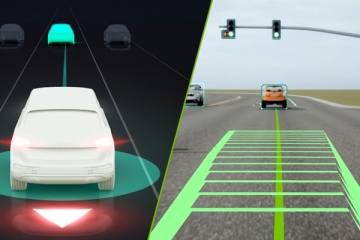
NVIDIA Unveils Drive AV Safety Force Field, "Mathematically Validated to Reduce Autonomous Vehicle Accident Rates."
Nvidia has strengthened its "Nvidia Drive AV autonomous vehicle software" product line by applying a control layer designed to implement safe and comfortable driving experiences. The key component of this software is Safety Force Field (SFF), a powerful driving policy that protects vehicles, passengers, and other road users. Rather than modeling the high complexity of real-world scenarios with limited statistics, SFF ensures that vehicles maintain safety based on mathematically verified zero-collision verification.
2019.03.20by 이수민 기자
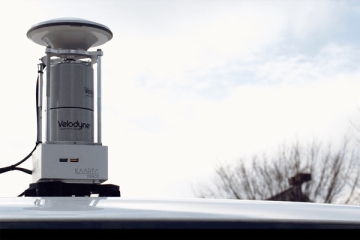
Velodyne Lidar Provides Lidar Technology for Karta's Stencil 2-32 Mobile Mapping System
Velodyne's lidar technology is embedded in Kaarta's Stencil 2-32 ground surface mapping solution. The Stencil 2-32 accurately surveys ground surface at a lower cost than existing mobile mapping systems, mapping curbs, manholes, signage, poles, and other features. The Stencil platform can assist not only urban planning for infrastructure improvement but also parking and traffic management. AllVision in the United States was able to analyze curb occupancy within Pittsburgh's Strip District, known for high on-street parking demand, using data from autonomous vehicle developers together with the Stencil 2-32.
2019.07.18by 이수민 기자
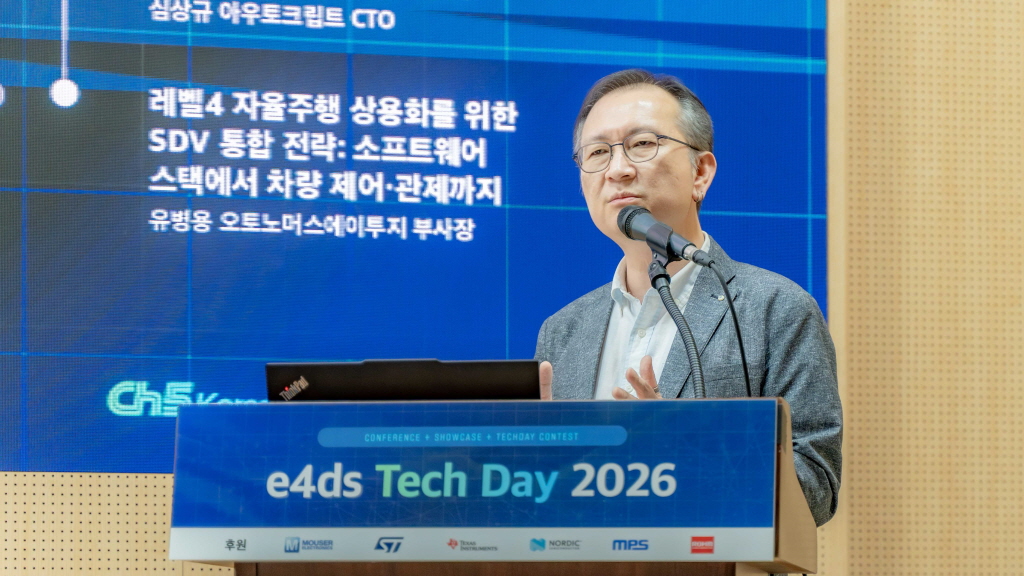
[e4ds Tech Day 2026 ⑨] Sim Sang-gyu, Autocrypt CTO: "In the Physical AI Era, Automotive Security Must Extend Beyond the Vehicle"
At e4ds Tech Day 2026, Sim Sang-gyu, CTO of Autocrypt, explained automotive cybersecurity strategies in the era of Physical AI and SDV (Software-Defined Vehicle). Automobiles are evolving as part of an ecosystem connected to AI, cloud, chargers, IoT, and robots, and he emphasized that the scope of security must expand beyond the vehicle interior to the entire connected environment. In particular, AI model tampering, adversarial attacks, OTA updates, and EV charger hacking were identified as major threats. He explained that response measures require zero trust, AI model integrity protection, intrusion detection, Security by Design and Default, and full lifecycle security management, and that proactive security system establishment beyond regulatory compliance is critical for securing future mobility competitiveness.
2026.10.12by 배종인 기자

Practical HIL Construction Strategy for Automotive and Off-Highway Controller Validation
As vehicle E/E architecture transitions to zonal structures and shifts to software-defined vehicles (SDV), the number of controllers (ECUs) requiring validation and software complexity are surging dramatically. Meanwhile, real vehicle testing cannot provide repeated verification under identical conditions and entails lead time and safety concerns. This white paper explains the principles of HIL (Hardware-in-the-Loop) validation and the structure of the NI platform composed of PXI, SLSC, and VeriStand, and through two actual implementation cases—Camera Record & Replay HIL for In-Cabin Monitoring Controller (ICMU) and Forklift Controller (VCU) HILS—describes how controller-level regression testing becomes possible. Additionally, it explicitly states application boundaries and limitations, such as lack of A2B support.
2026.10.12by 편집부











