This page was machine-translated and may differ from the original. View original
The present and future of the smart city platform as seen through Daegu Suseong Alpha City

Smart City as a City Platform in a City Model
Mercury Alpha City, Establishing 13 Services in 5 Major Fields
Participation of small and medium-sized enterprises is the key to the prosperity of smart cities
Increasing urbanization is causing problems worldwide.
As populations are concentrated in cities, resource, infrastructure, energy shortages, and traffic congestion are occurring. According to the UN, the urbanization rate in 2015 was 81.6% in the United States, 93.5% in Japan, and 82.5% in South Korea.
Governments around the world are defining smart cities as urban models that can solve various urban problems and improve the quality of life by incorporating new technologies such as ICT and big data into cities. Recently, they are also being used as urban platforms, meaning spaces where various innovative technologies can be implemented and integrated with urban infrastructure.
On August 22, the '2019 4th Industrial Revolution Excellent Company Competition' was held at the National Assembly Memorial Hall in Seoul, hosted by the Korea Press Association and the National Assembly Convergence Innovation Economy Forum. Approximately 200 people from ICT-related companies and organizations attended the competition.
In the first half of the event, there was an awards ceremony for excellent companies in the 4th Industrial Revolution, and in the second half of the event, there were keynote speeches and keynote lectures on the 4th Industrial Revolution and shared growth. And in the corporate case presentation, Bae-Seong Bae, head of the Smart City Business Division of Daegu Urban Development Corporation, introduced the 'Susung Alpha City Smart City Construction Project' that encompasses all the 4th Industrial Revolution technologies.

Suseong Alpha City, built on 976,000㎡ of land in Daeheung-dong, Suseong-gu, Daegu Metropolitan City, was completed with a total project cost of 614.2 billion won invested over 10 years starting in 2008.
In August 2019, Suwon Alpha City completed 13 services in 5 major fields and completed stability and efficacy verification. Many small and medium-sized enterprises are currently participating in the verified system. Daegu Urban Corporation plans to gradually make existing urban areas smart and fully apply smart technology to new development sites from the planning stage.
The process of building Daegu Suseong Alpha City
Susung Alpha City was not built as a smart city from the beginning. Daegu City’s smart city construction project began with the Susung Smart City Strategy Meeting held in December 2015. In July 2016, Daegu City decided to build a smart city test bed in the Susung Medical District, and began construction work on October 25, 2017. October 2017 was also when the government announced smart cities as a national innovation growth leading project.
In July 2018, it was selected as a demonstration project for the Smart City National Strategy Project. At the same time, after carrying out the autonomous driving infrastructure construction project from May to October, the International University Autonomous Driving Competition was successfully concluded on November 2. On December 26, 2018, Susung Alpha City was finally completed.
Daegu Smart City aims to improve the quality of life of citizens, improve the efficiency of urban management, foster growth industries, and foster talent by connecting IoT connection, urban control, urban data, and urban information provision platforms. The implementation and connection of the platform uses IoT, cloud, AI, and autonomous driving, which are technologies based on the 4th industrial revolution.
Smart City Platform Differentiated from U-City Control Center
There was a time when the concept of ubiquitous computing was popular. Ubiquitous computing refers to an environment in which users can freely access networks regardless of location without being aware of the computer or network.
In 2008, the Ubiquitous City Act was enacted. A Ubiquitous City, or U-City for short, refers to a city that provides citizens with the conditions to conveniently receive and utilize city information on administration, transportation, welfare, environment, and disaster prevention anytime and anywhere.
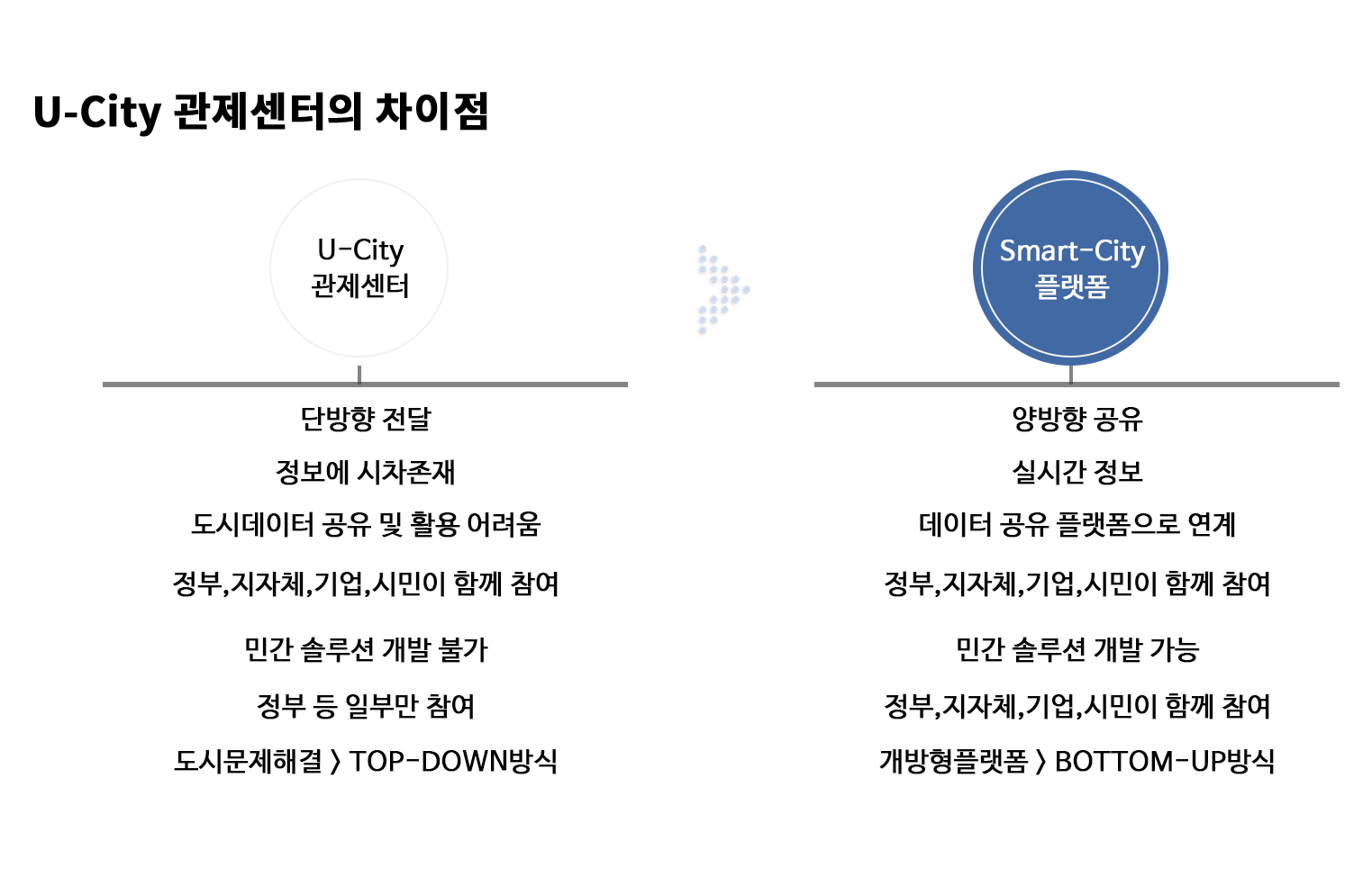
The organization that oversees U-City operations is the U-City Control Center. However, the U-City Control Center only allows one-way data transmission, and there is a time difference, making it difficult to share and utilize city data. Additionally, the development of civilian solutions was impossible.

In 2017, the Ministry of Land, Infrastructure and Transport decided to replace the outdated term ubiquitous. And the Ubiquitous City Act was renamed the Smart City Act. The difference between a smart city and a U-city is that instead of a U-city control center, there is a basic system called a smart city platform.
The smart city platform collects and organically analyzes city data based on ICT technology to efficiently manage the city through convergence service management and situation prediction. It can share real-time information in both directions with the U-City control center and can be linked to a data sharing platform. Since development of private solutions is also possible, it has become easier for small and medium-sized businesses to develop solutions.

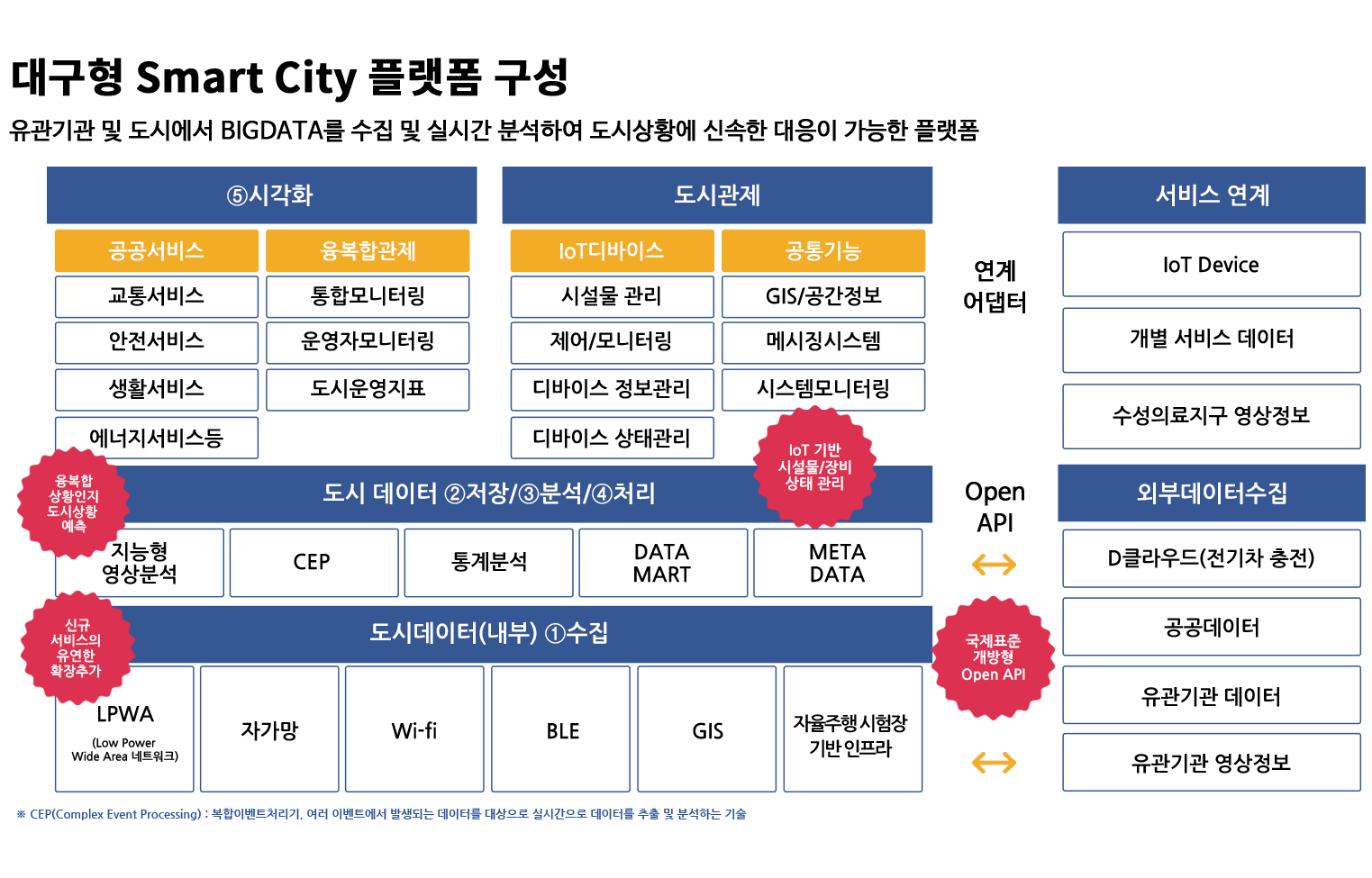
The smart city platform of Suwon Alpha City follows the IoT international standard. OneM2M and LWM2M are applied, and it supports international standard open API. In addition, real-time data analysis is possible through the real-time complex event processing (CEP), enabling city situation analysis and rapid accident processing support. CEP uses machine learning to determine the appropriateness of the CEP analysis rule, and predicts and corrects the rule threshold.
It also provides CCTV footage analysis using AI. It can identify where trash is piled up, who is driving the wrong way on the road, and which field has a fire. It collects this data and provides event, object-based search, and statistical functions.
There is also a developer portal for device developers and application developers. Through the developer portal, developers can check whether the functions they have developed are working properly. In addition, specialized services are provided through a dedicated app (Susung Citizen) for Susung Alpha City residents. Data collected through various routes are used in the decision-making process to solve urban problems. The Suwon Alpha City Smart City Platform provides urban operation indicator functions and provides internal and external data analysis results.
As a smart city test bed
Daegu Urban Development Corporation divided the Susung Alpha City Smart City project into two stages. Stage 1 is to build 13 pilot services in five areas including transportation, energy, living, safety, and urban infrastructure management to create smart city infrastructure, and has already been completed.
The 13 pilot services are autonomous vehicle test roads, intelligent pedestrian safety systems, road hazard information provision, unmanned illegal parking control systems, smart streetlights, living safety CCTVs, license plate recognition CCTVs, smart media walls, smart walking, digital signage, private communication networks, communication stations, and electric vehicle chargers.
Phase 2 is the construction of a smart city business center. The business center will include a control center that organically manages the 13 service-based facilities built in Phase 1 by connecting them into an integrated platform, as well as a 4th Industrial Revolution Startup Support Center that encourages collaboration, such as technology support development between large and small businesses.
Smart streetlight and underground facility management service

Can you imagine a city without streetlights? Smart streetlights are intelligent versions of streetlights that are essential to cities, and 18 of them are currently in operation in Suwon Alpha City.
Smart streetlights are equipped with intelligent CCTV, emergency bells, various multi-functional sensors, Wi-Fi, LoRa, GPS, and other communication modules. Through this, smart streetlights are connected to the Susung Police Station with real-time monitoring and emergency bell services, immediately ensuring the safety of citizens.
Convenience is also enhanced by providing Wi-Fi. In addition, it improves the appearance of the city by integrating various functions into one smart streetlight.
The underground facility management service provides information through an app by integrating information on underground water and sewage pipes, communications, electricity, gas, and other facilities with location information.

By utilizing the underground facility management service, safety accidents can be prevented by providing information on underground facilities during excavation work, and the spread of disaster can be prevented by remotely providing information on underground facilities in the event of an accident. It can also provide various information such as depth, diameter, material, and management organization.
This underground facility management service has proven its effectiveness by being selected as the best administrative project at the 2019 Smart City Asia Pacific Awards (SCAPA).
SCAPA recognized the development of the SPI (Smart Pipe Indicator) application, which provides information on various underground facilities such as water supply, sewerage, city gas, and communication networks to smartphones through an intelligent buried pipeline recognition indicator (NFC) tag.

In existing cities, users had to check information on underground facilities from each management agency, but in Suwon Alpha City, users can check information on the status of underground facilities anytime, anywhere by using the SPI application.
A smart city that encompasses the region’s present and future
It is impossible for the government or large corporations to develop all solutions. Also, a smart city is about increasing citizens’ access to urban infrastructure. Solutions developed without understanding citizens or the city are ultimately abandoned. The top-down approach has already revealed its limitations in the disjointed U-City.
Professor Yongjin Kim of Sogang University's Department of Business Administration, who gave a lecture on the topic of digital transformation and regional industrial convergence, said, "The government's regional industrial R&D projects are not bearing fruit because the concentration of human resources and resources in the metropolitan area has not been resolved." He added, "We need to establish a regional-led policy governance rather than a central government-led governance and implement a regional industrial development strategy based on the unique culture and identity of the region."
He added, “Rather than providing funding to one small business to turn it into a medium-sized business, the government should work harder to create an environment where many small businesses can come together and cooperate.”
Director Bae Sung-woo said, “Susung Alpha City is a smart city test bed that supports the development of new products, technologies, and services related to smart cities, as well as the cultivation of talent,” and explained, “It not only provides high safety and specialized convenience to Daegu citizens, but is also a place where 4th Industrial Revolution technology entrepreneurs and companies can develop, verify, and commercialize technologies.”
He continued, “The Susung Alpha City Smart City, which began development two years before the central government, is now a leading model for the domestic smart city platform,” and “We will actively support fostering the technological capabilities of the 4th Industrial Revolution by bringing together local companies through the smart city platform we have developed and the smart city business center that will be built in the future.”
Mercury Alpha City, Establishing 13 Services in 5 Major Fields
Participation of small and medium-sized enterprises is the key to the prosperity of smart cities
Increasing urbanization is causing problems worldwide.
As populations are concentrated in cities, resource, infrastructure, energy shortages, and traffic congestion are occurring. According to the UN, the urbanization rate in 2015 was 81.6% in the United States, 93.5% in Japan, and 82.5% in South Korea.
Governments around the world are defining smart cities as urban models that can solve various urban problems and improve the quality of life by incorporating new technologies such as ICT and big data into cities. Recently, they are also being used as urban platforms, meaning spaces where various innovative technologies can be implemented and integrated with urban infrastructure.
On August 22, the '2019 4th Industrial Revolution Excellent Company Competition' was held at the National Assembly Memorial Hall in Seoul, hosted by the Korea Press Association and the National Assembly Convergence Innovation Economy Forum. Approximately 200 people from ICT-related companies and organizations attended the competition.
In the first half of the event, there was an awards ceremony for excellent companies in the 4th Industrial Revolution, and in the second half of the event, there were keynote speeches and keynote lectures on the 4th Industrial Revolution and shared growth. And in the corporate case presentation, Bae-Seong Bae, head of the Smart City Business Division of Daegu Urban Development Corporation, introduced the 'Susung Alpha City Smart City Construction Project' that encompasses all the 4th Industrial Revolution technologies.

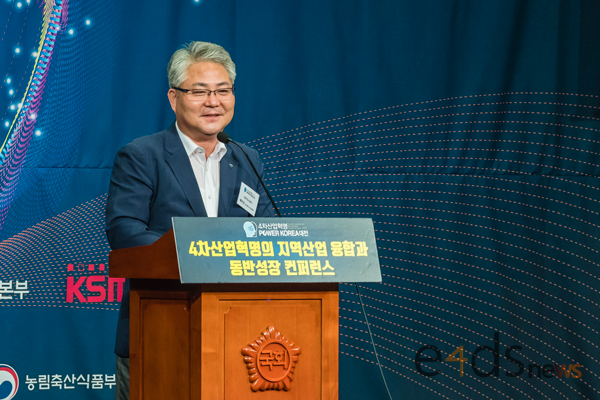
▲ Daegu Urban Development Corporation Director Bae Woo-seong (Photo = Reporter Lee Su-min)
Suseong Alpha City, built on 976,000㎡ of land in Daeheung-dong, Suseong-gu, Daegu Metropolitan City, was completed with a total project cost of 614.2 billion won invested over 10 years starting in 2008.
In August 2019, Suwon Alpha City completed 13 services in 5 major fields and completed stability and efficacy verification. Many small and medium-sized enterprises are currently participating in the verified system. Daegu Urban Corporation plans to gradually make existing urban areas smart and fully apply smart technology to new development sites from the planning stage.
The process of building Daegu Suseong Alpha City
Susung Alpha City was not built as a smart city from the beginning. Daegu City’s smart city construction project began with the Susung Smart City Strategy Meeting held in December 2015. In July 2016, Daegu City decided to build a smart city test bed in the Susung Medical District, and began construction work on October 25, 2017. October 2017 was also when the government announced smart cities as a national innovation growth leading project.
In July 2018, it was selected as a demonstration project for the Smart City National Strategy Project. At the same time, after carrying out the autonomous driving infrastructure construction project from May to October, the International University Autonomous Driving Competition was successfully concluded on November 2. On December 26, 2018, Susung Alpha City was finally completed.
Daegu Smart City aims to improve the quality of life of citizens, improve the efficiency of urban management, foster growth industries, and foster talent by connecting IoT connection, urban control, urban data, and urban information provision platforms. The implementation and connection of the platform uses IoT, cloud, AI, and autonomous driving, which are technologies based on the 4th industrial revolution.
Smart City Platform Differentiated from U-City Control Center
There was a time when the concept of ubiquitous computing was popular. Ubiquitous computing refers to an environment in which users can freely access networks regardless of location without being aware of the computer or network.
In 2008, the Ubiquitous City Act was enacted. A Ubiquitous City, or U-City for short, refers to a city that provides citizens with the conditions to conveniently receive and utilize city information on administration, transportation, welfare, environment, and disaster prevention anytime and anywhere.
The organization that oversees U-City operations is the U-City Control Center. However, the U-City Control Center only allows one-way data transmission, and there is a time difference, making it difficult to share and utilize city data. Additionally, the development of civilian solutions was impossible.

▲ Differences between U-City Control Center and Smart City Platform
(Image source = Suwon Alpha City Smart City Platform Center)
In 2017, the Ministry of Land, Infrastructure and Transport decided to replace the outdated term ubiquitous. And the Ubiquitous City Act was renamed the Smart City Act. The difference between a smart city and a U-city is that instead of a U-city control center, there is a basic system called a smart city platform.
The smart city platform collects and organically analyzes city data based on ICT technology to efficiently manage the city through convergence service management and situation prediction. It can share real-time information in both directions with the U-City control center and can be linked to a data sharing platform. Since development of private solutions is also possible, it has become easier for small and medium-sized businesses to develop solutions.

▲ Daegu-type smart city platform configuration diagram
(Image source = Suwon Alpha City Smart City Platform Center)
The smart city platform of Suwon Alpha City follows the IoT international standard. OneM2M and LWM2M are applied, and it supports international standard open API. In addition, real-time data analysis is possible through the real-time complex event processing (CEP), enabling city situation analysis and rapid accident processing support. CEP uses machine learning to determine the appropriateness of the CEP analysis rule, and predicts and corrects the rule threshold.
It also provides CCTV footage analysis using AI. It can identify where trash is piled up, who is driving the wrong way on the road, and which field has a fire. It collects this data and provides event, object-based search, and statistical functions.
There is also a developer portal for device developers and application developers. Through the developer portal, developers can check whether the functions they have developed are working properly. In addition, specialized services are provided through a dedicated app (Susung Citizen) for Susung Alpha City residents. Data collected through various routes are used in the decision-making process to solve urban problems. The Suwon Alpha City Smart City Platform provides urban operation indicator functions and provides internal and external data analysis results.
As a smart city test bed
Daegu Urban Development Corporation divided the Susung Alpha City Smart City project into two stages. Stage 1 is to build 13 pilot services in five areas including transportation, energy, living, safety, and urban infrastructure management to create smart city infrastructure, and has already been completed.
The 13 pilot services are autonomous vehicle test roads, intelligent pedestrian safety systems, road hazard information provision, unmanned illegal parking control systems, smart streetlights, living safety CCTVs, license plate recognition CCTVs, smart media walls, smart walking, digital signage, private communication networks, communication stations, and electric vehicle chargers.
Phase 2 is the construction of a smart city business center. The business center will include a control center that organically manages the 13 service-based facilities built in Phase 1 by connecting them into an integrated platform, as well as a 4th Industrial Revolution Startup Support Center that encourages collaboration, such as technology support development between large and small businesses.
Smart streetlight and underground facility management service

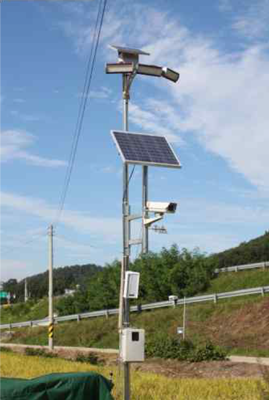
▲ Mercury Alpha City Smart Streetlights
(Image source = Suwon Alpha City Smart City Platform Center)
Can you imagine a city without streetlights? Smart streetlights are intelligent versions of streetlights that are essential to cities, and 18 of them are currently in operation in Suwon Alpha City.
Smart streetlights are equipped with intelligent CCTV, emergency bells, various multi-functional sensors, Wi-Fi, LoRa, GPS, and other communication modules. Through this, smart streetlights are connected to the Susung Police Station with real-time monitoring and emergency bell services, immediately ensuring the safety of citizens.
Convenience is also enhanced by providing Wi-Fi. In addition, it improves the appearance of the city by integrating various functions into one smart streetlight.
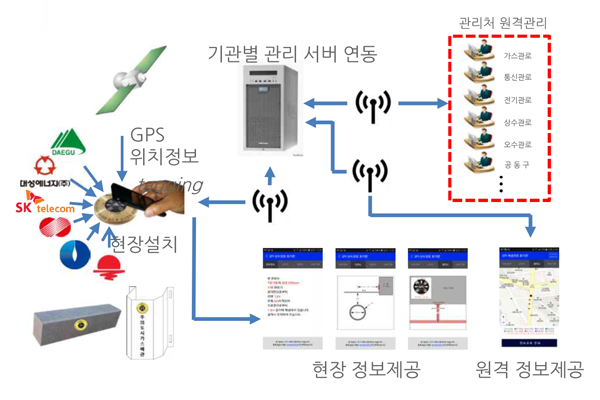
The underground facility management service provides information through an app by integrating information on underground water and sewage pipes, communications, electricity, gas, and other facilities with location information.

▲ Concept diagram of underground facility management service
(Image source = Suwon Alpha City Smart City Platform Center)
By utilizing the underground facility management service, safety accidents can be prevented by providing information on underground facilities during excavation work, and the spread of disaster can be prevented by remotely providing information on underground facilities in the event of an accident. It can also provide various information such as depth, diameter, material, and management organization.
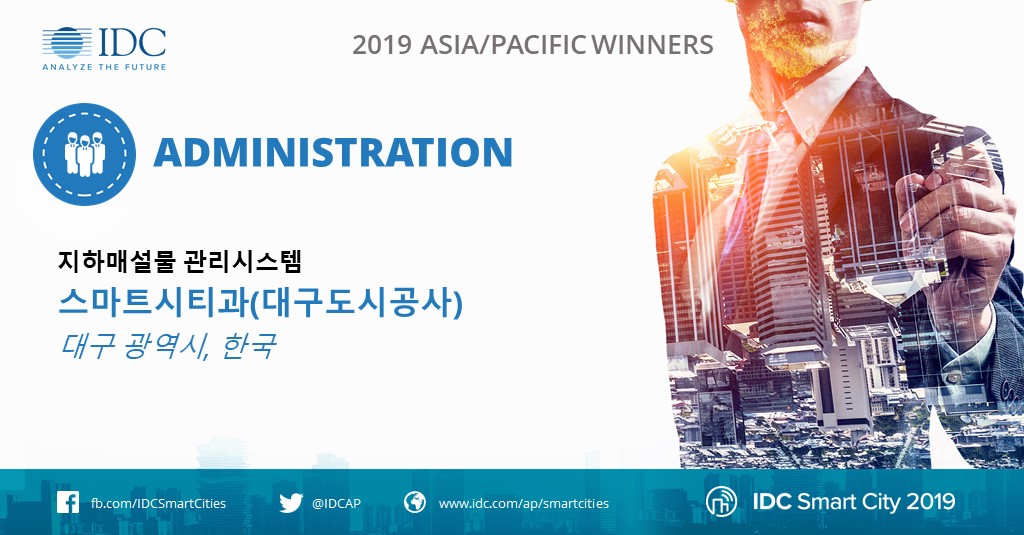
This underground facility management service has proven its effectiveness by being selected as the best administrative project at the 2019 Smart City Asia Pacific Awards (SCAPA).
SCAPA recognized the development of the SPI (Smart Pipe Indicator) application, which provides information on various underground facilities such as water supply, sewerage, city gas, and communication networks to smartphones through an intelligent buried pipeline recognition indicator (NFC) tag.

▲ Daegu Suseong Alpha City Underground Facility Management Service
Selected as the best project in the Asia Pacific region smart city administration sector
(Image source = IDC 2019 SCAPA)
Selected as the best project in the Asia Pacific region smart city administration sector
(Image source = IDC 2019 SCAPA)
In existing cities, users had to check information on underground facilities from each management agency, but in Suwon Alpha City, users can check information on the status of underground facilities anytime, anywhere by using the SPI application.
A smart city that encompasses the region’s present and future
It is impossible for the government or large corporations to develop all solutions. Also, a smart city is about increasing citizens’ access to urban infrastructure. Solutions developed without understanding citizens or the city are ultimately abandoned. The top-down approach has already revealed its limitations in the disjointed U-City.
Professor Yongjin Kim of Sogang University's Department of Business Administration, who gave a lecture on the topic of digital transformation and regional industrial convergence, said, "The government's regional industrial R&D projects are not bearing fruit because the concentration of human resources and resources in the metropolitan area has not been resolved." He added, "We need to establish a regional-led policy governance rather than a central government-led governance and implement a regional industrial development strategy based on the unique culture and identity of the region."
He added, “Rather than providing funding to one small business to turn it into a medium-sized business, the government should work harder to create an environment where many small businesses can come together and cooperate.”
Director Bae Sung-woo said, “Susung Alpha City is a smart city test bed that supports the development of new products, technologies, and services related to smart cities, as well as the cultivation of talent,” and explained, “It not only provides high safety and specialized convenience to Daegu citizens, but is also a place where 4th Industrial Revolution technology entrepreneurs and companies can develop, verify, and commercialize technologies.”
He continued, “The Susung Alpha City Smart City, which began development two years before the central government, is now a leading model for the domestic smart city platform,” and “We will actively support fostering the technological capabilities of the 4th Industrial Revolution by bringing together local companies through the smart city platform we have developed and the smart city business center that will be built in the future.”
본 기사에 대한 정정·반론·추후보도 청구는 보도 청구 안내를, 그간 게재된 보도문은 정정·반론보도 모아보기를 참고해 주세요.

.png)