


22 Locations Selected for Big Data Platform and Center Construction Project
 Published2019.09.06 16:05
Promoting the open call process for the selection of additional centers
The Ministry of Science and ICT announced the selection results for the 'Big Data Platform and Center Construction Project' on the 6th. To select projects for the open call, the Ministry of Science and ICT held an evaluation committee meeting at the Korea Information Society Agency in late August.

The Ministry of Science and ICT plans to invest a total of 151.6 billion won over three years to establish 10 sector-specific platforms and 100 linked institutional centers, and will proceed with the project this year on a scale of 64 billion won.
At the same time, institutions and companies selected in this year's open call projects will undergo an annual evaluation to determine whether to continue support for the second and third years.
Last June, the Ministry of Science and ICT selected platforms in 10 fields and 72 centers, and proceeded with a public call for proposals to select 28 centers.
As a result, a total of 37 projects in 10 fields were received from July 8 to August 8, and 22 projects were selected through a two-stage evaluation process including field-specific evaluation and comprehensive evaluation.
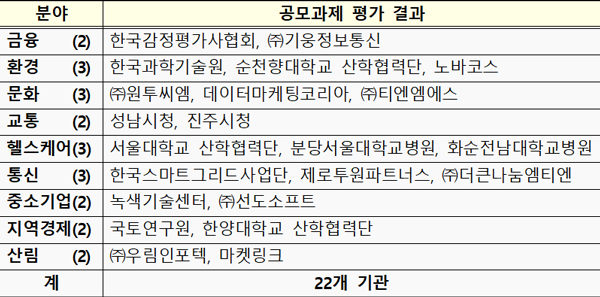
In the healthcare sector, Seoul National University Bundang Hospital is pursuing the establishment of a Cancer Big Data Center, and the National Cancer Center, the implementing agency for the Cancer Big Data Platform,Enhances the linkage effect with the site.
Seoul National University Bundang Hospital plans to produce and build standard clinical data for approximately 30,000 cancer patients, including diagnostic, treatment, and follow-up data for five major types of cancer: breast, colorectal, lung, stomach, and ovarian cancer. It then plans to utilize this data for national-level cancer diagnosis and treatment decisions, as well as for the research and development of anticancer drugs, in order to provide cancer prevention and diagnosis solutions.
In the transportation sector, Seongnam City Hall, which possesses infrastructure data such as CCTV footage, serves as the implementing agency and is pursuing the establishment of an autonomous vehicle big data center in collaboration with the Electronics Technology Institute, which holds autonomous vehicle control data, and Unicomnet, which holds driving environment data.
Seongnam City Hall and Unicomnet will produce and build approximately 70,000 pieces of data on autonomous vehicles and driving environments over a three-year period, including autonomous driving sensor data, unstructured CCTV road video data, seasonal and situational road video data, and movement video data of vulnerable road users. In addition, they plan to strengthen the competitiveness of the autonomous vehicle ecosystem by linking with the transportation big data platform (implementing agency: Korea Transport Institute), including the development of AI-based autonomous driving control algorithms and autonomous driving models.
In the telecommunications sector, the Korea Smart Grid Association, an industrial promotion agency for intelligent power grids, is pushing ahead with the establishment of a Smart Grid Big Data Center.
Based on smart meters and energy management systems, we will produce and establish real-time electricity usage data for 150,000 individual households in apartments and commercial buildings, as well as 550 factories and office buildings, and processed energy data that reflects demographic characteristics such as the number of residents per apartment household. In addition, we plan to support the revitalization of the smart home and smart city industries through linkage with telecommunications big data platforms.
In addition to this, in the regional economy sector, the Korea Institute for National Land Planning and Research is promoting the establishment of a National Land and Urban Big Data Center to support site selection for regional development companies. In the financial sector, the Korea Association of Real Estate Appraisers, which holds 2.6 billion pieces of real estate-related data, is pursuing the establishment of a real estate appraisal big data center. In the culture sector, TNMS is pursuing the establishment of a media big data center. The plan is to enhance synergy through collaboration between the 22 big data centers selected this time and existing sector-specific platforms.
Kim Jeong-won, Director General of Internet Convergence Policy at the Ministry of Science and ICT, stated, “This project, which has been underway since this year to lay the foundation for a data ecosystem, has completed the selection of platforms in 10 fields and 94 centers under the interest and support of many companies and institutions.”
“We will complete the open call process for the remaining six centers as well and continue our policy efforts to ensure that various data that has not been distributed until now can be easily secured and utilized through sector-specific platforms,” he stated.
The implementing organizations selected for this open call will be finalized in September after undergoing deliberation procedures by the Project Coordination Committee regarding the scope of the project and budget adjustments.
Meanwhile, the open call process to select six additional centers is scheduled to be conducted in early September. Details can be found on the websites of the Ministry of Science and ICT and the National Information Society Agency .
Comments
Related news
Sejong City to Launch Autonomous Public Transportation Starting 2021
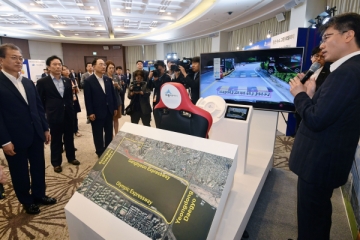
President Moon Jae-in held a roundtable discussion at Nurimaru APEC House in Haeundae, Busan with provincial governors, government officials, and business representatives under the theme of "Regulatory Sandbox as the Center of Region-Led Innovative Growth." At this meeting, the government's support plan for the regulatory sandbox, which was introduced to promote regional innovation and strategic growth, was announced. LG Uplus unveiled its plans for autonomous driving demonstration projects and 5G technology to enhance the safety of autonomous driving in collaboration with Sejong Special Self-Governing City. LG Uplus plans to work together with Sejong City to establish and operate an autonomous driving big data control center, and will promote autonomous shuttle operation services based on stable 5G networks on general roads, residential complexes, and urban parks within Sejong City.
2019.07.25by 이수민 기자

The ICT budget has been released. 72.2 billion won has been secured for high-tech startups and other projects.
The government has secured a budget for supporting high-tech startups by middle-aged and older entrepreneurs. It will provide 31.8 billion won to support technology startups for the Baby Boomer generation aged 40-50, who account for 66% of the startup market, and allocate a total of 15.4 billion won to emerging technology startup sectors such as artificial intelligence, big data, and Internet of Things. Additionally, support will be provided to the materials, components, and equipment sectors in response to Japan's export restrictions.
2019.08.19by 명세환 기자
The present and future of the smart city platform as seen through Daegu Suseong Alpha City
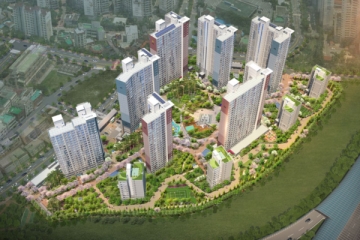
As population concentrates in urban areas, various social and environmental problems are emerging. Smart city is an urban model that can solve various urban issues and improve quality of life by integrating new technologies such as ICT and big data into cities. Recently, it has further evolved to aim for an urban platform—a space where diverse innovative technologies can be implemented and converged by combining them with urban infrastructure. Daegu Suseong Alpha City completed 13 services across five smart city domains in August 2019 and finished verification of stability and effectiveness. Daegu Urban Corporation plans to systematically smartify existing urban areas going forward, while applying smart technologies comprehensively from the planning stage in newly developed areas.
2019.09.03by 이수민 기자
Nvidia invests $5 billion in Intel
NVIDIA and Intel, leaders in global AI computing technology, are now forging ahead in providing cutting-edge solutions through NVLink-based architecture integration. NVIDIA and Intel have officially announced a strategic partnership and stated that they will jointly develop customized data center and personal computing products to accelerate diverse applications and workloads ranging from hyperscale to enterprise and consumer markets, thereby laying the foundation for the next generation computing era.
2025.09.22by 배종인 기자
.jpg)
Applied Materials Launches Environmental Protection Campaign to Mark World Cleanup Day
Applied Materials Korea (CEO Park Kwang-seon) is carrying out environmental cleanup activities with employees and their families around the Dongtan Sinricheon area on the occasion of World Cleanup Day, evolving into a company that engages with the local community beyond technological innovation.
2025.09.22by 명세환 기자











