


Four ITU-T security standards proposed by Korea have been pre-adopted.
 Published2019.09.09 07:01
Korean companies and organizations participated in establishing international standards for information security in the era of the Fourth Industrial Revolution, making their voices heard.
The National Radio Research Agency of the Ministry of Science and ICT announced that four recommendations on intelligent vehicle security, quantum cryptography, and smart grid, developed by Korea, were pre-adopted as international standards at the International Telecommunication Union Telecommunication Standardization Sector (ITU-T) SG17 (Security) international conference held in Geneva, Switzerland from August 27 to September 5.
The first recommendation, the international standard 'V2X Communication Environment Security Guidelines (X.1372)', defines security technology for vehicle communication, which is the most fundamental for autonomous vehicle services.
This standard has been developed since 2014 by the Electronics and Telecommunications Research Institute (ETRI), Hyundai Motor Company, and Kakao Mobility. V2X (Vehicle-to-Everything) communication refers to communication between vehicles (Vehicle to Vehicle; V2V), vehicles and transportation infrastructure (Vehicle to Infrastructure; V2I), vehicles and mobile devices (Vehicle to Device; V2D), and vehicles and pedestrians (Vehicle to Pedestrian; V2P).
By defining security threats, security requirements, and use cases for each communication channel, this document is expected to serve as useful data for domestic industries researching autonomous vehicles, helping them develop products, prevent duplicate investments, and ensure vehicle safety.
The second recommendation, the international standard 'Connected Car Security Threat Definition (X.1371)', defines use cases for providing intelligent vehicle security services and identifies and defines security threats that may arise in each case.
This standard, developed by ETRI, Hyundai Motor Company, and Kakao Mobility since 2018, identifies and defines security threats that consider external hacking, backend servers, communication channels, and update procedures for intelligent vehicle security.
It is expected to be applied as a basic standard to the international standard for intelligent vehicle security developed by ITU-T in the future, and it is also expected to be utilized in domestic vehicle security research, securing technological superiority and contributing to exports.
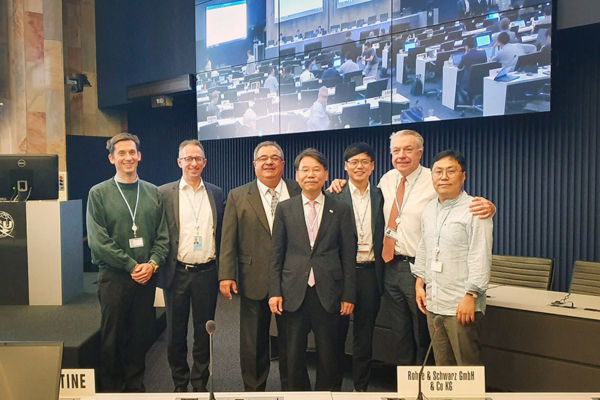
SK Telecom Team Leader Shim Dong-hee (far right) (Photo = SK Telecom)
The third recommendation, 'Quantum Noise Random Number Generator Structure (X.1702)’ The international standard defines the world's first random number generation method that applies quantum technology from a security perspective.
This standard, which has been developed by SKT since 2018, is a quantum technology that generates unpredictable and patternless pure random numbers, and is expected to enhance the security of cutting-edge services such as the Internet of Things, autonomous vehicles, and smart cities.
The fourth recommendation, the international standard 'Smart Metering Service Security Guidelines (X.1332)', defines security measures to safely utilize data collected from users' smart meters in a smart grid environment.
Smart grid is a service that manages the effective supply of electricity by remotely automating the transmission of electricity usage and quality information from electricity suppliers to all electricity consumers.
This standard, developed under the leadership of the National Security Research Institute since 2016, defines how electricity usage and quality information collected from smart meters installed in consumer areas can be safely shared among power companies, value-added service providers, and consumers. Therefore, it is expected to be applied to the shared use of electric power and energy big data, which is expanding through the domestic new energy industry plan.
Meanwhile, at this meeting, our country proposed and passed four new standardization tasks, including the 'Definition of Distributed Ledger Technology Terminology' standard, which is the result of the recently concluded FG-DLT (ITU-T Focus Group on Application of Distributed Ledger Technology) meeting. It is expected that Korea's standardization position will further expand in the future research and development of security technologies, including blockchain technology.
Lee Kyung-hee, head of the International Cooperation Team at the National Radio Research Agency, said, “Based on the results of this international conference, we have confirmed Korea’s status in the field of information security within the ITU-T,” and “We expect this to greatly contribute to enhancing the international market competitiveness of the domestic information security industry.”
Comments
Related news
Domestic quantum cryptography technology is on the verge of adoption as an ITU international standard.
Quantum key distribution (QKD) technology is a next-generation communication security technology that makes eavesdropping and wiretapping impossible. QKD technology is also called quantum key distribution technology, which is based on the laws of quantum mechanics, such as the no-cloning theorem of quantum states, and securely distributes encryption keys—that is, one-time random number tables—in real-time between sender and receiver. Recently, there has been a clear trend of quantum key distribution technology development among the three major domestic mobile carriers. The three carriers recently opened the 5G era. While 5G features ultra-high speed, ultra-low latency, and ultra-connectivity, its architecture, which processes data at the base station level, has weak security. This problem is expected to become more severe in 6G, which will emerge within the next decade. Accordingly, it appears that the three carriers have selected quantum key distribution as a security countermeasure.
2019.07.01by 이수민 기자
Korea Leads ITU-T International Standardization Research on Distributed Ledger Technology
The National Institute of Radio Research of the Ministry of Science and ICT announced that three pre-standardization research documents on distributed ledger technology, developed under South Korea's leadership, were agreed upon as final deliverables of the ITU-T Distributed Ledger Technology Focus Group International Conference held in Geneva, Switzerland from July 29 to August 1. Distributed ledger technology is an information security technology designed to protect digital ledgers in which participants in a P2P network continuously update all transaction records, and integrity is verified through a decentralized consensus mechanism when data states are modified or recorded, providing advantages against document forgery, tampering, and hacking. These three research documents will be transferred to the ITU-T SG17 study group and are scheduled to be developed as formal international standards.
2019.08.03by 이수민 기자
.jpg)
Pisofttech Participates in 2019 BRICS Future Networks Innovation Forum
At the 2019 BRICS Future Networks Forum held in Shenzhen, China on the 6th of this month, the BRICS Institute of Future Networks hosted a forum to deepen ICT cooperation among member states. Alongside officials from global ICT organizations such as the ITU and GSMA, ICT directors from various countries including China, Russia, India, South Africa, the Philippines, and Egypt attended. Meanwhile, around the same time, major Chinese 5G companies including telecommunications carriers, Huawei, ZTE, and Shenzhen Pisoft Technology held a 5G experience week at Futian Station, Asia's largest underground high-speed railway station, to demonstrate 5G application solutions.
2019.08.19by 명세환 기자
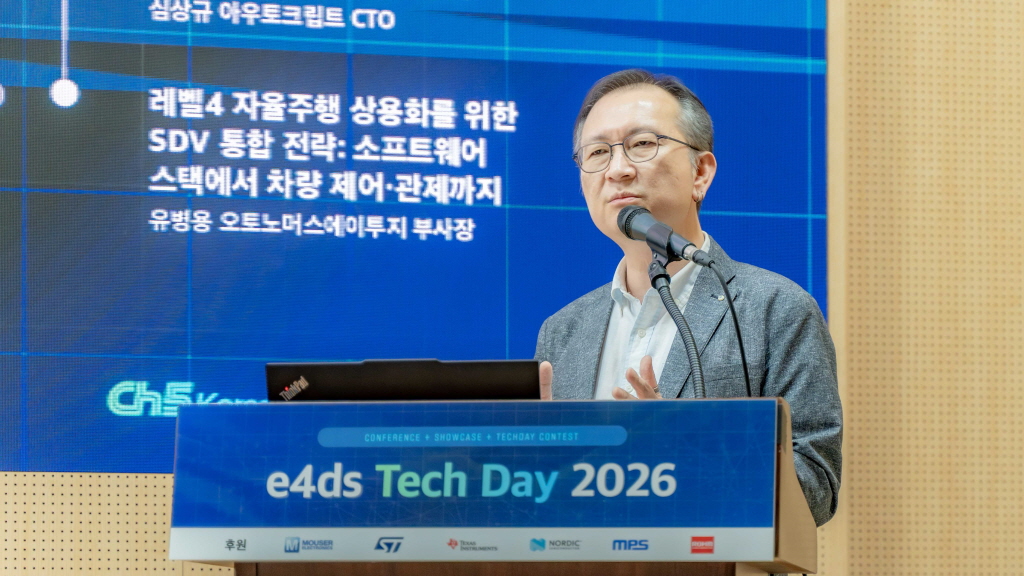
[e4ds Tech Day 2026 ⑨] Sim Sang-gyu, Autocrypt CTO: "In the Physical AI Era, Automotive Security Must Extend Beyond the Vehicle"
At e4ds Tech Day 2026, Sim Sang-gyu, CTO of Autocrypt, explained automotive cybersecurity strategies in the era of Physical AI and SDV (Software-Defined Vehicle). Automobiles are evolving as part of an ecosystem connected to AI, cloud, chargers, IoT, and robots, and he emphasized that the scope of security must expand beyond the vehicle interior to the entire connected environment. In particular, AI model tampering, adversarial attacks, OTA updates, and EV charger hacking were identified as major threats. He explained that response measures require zero trust, AI model integrity protection, intrusion detection, Security by Design and Default, and full lifecycle security management, and that proactive security system establishment beyond regulatory compliance is critical for securing future mobility competitiveness.
2026.10.12by 배종인 기자
Practical HIL Construction Strategy for Automotive and Off-Highway Controller Validation
As vehicle E/E architecture transitions to zonal structures and shifts to software-defined vehicles (SDV), the number of controllers (ECUs) requiring validation and software complexity are surging dramatically. Meanwhile, real vehicle testing cannot provide repeated verification under identical conditions and entails lead time and safety concerns. This white paper explains the principles of HIL (Hardware-in-the-Loop) validation and the structure of the NI platform composed of PXI, SLSC, and VeriStand, and through two actual implementation cases—Camera Record & Replay HIL for In-Cabin Monitoring Controller (ICMU) and Forklift Controller (VCU) HILS—describes how controller-level regression testing becomes possible. Additionally, it explicitly states application boundaries and limitations, such as lack of A2B support.
2026.10.12by 편집부











