



Investment in raw materials, components, and equipment R&D will double starting next year.
 Published2019.09.11 12:05
| Innovating the way we conduct R&D to increase investment efficiency
Expanding open, shared, and collaborative research and development infrastructure
In response to Japan's export restrictions and other global material strategy weaponization, the budget for basic R&D of materials, components, and equipment with a mid- to long-term perspective will be significantly expanded.
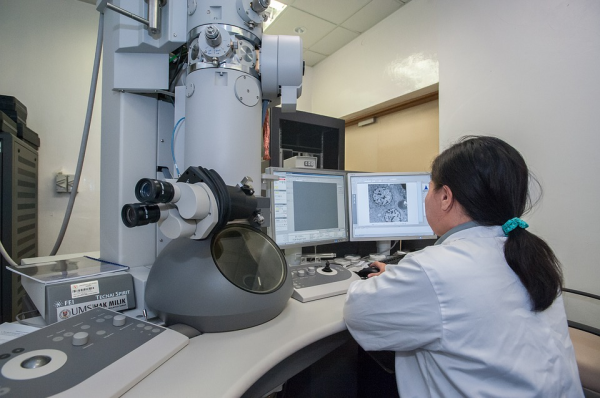
Following Japan's announcement of export restrictions on key semiconductor materials on July 4, the government, in collaboration with relevant ministries, announced the "Measures to Strengthen Competitiveness in Materials and Components to Escape Externally Dependent Industrial Structure (August 5, 2019)" and the "Comprehensive Measures for Research and Development of Materials, Components, and Equipment to Strengthen Self-Reliance in Core Source Technologies (August 27, 2019)" in succession.
The main contents include securing short-term supply stability for strategic items, strengthening the competitiveness of the entire materials, components, and equipment industry by establishing a healthy cooperative model between demand and supply companies, and expanding R&D investment to strengthen self-reliance in core technologies.
In line with this, the Ministry of Science and ICT plans to ▲ drastically expand the scale of investment in basic source R&D, ▲ innovate R&D promotion methods and eliminate barriers between ministries to improve investment efficiency, and ▲ expand R&D infrastructure based on openness, sharing, and cooperation.
Strong>Doubling investment in basic R&D for materials, components, and equipment.
The government's plan to expand the basic R&D investment in materials, components, and equipment, which is currently worth approximately 160 billion won, to approximately 300 billion won next year.
Support for basic research continues to expand. In 2020, approximately 60 basic research laboratories specializing in materials and components will be designated to support the expansion of research bases and the acquisition of basic technologies for core materials technology self-sufficiency in key industries such as semiconductors and displays.
To secure core technologies, a new nano-future materials core technology development project will be launched with a total investment of KRW 400.4 billion from 2020 to 2032, linking basic research results to commercialization. In addition, in addition to the existing 25 future materials discovery research groups, we plan to select three new research groups to secure original patents for innovative alternative materials for materials with high dependence on foreign sources.
Through the Materials Innovation Leading Project (KRW 32.6 billion in 2020), we plan to establish a materials innovation platform that integrates core technologies held by universities and research institutes with corporate demands. This will also address the gap between basic research and development/commercialization research, which has been a chronic problem.
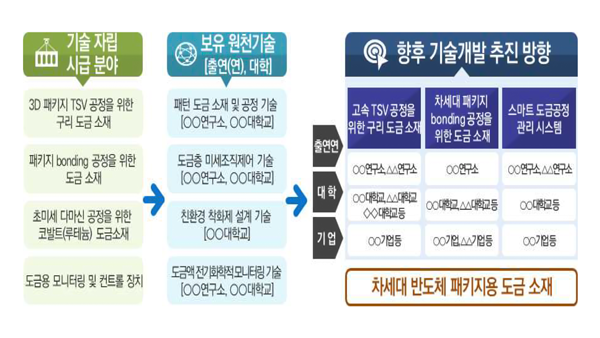
(Image = Ministry of Science and ICT)
In addition, basic R&D investment, which has been mainly focused on future materials, will be diversified to include materials that urgently require technological independence in key industries and materials for preemptive crisis response in response to potential material strategic weaponization.
The Ministry of Science and ICT has, through gathering opinions from industry, academia, and research experts, identified approximately 30 essential technologies (such as next-generation semiconductor plating materials and high-temperature/ultra-high voltage semiconductors) that are key to the development of approximately 100 strategic items that urgently require technological advancement at the national level or require more fundamental replacement. The Ministry plans to support the initiation of technological development by considering factors such as the urgency of investment and the ripple effect of technological development.
Development of extreme ultraviolet (EUV) light sources and inspection equipment for semiconductor inspection based on synchrotron radiation accelerators (KRW 11.5 billion in 2020) and development of domestic technology for research equipment for advanced measurement and analysis (KRW 7.3 billion in 2020) We plan to promote it.
Innovation in R&D implementation methods to improve the efficiency of basic R&D investment.
When promoting basic research and development (R&D), we will alleviate excessive competition among industry, academia, and research institutes to secure projects, and further strengthen the division of roles and collaboration among R&D entities.
The Materials Research Institute Council (March 2019~), which has been operated primarily by 11 existing public research institutes, will be expanded and reorganized to launch the (tentative name) Materials Innovation Strategy Headquarters (scheduled for early 2020). This will strengthen collaboration channels between academia, industry, and research institutes and actively support the creation of diverse successful models for role division and cooperation among universities, government-funded research institutes, and corporations. For example, universities would conduct basic research, public research institutes would conduct applied research, and corporations would conduct developmental research.
To ensure that the significantly expanded basic source R&D project is carried out through optimal project promotion methods, differentiated support methods will be fully implemented based on the level of relevant technology and industry maturity.
For materials where industrial maturity is insufficient compared to technological advancement, relevant companies and research groups will jointly establish clear technological goals and pursue technology-leading research. We also plan to expand the selection of policy-designated leading research groups, with participation from research groups possessing relevant technologies and companies in need.
In the materials sector, where technological advancements are low compared to the competitiveness of related industries, we plan to pursue rapid technological advancements through a competitive R&D approach. For unexplored areas with low technological advancements and industrial competitiveness, we also plan to introduce a challenging R&D approach to maximize researcher creativity.
We plan to strengthen the link between basic research and core technology development within the Ministry of Science and ICT, as well as the “linkage” between the Ministry of Science and ICT and the Ministry of Trade, Industry and Energy in materials research. We plan to discover and support various collaborative models, such as supporting follow-up research led by companies on the development of core technologies by universities and research institutes (relaying), responding to the demand for core technology development in areas where gaps arise during the commercialization process (reverse relaying), and simultaneously promoting basic core R&D and applied development R&D (joint running).
Expanding open, shared, and collaborative research and development infrastructure
To promote information sharing and openness among materials and component R&D entities and support organic collaborative R&D based on cutting-edge research infrastructure, approximately KRW 170 billion will be newly invested over the next five years, starting this year.
First, we plan to establish a materials research data platform (KRW 45 billion, 2020-25) that will collect, share, and utilize the diverse research data accumulated by individual researchers during the materials and components R&D process. This will drastically shorten the R&D period and promote the linkage and integration of diverse research outcomes.
Additionally, we will support the construction of a 12-inch semiconductor public test bed (KRW 45 billion, 2019-2022) to enable semiconductor material component researchers and small and medium-sized enterprises to verify their research results and prototypes in an environment similar to actual semiconductor processes. Investment will also be significantly strengthened to establish a Multi-Project-Wafer (MPW) process support system (KRW 45 billion from 2019 to 2022) to support small and medium-sized fabless companies designing system semiconductors.
Meanwhile, the Ministry of Science and ICT is currently allocating a supplementary budget of 24.1 billion won this year to create early results by improving the perfection of existing material source technologies and to establish an urgent semiconductor material component test bed. It plans to finalize the selection of research groups and facility equipment construction institutions by September.
The Ministry of Science and ICT plans to enhance on-site understanding of the expanded materials, components, and equipment basic source R&D project and hold weekly "on-site briefing sessions." In addition, it plans to increase the number of research management professionals (PMs) in the materials, components, and equipment field at research management specialized institutions from 34 to 52, and simultaneously reinforce the substantial project management system.
Comments
Related news
Ministry of Science and ICT to Promote Training for Unemployed R&D Personnel in Materials, Parts, and Equipment Sector
The Ministry of Science and ICT and the Korea Industrial Technology Advancement Association will recruit 80 master's and doctoral degree holders to participate in the 2019 supplementary budget science and engineering specialized technical training (master's and doctoral) program starting from the 27th. This program provides unemployed master's and doctoral degree holders in science and engineering with opportunities to gain industrial R&D experience by conducting industry-related R&D projects at government-funded research institutes and national/public research institutions, and supports their employment at excellent companies requiring master's and doctoral personnel by fostering R&D capabilities such as utilization of national research equipment. Young researchers who are currently unemployed will receive training at materials, parts, and equipment research institutions including the Korea Chemical Research Institute, Nano Comprehensive Technology Center, Korea Nano Technology Institute, Materials Research Institute, and Korea Institute of Science and Technology, and are expected to develop into industrial R&D professionals who will contribute to the future localization of materials, parts, and equipment.
2019.08.28by 이수민 기자
The government establishes R&D investment strategies and innovation measures for materials, parts, and equipment, and invests 5 trillion won.
As of August 28, our country was removed from Japan's whitelist. Simultaneously, the Ministry of Science and ICT, the Ministry of Trade, Industry and Energy, the Ministry of SMEs and Startups, and the Korean Intellectual Property Office held an expanded countermeasure meeting against Japanese export restrictions chaired by the Prime Minister, concurrent with the 7th Ministerial Conference on Science and Technology, and finalized R&D investment strategies and innovation measures for materials, components, and equipment. This measure was established in conjunction with the government's materials, components, and equipment competitiveness enhancement plan announced on the 5th, with the aim of fundamentally resolving the issue of external dependence on key items through R&D and securing strategic positioning in core source technologies.
2019.08.28by 이수민 기자
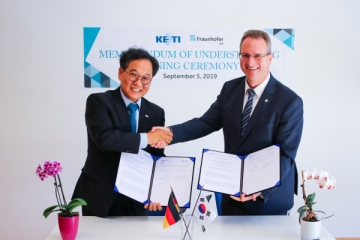
KETI Signs MOU with Germany's IAP for Display R&D
KETI signed a memorandum of understanding with Fraunhofer IAP Institute for technology development in the quantum dot display field at the conference room of Fraunhofer IAP Institute in Potsdam, Germany. IAP operates seven research divisions including biopolymers, functional polymer systems, synthetic polymer technology, polymers for life science and bio processes, and nano-application technology. Additionally, it provides corporate support services including process development and optimization, testing analysis and consulting, and is actively collaborating with private enterprises. KETI and IAP have continued their cooperation since 2009 through joint technology development and research personnel dispatch for material and device technology development in the display field. Through joint research on core materials and device implementation process technology, they are contributing to securing the display industry competitiveness of domestic companies.
2019.09.10by 이수민 기자

Intel Unveils Next-Generation 'Core Ultra Series 3' and vPro Platform for Enterprise PCs
Intel has officially unveiled the "Intel Core Ultra Series 3" for next-generation enterprise PCs and the latest vPro platform, addressing a wide range of demands from enterprise notebooks to high-performance workstations.
2026.03.26by 배종인 기자

ROHM Launches ESD Protection Diode Compatible with High-Speed Interfaces of 10Gbps or Higher
Semiconductor specialist ROHM has developed the 'RESDxVx series' of ESD (electrostatic discharge) protection diodes capable of responding to next-generation high-speed data communication environments exceeding 10Gbps, simultaneously enhancing both signal quality maintenance required in high-speed interfaces and IC protection performance.
2026.03.26by 배종인 기자











