This page was machine-translated and may differ from the original. View original
"Now an essential element of home appliances" Variable speed drive must be implemented for efficient use of BLDC motors

It has been several years since Dyson's cordless vacuum cleaner changed the vacuum cleaner market. Unlike existing cordless vacuum cleaners that had weaker suction power than corded vacuum cleaners and were used only as auxiliary devices, Dyson's cordless vacuum cleaner captured the hearts of male consumers in particular with its powerful suction power.
Inspired by Dyson's success, the world's leading home appliance companies have entered the cordless vacuum cleaner market. Representative products include LG's 'Cord Zero' and Samsung's 'Power Gun'.

This is a market change brought about by the development of motors. As motors with freely adjustable speeds and long lifespans become widely available, manufacturers can now implement the functions they want. And in order for manufacturers to implement the motor functions they want, they need a variable speed drive solution to control the motor.
What solutions are needed to implement variable speed drives?
We asked Geunhyung Lee, Manager of the Industrial Power Semiconductor Business Unit at Infineon Korea, about iMOTION, Infineon's variable speed drive solution.
Q1. There is a growing number of companies, including Dyson and LG Electronics, that are marketing their home appliances using BLDC motors or inverters. What are the advantages of using BLDC motors in home appliances?
With the increasing demands for energy efficiency, lifespan, noise and safety in recent motor applications, the use of BLDC motors is increasing in various fields.
Unlike the AC motors used in the past, BLDC motors do not have brushes or commutators inside, so there is no wear and tear and they have a long lifespan. There is no mechanical friction, so low-noise operation is possible. In addition, they can be operated at higher RPMs, and because of their structure, there is no dust caused by mechanical friction, and they are protected from the outside through the housing, making them environmentally friendly and safe.
Q2. Due to the characteristics of the products in which BLDC motors are used, it seems that they often change speed and direction depending on the situation rather than rotating at a constant speed. What parts and technologies are needed for this control?
Unlike AC motors that only operate on and off, BLDC motors can control their speed as needed, which requires a variable speed drive.
To implement a variable speed drive, AC is functionally rectified and the motor speed is controlled through the inverter stage via the DC link capacitor. In this process, a PFC stage may be required to meet the power factor standard. In addition, a controller and sensor that can control this variable speed drive as a whole are required.
The core parts among these are the PFC section, the inverter section, and the motor control section. For a 3-phase motor, configuring an inverter requires six power switches (MOSFETs or IGBTs and diodes), a gate driver IC with protection against overvoltage, overcurrent and overload, and a temperature sensor.
Although it is possible to construct these as individual components, IPM (Intelligent Power Module) that integrates all components into one is widely used for convenience of development, simplification of assembly process, ease of parts procurement, and high system reliability.
For motor control, MCU or motor controller is also used. If MCU is used, motor control algorithm must be developed independently, so software engineering capabilities are required as well as knowledge of motors.

Q3. What exactly is iMOTION, Infineon's motor control solution? I wonder if it is the name of a product line or the name of a related technology. Also, is it a product or technology that can respond to AI? iMOTION is the general name for Infineon's motor control product line. iMOTION can be broadly divided into three product lines.
The iMOTION Controller, which I will introduce first, is a product with a built-in MCE (Motion Control Engine). MCE is a dedicated motor control solution. This product offers MCE or Cortex-M0. The MCE version focuses on ease of use, while the Cortex-M0 version focuses on flexibility to allow customers to utilize their own code. We also offer products that embed MCE + Cortex-M0 in one package. Users can implement an inverter by combining iMOTION Controller and IPM.
Next is the iMOTION Smart driver family. This product integrates the gate driver IC into a single package on the MCE or Cortex-M0. Users can implement an inverter with a combination of the iMOTION Smart driver and a power discrete.
Finally, there is the iMOTION Smart IPM family. This product integrates power switches and temperature sensors, allowing the inverter stage to be implemented as a single component. However, the product currently in production is limited by the package size, so the maximum implementable power is less than 100 W, and is only used in applications where very small inverters are required, such as hair dryers. Infineon plans to launch products that can be applied to high-power motors using various packages in the future.
Q4. As the market is changing rapidly, it is said that companies are often implementing motor control with external solutions rather than their own solutions. What is the difference between iMOTION and other companies’ solutions?
Hardware engineers with motor and power knowledge can develop motor control solutions in a short period of time using iMOTION products without separate complex software knowledge. Another advantage is that the control solution can be maintained and changed to suit changing motor specifications.
In particular, it can be said that the part that differentiates it from existing motor control ICs is not only ease of use but also the part that allows engineers to finely tune the specifications they want.
Q5. There are as many types of applications as there are customers. Can customers upload their own motor control algorithms to iMOTION? Also, what Cortex-M0 options are available to customers?
The iMOTION family offers both MCE and Cortex-M0 versions, and the Cortex-M0 version can be used when uploading the customer's motor control algorithm. There are three iMOTION options available to customers: MCE only, Cortex-M0 only, and MCE+Cortec-M0 dual.

Q6. Looking at the iMOTION product line, it is divided into the IMM100, IMC100, and IRMC series. What are the differences between the three series?
The IMM100 series is the name of the Smart IPM product line, and the IMC100 series is the name of the Controller product line. Also, the IRMC series is the name of the 1st generation iMOTION product line, and the IMM series is the name of the 2nd generation product line.
Q7. What types of control algorithms does the built-in MCE support?
The built-in MCE basically supports sensorless FOC (Field-Oriented Control). It also provides analog & digital Hall sensor type options.
For cases where power factor control is required, PFC control is optionally available along with the motor control algorithm. PFC supports two topologies: boost PFC and totem pole PFC.
Q8. I am curious about the certifications that the built-in MCE has received. Also, to what extent do these certifications apply and is it possible to skip the certification check?
The embedded MCE is a pre-certified ICE60353 (Class B / UL) product, so it does not omit certification at the customer product level. However, it can reduce the effort and time required for the customer to obtain product level UL certification.

Q9. Infineon provides tools for motor control, including MCE Wizard and Designer. What are the differences between the two programs?
MCE Wizard is a PC-based tool that allows you to easily generate motor control algorithms by entering motor specifications.
MCE Designer is a PC-based application tool that helps you precisely tune the algorithms generated in the wizard to fit actual motors.
Q10. Can iMOTION only be used in BLDC motors used in small home appliances? Are there any plans to use iMOTION in other fields in the future, such as the battlefield? Or are there other product groups?
In order to be applied to the battlefield, it must be qualified for battlefield AEC Q100. The products currently in mass production are not certified for battlefield use and are mainly suitable for household and industrial use.
Infineon's iMOTION The product range is For the time being, we plan to focus on large-scale household and industrial applications.
Q11. Some Infineon products use DCB packages. Why do DCB packages have better thermal characteristics than FullPack packages? Also, what is the difference between FullPack and Advanced Isolation packages?
DCB and Full Pack are used in IPM product packages. Full Pack is EMC (Epoxy Mold Compound), while DCB (Direct Copper Bonding) is a product that improves heat dissipation properties by using copper bonding on the heat sink contact surface.
Advanced Isolation is a technology applied to Infineon IGBT discretes. The existing TO-247 full pack is easy to use, but its heat dissipation characteristics are relatively poor, and the general TO-247 package has the inconvenience of having to use an insulating paper on the outside. Advanced Isolation is a solution that improves this and satisfies both ease of assembly and excellent heat dissipation characteristics.
Efficient implementation of BLDC motor control requires not only software engineering capabilities but also specialized knowledge of motors.

Engineers who want to implement their own motor control in the shortest possible time with minimal engineering resources can learn more through e4ds' 'Implementing Smart Motor Control Using Motion Control Engine' on the 22nd.
Inspired by Dyson's success, the world's leading home appliance companies have entered the cordless vacuum cleaner market. Representative products include LG's 'Cord Zero' and Samsung's 'Power Gun'.

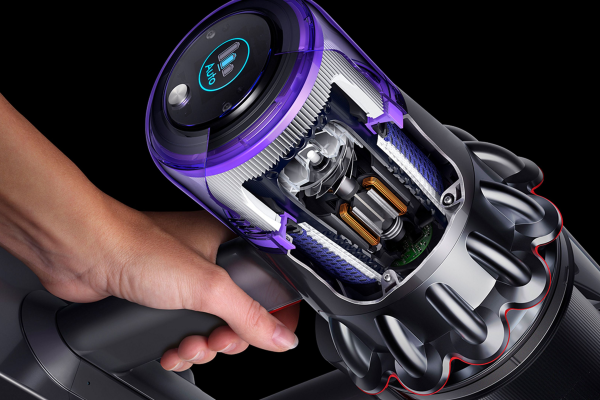
▲ Dyson V11 Torque Drive (Photo = Dyson)
This is a market change brought about by the development of motors. As motors with freely adjustable speeds and long lifespans become widely available, manufacturers can now implement the functions they want. And in order for manufacturers to implement the motor functions they want, they need a variable speed drive solution to control the motor.
What solutions are needed to implement variable speed drives?
We asked Geunhyung Lee, Manager of the Industrial Power Semiconductor Business Unit at Infineon Korea, about iMOTION, Infineon's variable speed drive solution.
Q1. There is a growing number of companies, including Dyson and LG Electronics, that are marketing their home appliances using BLDC motors or inverters. What are the advantages of using BLDC motors in home appliances?
With the increasing demands for energy efficiency, lifespan, noise and safety in recent motor applications, the use of BLDC motors is increasing in various fields.
Unlike the AC motors used in the past, BLDC motors do not have brushes or commutators inside, so there is no wear and tear and they have a long lifespan. There is no mechanical friction, so low-noise operation is possible. In addition, they can be operated at higher RPMs, and because of their structure, there is no dust caused by mechanical friction, and they are protected from the outside through the housing, making them environmentally friendly and safe.
Q2. Due to the characteristics of the products in which BLDC motors are used, it seems that they often change speed and direction depending on the situation rather than rotating at a constant speed. What parts and technologies are needed for this control?
Unlike AC motors that only operate on and off, BLDC motors can control their speed as needed, which requires a variable speed drive.
To implement a variable speed drive, AC is functionally rectified and the motor speed is controlled through the inverter stage via the DC link capacitor. In this process, a PFC stage may be required to meet the power factor standard. In addition, a controller and sensor that can control this variable speed drive as a whole are required.
The core parts among these are the PFC section, the inverter section, and the motor control section. For a 3-phase motor, configuring an inverter requires six power switches (MOSFETs or IGBTs and diodes), a gate driver IC with protection against overvoltage, overcurrent and overload, and a temperature sensor.
Although it is possible to construct these as individual components, IPM (Intelligent Power Module) that integrates all components into one is widely used for convenience of development, simplification of assembly process, ease of parts procurement, and high system reliability.
For motor control, MCU or motor controller is also used. If MCU is used, motor control algorithm must be developed independently, so software engineering capabilities are required as well as knowledge of motors.

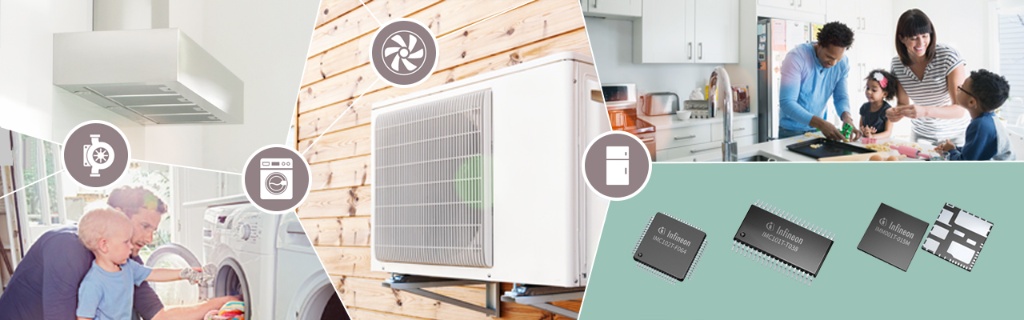
▲ Infineon's digital motor controller solution
iMOTION (Photo = Infineon)
Q3. What exactly is iMOTION, Infineon's motor control solution? I wonder if it is the name of a product line or the name of a related technology. Also, is it a product or technology that can respond to AI? iMOTION is the general name for Infineon's motor control product line. iMOTION can be broadly divided into three product lines.
The iMOTION Controller, which I will introduce first, is a product with a built-in MCE (Motion Control Engine). MCE is a dedicated motor control solution. This product offers MCE or Cortex-M0. The MCE version focuses on ease of use, while the Cortex-M0 version focuses on flexibility to allow customers to utilize their own code. We also offer products that embed MCE + Cortex-M0 in one package. Users can implement an inverter by combining iMOTION Controller and IPM.
Next is the iMOTION Smart driver family. This product integrates the gate driver IC into a single package on the MCE or Cortex-M0. Users can implement an inverter with a combination of the iMOTION Smart driver and a power discrete.
Finally, there is the iMOTION Smart IPM family. This product integrates power switches and temperature sensors, allowing the inverter stage to be implemented as a single component. However, the product currently in production is limited by the package size, so the maximum implementable power is less than 100 W, and is only used in applications where very small inverters are required, such as hair dryers. Infineon plans to launch products that can be applied to high-power motors using various packages in the future.
Q4. As the market is changing rapidly, it is said that companies are often implementing motor control with external solutions rather than their own solutions. What is the difference between iMOTION and other companies’ solutions?
Hardware engineers with motor and power knowledge can develop motor control solutions in a short period of time using iMOTION products without separate complex software knowledge. Another advantage is that the control solution can be maintained and changed to suit changing motor specifications.
In particular, it can be said that the part that differentiates it from existing motor control ICs is not only ease of use but also the part that allows engineers to finely tune the specifications they want.
Q5. There are as many types of applications as there are customers. Can customers upload their own motor control algorithms to iMOTION? Also, what Cortex-M0 options are available to customers?
The iMOTION family offers both MCE and Cortex-M0 versions, and the Cortex-M0 version can be used when uploading the customer's motor control algorithm. There are three iMOTION options available to customers: MCE only, Cortex-M0 only, and MCE+Cortec-M0 dual.

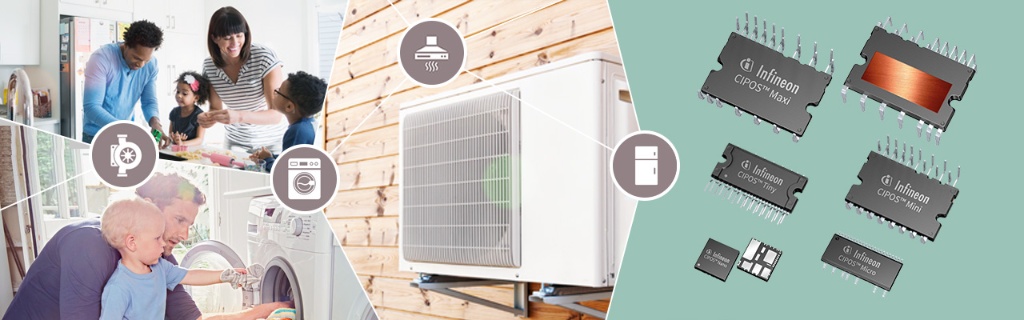
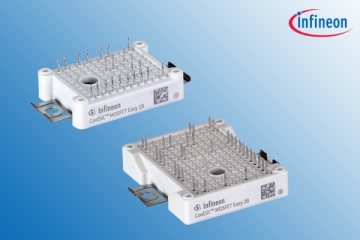
▲ Infineon's intelligent power module solution
CIPOS (Photo = Infineon)
Q6. Looking at the iMOTION product line, it is divided into the IMM100, IMC100, and IRMC series. What are the differences between the three series?
The IMM100 series is the name of the Smart IPM product line, and the IMC100 series is the name of the Controller product line. Also, the IRMC series is the name of the 1st generation iMOTION product line, and the IMM series is the name of the 2nd generation product line.
Q7. What types of control algorithms does the built-in MCE support?
The built-in MCE basically supports sensorless FOC (Field-Oriented Control). It also provides analog & digital Hall sensor type options.
For cases where power factor control is required, PFC control is optionally available along with the motor control algorithm. PFC supports two topologies: boost PFC and totem pole PFC.
Q8. I am curious about the certifications that the built-in MCE has received. Also, to what extent do these certifications apply and is it possible to skip the certification check?
The embedded MCE is a pre-certified ICE60353 (Class B / UL) product, so it does not omit certification at the customer product level. However, it can reduce the effort and time required for the customer to obtain product level UL certification.

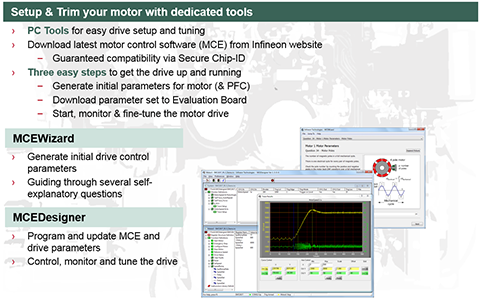
▲ MCE Wizard and Designer (Image = Infineon)
Q9. Infineon provides tools for motor control, including MCE Wizard and Designer. What are the differences between the two programs?
MCE Wizard is a PC-based tool that allows you to easily generate motor control algorithms by entering motor specifications.
MCE Designer is a PC-based application tool that helps you precisely tune the algorithms generated in the wizard to fit actual motors.
Q10. Can iMOTION only be used in BLDC motors used in small home appliances? Are there any plans to use iMOTION in other fields in the future, such as the battlefield? Or are there other product groups?
In order to be applied to the battlefield, it must be qualified for battlefield AEC Q100. The products currently in mass production are not certified for battlefield use and are mainly suitable for household and industrial use.
Infineon's iMOTION The product range is For the time being, we plan to focus on large-scale household and industrial applications.
Q11. Some Infineon products use DCB packages. Why do DCB packages have better thermal characteristics than FullPack packages? Also, what is the difference between FullPack and Advanced Isolation packages?
DCB and Full Pack are used in IPM product packages. Full Pack is EMC (Epoxy Mold Compound), while DCB (Direct Copper Bonding) is a product that improves heat dissipation properties by using copper bonding on the heat sink contact surface.
Advanced Isolation is a technology applied to Infineon IGBT discretes. The existing TO-247 full pack is easy to use, but its heat dissipation characteristics are relatively poor, and the general TO-247 package has the inconvenience of having to use an insulating paper on the outside. Advanced Isolation is a solution that improves this and satisfies both ease of assembly and excellent heat dissipation characteristics.
Efficient implementation of BLDC motor control requires not only software engineering capabilities but also specialized knowledge of motors.

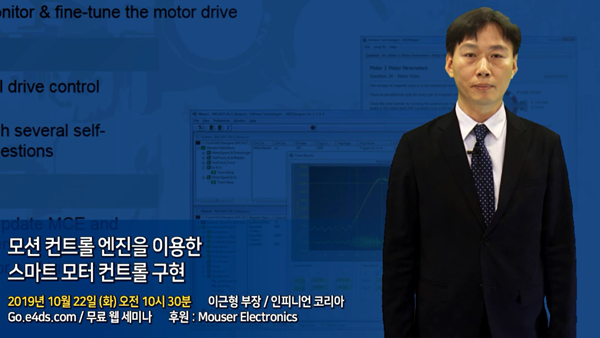
▲ Webinar on implementing smart motor control using MCE (Image = e4ds)
Engineers who want to implement their own motor control in the shortest possible time with minimal engineering resources can learn more through e4ds' 'Implementing Smart Motor Control Using Motion Control Engine' on the 22nd.
본 기사에 대한 정정·반론·추후보도 청구는 보도 청구 안내를, 그간 게재된 보도문은 정정·반론보도 모아보기를 참고해 주세요.