


5G commercialization is about to begin for the first time? We're still in the 4.5G era.
 Published2019.11.07 17:51
Unlike the 3.5GHz band, the 28GHz band is not used.
There is no suitable use for it, so we need to think about how to utilize it.
December 1st marks exactly one year since South Korea became the first country in the world to launch 5G commercial services. Commercial 5G mobile communications services began on April 3rd, and the Ministry of Science and ICT projects that approximately 5 million people will subscribe to 5G mobile communications services by the end of the year.
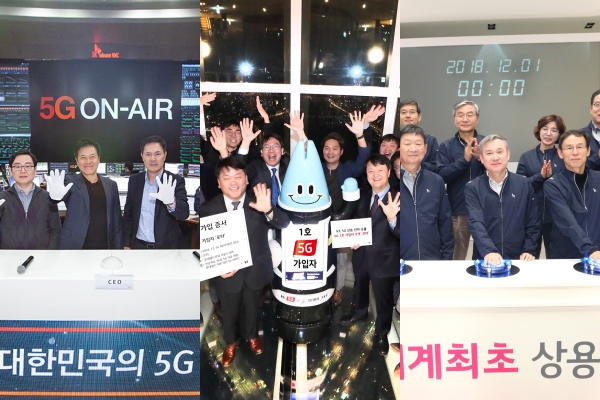
Looking at the number of subscribers alone, this is a remarkable achievement, but the third-quarter performance of the three mobile carriers is not so good.
SK Telecom's operating profit for the third quarter of this year was 302.1 billion won, a 0.7% decrease compared to the same period last year. KT's operating profit was 369.5 billion won, a 15.4% decrease compared to the same period last year. LG Uplus' operating profit for the third quarter of this year was 155.9 billion won, a 31.7% decrease compared to the same period last year.
Industry analysts say that while the number of 5G mobile subscribers has increased, operating profit has decreased due to increased marketing and network investment costs. In fact, 5G smartphones such as Samsung Electronics' 'Galaxy S10 5G' and LG Electronics' 'V50 ThinQ 5G' are being sold at a cheaper price than LTE smartphones in the market.
So far, 5G commercial services have only achieved superficial success. Service providers haven't seen any discernible benefits from 5G, and users haven't been able to discern any differences between 5G and LTE. 5G isn't really 5G yet; it's still 4.5G.
5G can't stand alone yet
Currently commercialized 5G does not operate independently. This is because 5G standalone (SA) mode, which operates independently, has not yet been commercialized. The currently used 5G non-standalone (NSA) mode operates alongside LTE.
Unlike 5G SA, 5G NSA's underlying technology emerged in 3GPP Release-12, before the 5G standard even existed. DC (Dual Connectivity) technology, which allows terminals supporting Rx (Receive) and TX (Transmit) to simultaneously use resources controlled by more than one base station, was designed to provide seamless LTE service in areas with high user traffic.
LTE terminals located in areas where the coverage of LTE base stations using frequencies below 2.6 GHz and LTE small cell base stations using the 3.5 GHz band overlap can utilize the resources of both base stations through DC technology. The 3.5 GHz band was later defined to be supported by 5G technology.
NSA was deployed faster than SA because the infrastructure was already established to some extent with LTE. As of November, SA is conducting demonstrations linking 5G core equipment, base station equipment, and additional equipment from different manufacturers, and it is expected that full commercialization will begin in the first half of next year.
5G still only goes one way
In June 2018, the Ministry of Science and ICT announced the results of the 5G spectrum auction. After fierce bidding, SK Telecom and KT won 100MHz of the 280MHz bandwidth in the 3.5GHz band for 1.2185 trillion won and 968 billion won, respectively. LG Uplus won the remaining 80MHz for 809.5 billion won.
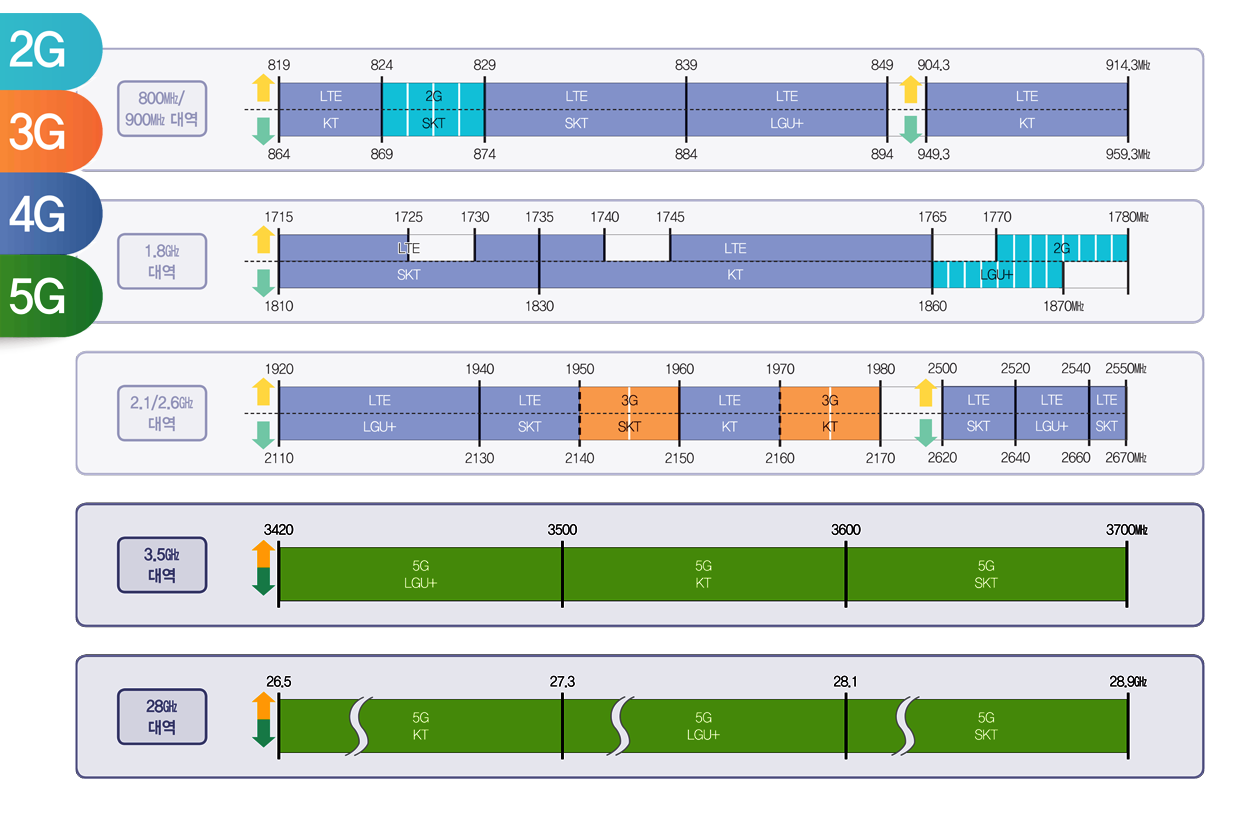
(Source: Korea Communications Commission)
Meanwhile, the 28GHz band was awarded to three companies, SK Telecom for 207.3 billion won, KT for 207.8 billion won, and LG Uplus for 207.2 billion won, each for 800MHz of bandwidth. This is because, unlike the 3.5GHz band, which has high immediate utilization, the 28GHz band was not.
The 3.5GHz band falls within the sub-6GHz band, while the 28GHz band falls within the mmWave band. mmWave is faster than sub-6GHz. In fact, the ultra-high speeds, ultra-low latency, and hyper-connectivity characteristics of 5G can be experienced in mmWave, not sub-6GHz.
However, mmWave's fast, straight-line signal characteristics make it difficult to avoid obstacles due to its low diffraction. This requires more base stations than the current sub-6GHz base stations. All three companies are targeting 2020 as the first year for the launch of 28GHz services.
To utilize the infrastructure, chipsets supporting mmWave must also be developed. Qualcomm plans to release a chipset supporting the 28GHz band by the end of this year. Unfortunately, currently available 5G smartphone modems do not support 28GHz, making it impossible to experience mmWave speeds.
5G is still not very useful
Even a string of beads is a precious jewel. Even if 5G is theoretically 20 times faster than LTE, has one-tenth the latency, and offers 10 times the connectivity, its intended use must be clear. 5G must not be just "fast LTE," but simply "5G."
The industry is focusing on the potential of 5G and devising effective ways to utilize it. Areas where 5G will be effectively utilized include C-V2X-based C-ITS, VR/AR/MR, holograms, and smart factories.
Cooperative-Intelligent Transport Systems (C-ITS) are next-generation intelligent transportation systems that provide drivers with real-time information on surrounding traffic conditions and accident risks while driving. They utilize 5G-based C-V2X (Cellular Vehicle-to-everything) technology for communication between vehicles and surrounding objects. The Ministry of Land, Infrastructure and Transport has been promoting the C-ITS project until the end of this year, conducting various demonstration projects across the country, and the three major mobile carriers have participated. However, related legislation remains insufficient, making commercialization a distant prospect.
VR/AR/MR and holograms are next-generation content formats that have gained traction thanks to the real-time transmission of large amounts of data via 5G. However, questions remain as to whether users truly desire them. For example, on October 15th, Google halted its "Google Daydream VR" project, which aimed to be a VR version of YouTube, after three years. The company concluded that VR could not grow into a mass-market content market. Holograms, while a form of content requiring large-scale data transmission, have not yet been clearly implemented.
AR and MR have great potential for application in industries like manufacturing, as they can be combined. For example, using AR glasses or goggles or a smartphone, users can check the internal condition of equipment simply by looking at it or pointing it at it, without having to disassemble it. Unskilled workers can also use AR to model skilled workers and follow their example. 5G can be utilized for data transmission in these situations.
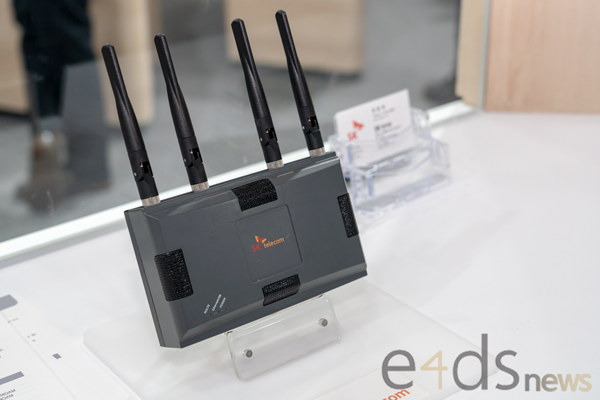
However, 5G isn't being used in manufacturing processes. In industrial settings, wired communications like Ethernet are still preferred over wireless due to their stability. Even in wireless communications, competition with Wi-Fi, Bluetooth, and Zigbee is inevitable. Industrial 5G modems are also still in their infancy. SK Telecom has no commercialized products other than the 'Industrial 5G Modem' introduced at the '2019 Internet of Things International Exhibition' on October 23.
Why We Still Need to Go 5G
An industry insider explained, "At this point, 5G mobile subscribers are beta testers," citing the lack of sufficient infrastructure and content to implement 5G performance. He added, "That's why we need to focus even more on 5G."
Since liberation, Korea has always been a latecomer, forced to enter mature markets. A recent example is AI. While AI is now becoming a foundational technology for virtually every industry, significant investment in it began only after the 2016 match between Lee Sedol and AlphaGo.
5G is different. Only a handful of countries around the world have commercialized 5G. Despite numerous trials and errors, Korea remains a leader in 5G. This is because it has gained a year of experience firsthand.
Countries entering the 5G market in the future will learn from Korea's expertise and rely on its technological prowess. While the 5G marketing slogans of ultra-high speeds, ultra-low latency, and hyper-connectivity still feel like a fantasy, they will soon become reality. When that day arrives, the 5G capabilities our companies have built up over the years will become a valuable asset.
Of course, this won't be of any consolation to those who pay expensive 5G rates and use 5G smartphones in LTE priority mode.
Comments 2
2 Comments:
Related news
KT Demonstrates 28GHz Band Enterprise 5G Network Technology
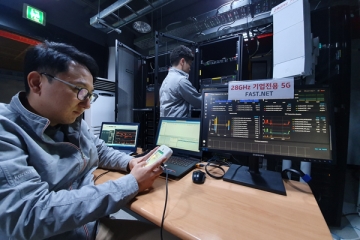
KT demonstrated FAST.NET, an enterprise-dedicated 5G network technology, using the 28GHz frequency band. The FAST.NET technology is KT's ultra-low latency infrastructure technology designed to transmit all data from terminals through networks to services within a round-trip latency of 10ms or less. It is a core technology for future enterprise-exclusive 5G networks aimed at realizing autonomous vehicles and smart factory automation control. In the demonstration, using 5G base station equipment and terminals supporting the domestic 28GHz band, ultra-low latency data transmission of a minimum of 5ms and an average of 8ms was achieved in actual wireless environments.
2019.10.31by 이수민 기자
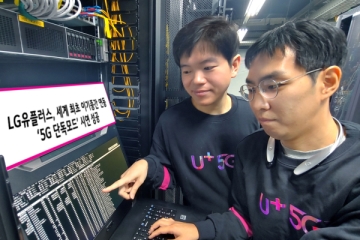
U+ succeeds in demonstrating interoperability of heterogeneous equipment based on 5G SA
LG U+ announced that it successfully demonstrated 5G services by interoperating core equipment, base station equipment, and ancillary equipment manufactured by different equipment vendors based on the 5G SA standard. While there have been previous successful interoperability tests between SA-based base stations and core equipment from the same manufacturer, this is the first time that equipment from different manufacturers such as Samsung Electronics and Ericsson has been successfully interoperated. Additionally, the company succeeded in demonstrating network slicing and MEC, which are key 5G technologies.
2019.11.05by 이수민 기자

The Ministry of Science and ICT and the UK are conducting joint research on 5G-based AR/MR services.
The Ministry of Science and ICT will launch a Korea-UK international joint research project with the UK Department for Digital, Culture, Media and Sport to develop 5G-based immersive content services in high-speed environments. On the 6th, a joint research kick-off workshop will be held at ETRI in Daejeon with approximately 50 participants including government officials and research personnel from both countries. This research was first discussed at the 3rd Korea-UK ICT Policy Forum held in Seoul in February 2018, and has been planned over approximately one year. The joint research topics are 5G ultra-high frequency wireless transmission and ultra-high-speed immersive media services in high-speed train environments. Korea will focus on developing 5G technology for real-time transmission of ultra-high-capacity information inside subway trains, while the UK will focus on developing ultra-high-speed AR/MR technology that can be operated on 5G networks.
2019.11.05by 이수민 기자
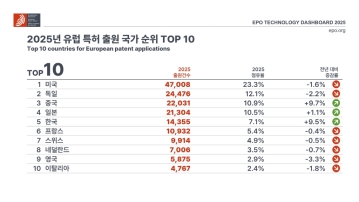
European Patent Applications Surpass 200,000 for the First Time… South Korea Maintains 5th Place, Led by Batteries and Telecommunications
According to the European Patent Office (EPO)'s 'Technology Dashboard 2025', European patent applications last year reached 201,974, surpassing 200,000 for the first time. Korean companies and inventors filed 14,355 applications, representing a 9.5% increase from the previous year and maintaining 5th place by country. Battery, digital communication, and semiconductor technologies led the growth, with Samsung ranking as the top EPO applicant for the second consecutive year and LG reaching 3rd place. The presence of major domestic cities such as Seoul, Suwon, and Yongin was also confirmed. It was also revealed that Korea's European patent strategy is expanding beyond individual technologies to span the entire industry.
2026.03.24by 명세환 기자
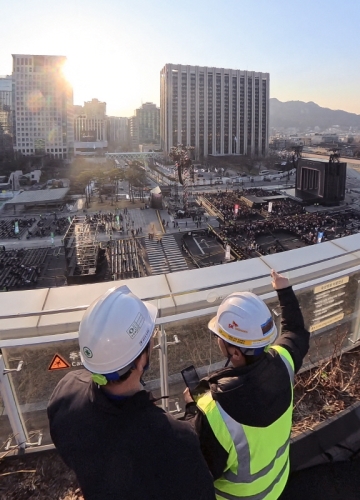
SK Telecom First Applies AI-Based Network Operations at Gwanghwamun K-Pop Concert
SK Telecom announced that it applied an AI-based network operation system for the first time at a large-scale K-pop concert held in the Gwanghwamun area of Seoul on March 21st, managing communication quality throughout the event. Mobile data usage during the three hours before and after the concert reached 12.15TB, approximately doubling compared to the same time slot the previous weekend. SK Telecom monitored traffic using the AI system 'A-One' in five-minute and 50-meter units to respond to potential overload situations, while also operating temporary communication facilities and on-site personnel in parallel. This case is interpreted as confirmation of the practical applicability of AI-based autonomous network operation in an environment where demand from dense events and foreign users increases simultaneously.
2026.03.23by 명세환 기자












좋은 기사네요. 기자 엄지 척~!
좋은 정보 감사합니다