



Microchip Expands EERAM Memory Solution Capable of Preserving Data Even When Power Is Cut Off
 Published2019.12.03 14:55
Standalone non-volatile RAM memory used
Application products requiring repetitive data logging tasks, ranging from smart meters to manufacturing production lines, must be able to automatically restore their contents if power is interrupted during processing. Existing low-density (64Kb to 1Mb) non-volatile (NV) SRAM products used for such data logging generally have the disadvantage of a high cost per bit in the final product.
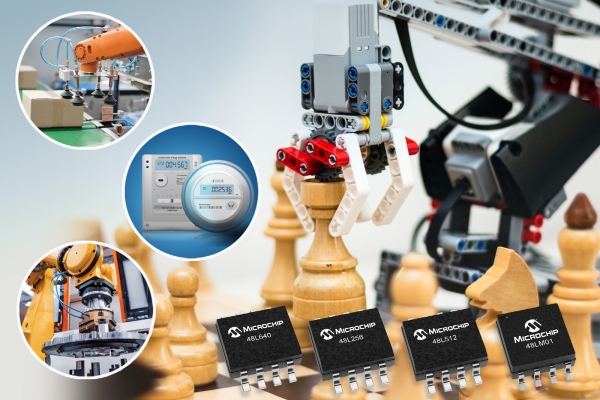
EERAM Memory Solution Launched (Image=Microchip)
On the 3rd, Microchip Technology announced a new family of Serial Peripheral Interface (SPI) EERAM memory products that enable system developers to reduce costs by up to 25% compared to existing Serial NVRAM products.
With the launch of this product family, Microchip’s EERAM portfolio has added four densities of SPI products ranging from 64Kb to 1Mb.
EERAM is a product that combines EEPROM and serial SRAM, and is a standalone non-volatile RAM memory that uses SPI and I²C protocols, such as serial SRAM. If the device loses power, the SRAM contents are preserved even without using an external battery.
When the device detects that the power is off, it automatically transfers SRAM data to non-volatile storage, and moves the data back to SRAM after power is restored. In the case of a manufacturing production line, each station handles millions of tasks over its entire lifespan.
Data loss occurring during the execution of each of these tasks can lead to situations where multiple items must be inspected or discarded. In such situations, EE RAM automatically saves the contents of the SRAM, enabling work to resume from the point where the production line stopped.
EE RAM has become more affordable by using standard CMOS and flash processes. Alternative solutions, such as Ferroelectric (Fe) RAM, utilize specialized processes, resulting in significantly higher prices and unstable supply in the long term. The new EE RAM product family is subject to Microchip's customer-centric discontinuation policy, allowing customers to continue purchasing it as long as they need it.
Randy Drwinga, Vice President of Microchip’s Memory Products business unit, said, “EE RAM can provide system developers with the reliable and cost-effective non-volatile RAM solutions required for systems.”
"He added, 'The new product family being launched includes Microchip's first SPI interface products up to 1 Mb, providing many options to meet system design requirements.'"
Comments
Related news

Visualizing Smart Factories with Real-Virtual Synchronization CPS
Smart manufacturing is manufacturing utilizing ICT, and the production system that implements this is a smart factory. A smart factory combines various ICT technologies at the production site to intelligentize the equipment and processes of individual factories and connects them through a network. Connected factories share all production information in real-time and operate efficiently and autonomously by utilizing that information. The primary objective of a smart factory is efficient, flexible, autonomous intelligent design and operation. The key concept applied for this purpose is a Cyber-Physical System (CPS) that actively and autonomously performs cognition, judgment, and action. CPS is a computer-based component and system that connects to and utilizes digital models in the cyber world.
2019.10.07by 이수민 기자
What smart factory sensor technologies should we pay attention to now?
Germany's Industry 4.0, defined by the German government for the revival of German manufacturing, pursues mass production of diverse product types, unlike the heavy and rigid Industry 3.0, through modular processes, variable and flexible equipment, autonomous and distributed control, wireless communication, and real-time location tracking. To realize Industry 4.0, sensors mounted on each piece of equipment in smart factories are trending toward transformation into MEMS that integrate sensing elements and sensor SoCs equipped with intelligent algorithms, moving away from board-form implementations.
2019.10.21by 이수민 기자

How to Efficiently Manage Power Distribution Facilities in Large Plants?
BASF's Beaumont Plant, part of the world's largest chemical company, serves as a key pillar of BASF's agricultural division. Schneider Electric has deployed EcoStruxure Asset Advisor services in BASF's new substation that supplies power throughout the Beaumont Plant's production processes. EcoStruxure Asset Advisor services evaluate and analyze real-time data from key connected assets to prevent potential threats. Through a service team comprised of power and distribution specialists, Schneider Electric provides BASF with customized advice and predictive maintenance information necessary to optimize maintenance strategies.
2019.11.12by 이수민 기자

Intel Unveils Next-Generation 'Core Ultra Series 3' and vPro Platform for Enterprise PCs
Intel has officially unveiled the "Intel Core Ultra Series 3" for next-generation enterprise PCs and the latest vPro platform, addressing a wide range of demands from enterprise notebooks to high-performance workstations.
2026.03.26by 배종인 기자

ROHM Launches ESD Protection Diode Compatible with High-Speed Interfaces of 10Gbps or Higher
Semiconductor specialist ROHM has developed the 'RESDxVx series' of ESD (electrostatic discharge) protection diodes capable of responding to next-generation high-speed data communication environments exceeding 10Gbps, simultaneously enhancing both signal quality maintenance required in high-speed interfaces and IC protection performance.
2026.03.26by 배종인 기자











