


Cause of performance degradation in electric vehicle lithium-ion batteries revealed.
 Published2019.12.17 09:45
Establishment of a platform for analyzing electrode material performance degradation mechanisms.
Laying the foundation for designing next-generation battery materials for electric vehicles
As electric vehicles become more widespread, attention is focused on the performance and longevity of their power sources, lithium-ion batteries. Unlike conventional, compact lithium-ion batteries, electric vehicle lithium-ion batteries must be able to operate without issues even under high-output conditions, such as rapid acceleration.
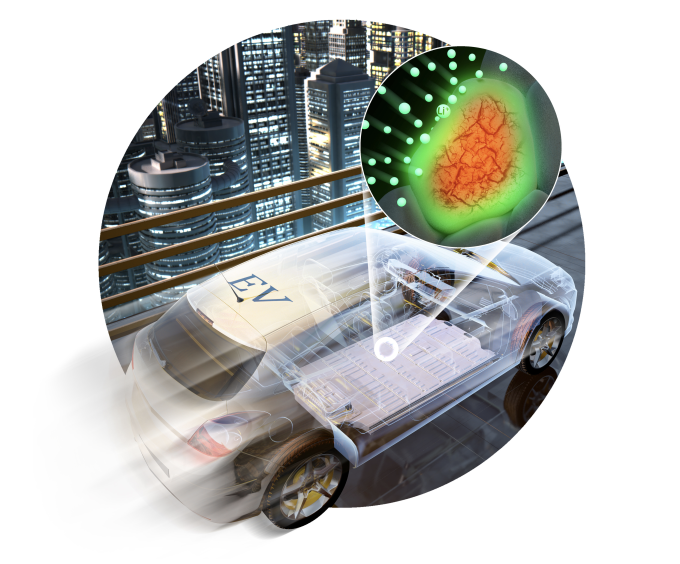
A joint research team led by Dr. Won-Young Jang of the Energy Storage Research Group at the Korea Institute of Science and Technology (KIST) and Dr. Seung-Min Kim of the Carbon Convergence Materials Research Center at the Jeonbuk Branch announced on the 3rd that they have built a platform that can identify the degree of deformation of electrode materials and deterioration of electrochemical performance when lithium-ion batteries for electric vehicles are used rapidly.
When lithium-ion batteries are used at high power, the batteries discharge rapidly. Under such rapid charging and discharging conditions, a problem occurs in which the battery capacity is significantly reduced compared to that obtained during slow charging and discharging.
This repetition of high-power charging and discharging ultimately reduced the lifespan of lithium-ion batteries, making it difficult to expand the electric vehicle market.
In a previous study, Dr. Won-Young Jang's research team at KIST established a platform that can analyze the performance degradation of lithium-ion batteries that occurs when rapidly charging them by analyzing ternary (Ni, Co, Mn) cathode (+) materials.
This time, we analyzed a different cathode material, 'high-nickel material (NCA),' to determine the performance degradation that occurs when the battery is rapidly discharged due to excessive use.
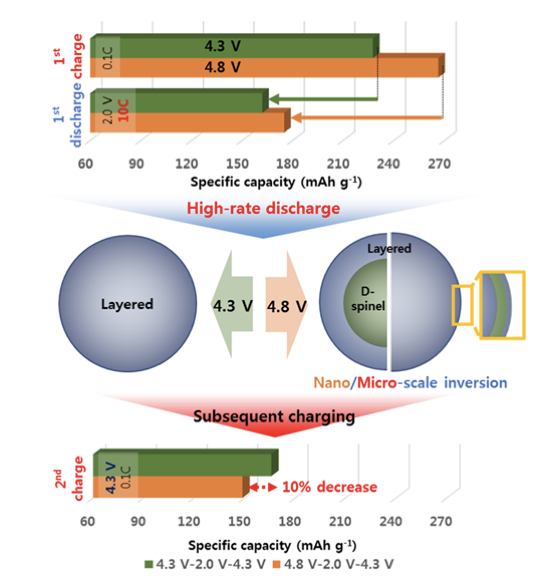
Changes in battery capacity reduction according to voltage conditions
Correlation between surface and bulk internal structure changes (Image = KIST)
The research team analyzed deformation of electrode materials that can cause operational errors and safety accidents in various driving environments of electric vehicles, such as rapid charging and discharging of lithium-ion batteries.
Through this, it was revealed that rapid discharge phenomena such as rapid acceleration limit the amount of lithium ions transferred to the positive electrode, and as a result, internal deformation of the incompletely recovered electrode material is ultimately a factor in the reduction of battery capacity and shortened lifespan. />
It was also confirmed that the instability of this electrode structure increases further when charging and discharging at high voltage for high-capacity use.
The research team established a performance degradation analysis platform for battery materials that can identify at a glance the subtle initial changes occurring in the internal structure of the electrode that lead to performance degradation over a wide range of conditions, and elucidated the performance degradation mechanism of battery materials.
Dr. Jang Won-young said, “Through this research, we have discovered the mechanism of battery performance degradation due to irregular internal deformation of battery materials during rapid acceleration of electric vehicles,” and “Based on this, we will develop stable battery materials that do not have performance issues during rapid acceleration in the future.”
Meanwhile, this research was conducted with support from the Ministry of Science and ICT as a major project of KIST and as a mid-career researcher support project of the National Research Foundation of Korea, and the results of the research are scheduled to be published as a cover paper in the latest issue of 'Angewandte Chemi,' an international academic journal in the field of chemistry.
Comments
Related news
Schneider Electric Announces First Version of 'Galaxy VS 3-Phase UPS' with Built-in Smart Battery Module
Schneider Electric has announced the first version of the Galaxy VS three-phase uninterruptible power supply with an integrated smart battery module. The Galaxy VS is a modular three-phase UPS with easy installation, designed to meet critical power requirements for IT facilities, commercial and industrial establishments, and delivers up to 99% energy efficiency to ensure sustainable business performance.
2019.12.03by 이수민 기자

ADI Battery Management ICs to be Featured in Rimac Supercars
ADI's battery management system IC is set to be installed in the battery management system of Rimac Automobili, which is renowned for its electric supercars. The BMS acts like a brain for the battery pack, not only managing output, charging, and discharging while the vehicle operates, but also providing precise measurement capabilities. Additionally, it provides safety functions that protect the battery from various hazards.
2019.12.03by 이수민 기자
LG Chem to Establish EV Battery Cell Joint Venture with GM
The US electric vehicle market is expected to grow at an average annual rate of 26%, from 520,000 units this year to 910,000 units in 2021 and 1.32 million units in 2023. LG Chem and GM announced on the 5th local time that they have signed a joint venture agreement. The two companies plan to invest a total of approximately 2.7 trillion won in phases to secure battery cell production capacity of 30GWh or more.
2019.12.06by 이수민 기자
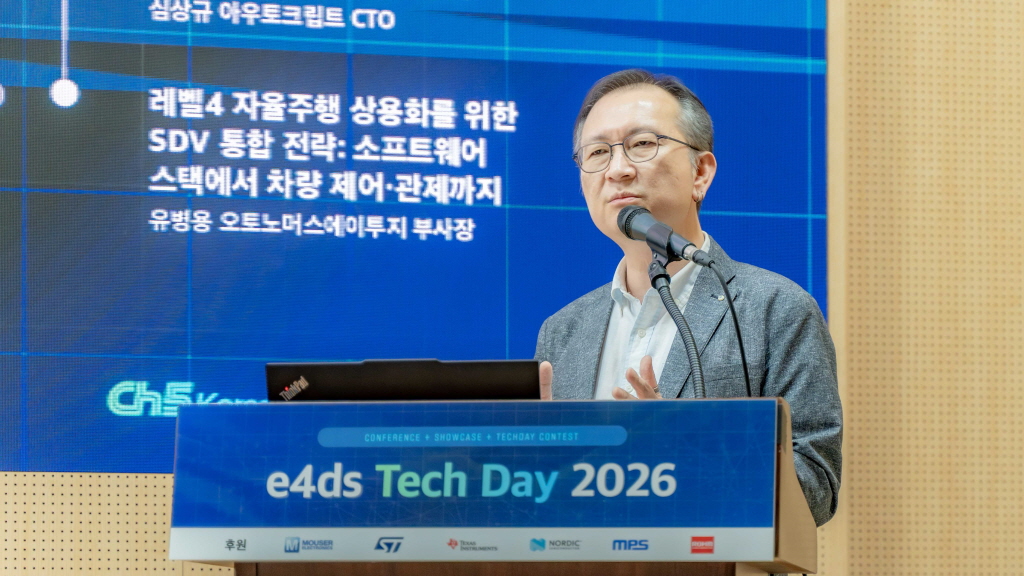
[e4ds Tech Day 2026 ⑨] Sim Sang-gyu, Autocrypt CTO: "In the Physical AI Era, Automotive Security Must Extend Beyond the Vehicle"
At e4ds Tech Day 2026, Sim Sang-gyu, CTO of Autocrypt, explained automotive cybersecurity strategies in the era of Physical AI and SDV (Software-Defined Vehicle). Automobiles are evolving as part of an ecosystem connected to AI, cloud, chargers, IoT, and robots, and he emphasized that the scope of security must expand beyond the vehicle interior to the entire connected environment. In particular, AI model tampering, adversarial attacks, OTA updates, and EV charger hacking were identified as major threats. He explained that response measures require zero trust, AI model integrity protection, intrusion detection, Security by Design and Default, and full lifecycle security management, and that proactive security system establishment beyond regulatory compliance is critical for securing future mobility competitiveness.
2026.10.12by 배종인 기자

Practical HIL Construction Strategy for Automotive and Off-Highway Controller Validation
As vehicle E/E architecture transitions to zonal structures and shifts to software-defined vehicles (SDV), the number of controllers (ECUs) requiring validation and software complexity are surging dramatically. Meanwhile, real vehicle testing cannot provide repeated verification under identical conditions and entails lead time and safety concerns. This white paper explains the principles of HIL (Hardware-in-the-Loop) validation and the structure of the NI platform composed of PXI, SLSC, and VeriStand, and through two actual implementation cases—Camera Record & Replay HIL for In-Cabin Monitoring Controller (ICMU) and Forklift Controller (VCU) HILS—describes how controller-level regression testing becomes possible. Additionally, it explicitly states application boundaries and limitations, such as lack of A2B support.
2026.10.12by 편집부











