



Top 5 Technology Trends for 2020, the Inaugural Year of the Data Era
 Published2019.12.19 10:12
PCs Transform into Efficient Assistants with AI and ML
We need sustainable innovation that is not harmful to the planet.
In 2020, data is expected to transform from a new resource into a tangible resource, and efforts to utilize it are expected to continue.
(Image = Dell Technologies)
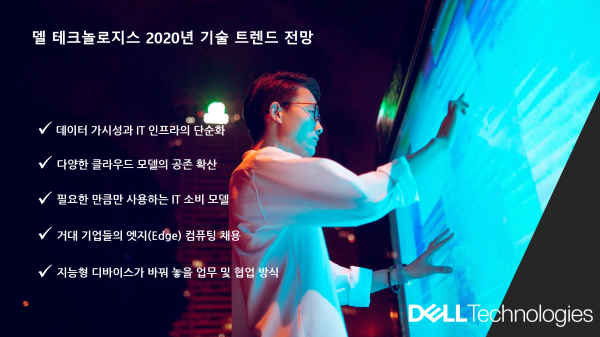
On the 19th, Dell Technologies announced its forecast for innovation and technology trends over the next 10 years.
Dell Technologies, viewing 2020 as the inaugural year of the Next Data Decade, predicted the technologies and innovations that form the foundation of this new data era, such as computing, edge, and cloud, which process the rapidly increasing amount of data.
Simplifying data visibility and IT infrastructure
While many companies manage rapidly increasing data across various locations such as the cloud, central data centers, and the edge, it has been found that data visibility—enabling IT personnel to easily and quickly access and analyze the data they need—is still lacking. Starting in 2020, such data visibility will become one of the top priorities for corporate Chief Technology Officers (CTOs).
Furthermore, it is predicted that digital innovation will be accelerated by simplifying and automating IT infrastructure and building systems and services into integrated solutions with clear and powerful control. A new chapter in data management is expected to open by ensuring consistency in architecture, orchestration, and service contracts.
Widespread coexistence of various cloud models
In 2020, the coexistence of public and private clouds is expected to become a more distinct reality. Multi-cloud strategies supported by hybrid cloud architectures will contribute to easier data access and secure data retention. IDC predicted that by 2021, more than 90% of enterprises worldwide will use a mix of on-premises, private cloud, multiple public clouds, and legacy platforms to meet their IT infrastructure requirements.
Private clouds do not simply reside at the center of data centers; as 5G and edge computing advance, real-time data visibility and management become possible regardless of where the data is located. Dell Technologies anticipates that security and data protection will be tightly integrated as part of the cloud environment and emphasized that cybersecurity must be converged across data management systems, from the edge to the core and the cloud.
IT consumption model using only what is needed
One of the biggest obstacles for decision-makers driving digital transformation is cost. Capital expenditures (CapEx) and operating expenses (OpEx) can be limiting factors when establishing annual cost plans. Accordingly, the adoption of Software as a Service (SaaS) and cloud consumption models is increasing, taking into account cost efficiency and workload flexibility.
Following this trend, Dell Technologies predicted that more organizations would transition to software-defined and cloud-based IT in 2020, forecasting that flexible consumption models based on usage as needed and IT as a service would rapidly become commonplace. Companies will be able to select models suitable for their business needs, secure data mobility and visibility, and easily handle even high-difficulty AI and machine learning workloads.
Adoption of Edge Computing by Giant Corporations
As discussions regarding the role and position of the edge continue, edge computing technology is also evolving. Taking the IoT as an example, the edge has become so ubiquitous today that it is difficult to find systems, applications, or services that are not interconnected. The edge is emerging in numerous locations and fields, and it is expected that large enterprises will lead its expansion in the future.
5G connectivity is creating new use cases and possibilities in the healthcare, financial services, education, and industrial manufacturing sectors. Consequently, SD-WAN and software-defined networking solutions have become a key link in integrated IT infrastructure solutions, enabling large-scale data workloads to move quickly and securely between edge, core, and cloud environments.
Dell Technologies stated that for long-term data management and protection, the flexibility and agility that only software-defined networks based on open networking can provide are essential.
How Intelligent Devices Will Transform Work and Collaboration
PC innovation is challenging limits and expanding horizons every year. Large-screen devices with immersive displays are becoming more common, and form factors are becoming smaller and thinner. AI and machine learning applications now recognize when and where to optimize power and computing based on user usage patterns. They also provide features that adjust sound and color based on the content the user is viewing or the game currently playing. Through biometric recognition, PCs recognize the user from the moment they look at the screen.
Dell Technologies predicted that advancements in AI and machine learning would make PCs smarter partners. Furthermore, it forecasted that smarter PCs would reduce user effort by automatically correcting errors and recovering systems, thereby significantly enhancing the efficiency and productivity of PC users and IT administrators.
Sustainable innovation
Dell Technologies predicted that sustainable innovation, which ensures that the activities of businesses and organizations do not have a harmful impact on the planet, will continue to be a major topic. It anticipated that increased investment in the reuse and recycling of industrial waste would accelerate, leading to smaller hardware, minimized electronic waste, and maximized the use of existing materials.
Kim Kyung-jin, General Manager of Dell Technologies Korea, said, “While there have been many changes over the past 10 years, the technological changes and social development of the next 10 years will be at an unimaginable level,” adding, “In 2020, these technological advancements and changes will accelerate even further.”
He added, “Companies and organizations must accelerate the implementation of digital strategies suited to the new data era so that humanity can achieve positive results in various areas, such as faster medical services, better access to education, and responses to global climate change.”
Comments
Related news

With 5G Commercialization One Year Ahead, Where Is Korea Heading?
# Translation 5G mobile communications are steadily expanding in Korea and several other countries. Gartner projected that global 5G mobile infrastructure revenue would reach $4.2 billion in 2020, an 89% increase from $2.2 billion in 2019. Additionally, it forecasted that 5G smartphones would capture 56% of the smartphone market by 2023, and that 5G-based IoT endpoints would increase approximately 14-fold from 3.5 million units in 2020 to 48.6 million units in 2028. With the growth of the 5G market now assured, what 5G roadmap does Korea have? The government's inter-ministerial Giga Korea project team is implementing the second phase of 5G convergence services initiatives. The project team has selected projects across five sectors with anticipated high synergy with 5G and is investing approximately 150 billion won in total project funding.
2019.10.06by 이수민 기자
.png)
What is the outlook for the Korean semiconductor industry and market in 2020? Semicon Korea 2020, pre-registration begins.
Semicon Korea 2020, which provides a glimpse into the future of the semiconductor industry beyond 2020, will be held for three days at COEX from February 5th (Wednesday) to 7th (Friday) next year. Approximately 500 semiconductor companies worldwide will set up roughly 2,200 booths, and 130 semiconductor experts from around the world are scheduled to conduct 25 or more technical programs.
2019.12.02by 이수민 기자
Global semiconductor equipment sales this year down 10.5% from last year… Room for rebound in next year and the year after
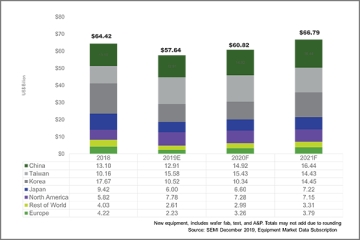
Global semiconductor equipment sales in 2019 fell approximately 10.5% from the record high of $64.4 billion in 2018, recording $57.6 billion. Semiconductor equipment sales in 2020 are expected to reach $60.8 billion, representing approximately 5.5% growth compared to this year, and are projected to record an all-time high of $66.8 billion in 2021. This is because major semiconductor manufacturers are expected to expand capital investments in equipment for sub-10 nanometer process nodes for foundry and logic semiconductor production.
2019.12.11by 이수민 기자
[e4ds Tech Day 2026 ⑨] Sim Sang-gyu, Autocrypt CTO: "In the Physical AI Era, Automotive Security Must Extend Beyond the Vehicle"
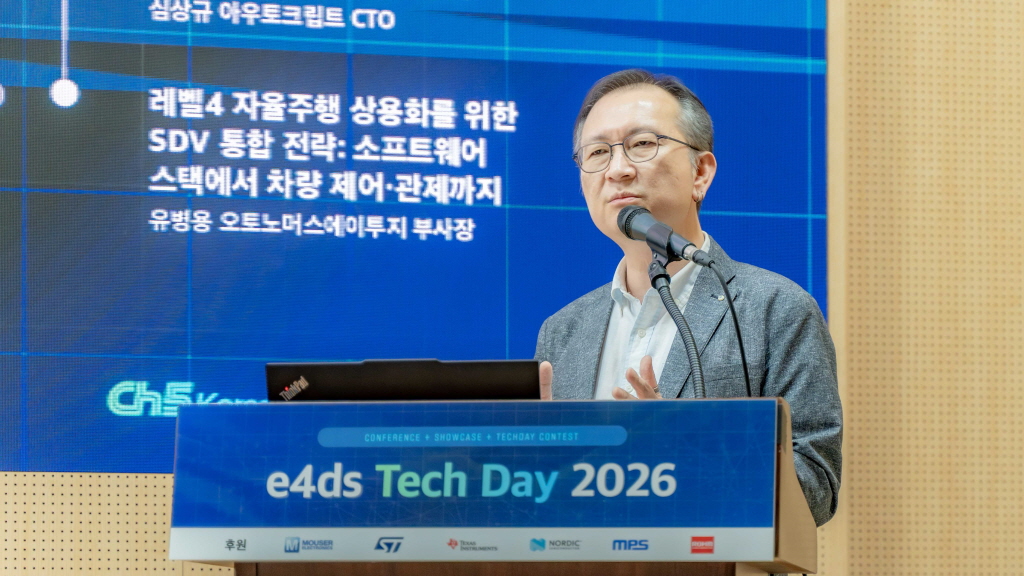
At e4ds Tech Day 2026, Sim Sang-gyu, CTO of Autocrypt, explained automotive cybersecurity strategies in the era of Physical AI and SDV (Software-Defined Vehicle). Automobiles are evolving as part of an ecosystem connected to AI, cloud, chargers, IoT, and robots, and he emphasized that the scope of security must expand beyond the vehicle interior to the entire connected environment. In particular, AI model tampering, adversarial attacks, OTA updates, and EV charger hacking were identified as major threats. He explained that response measures require zero trust, AI model integrity protection, intrusion detection, Security by Design and Default, and full lifecycle security management, and that proactive security system establishment beyond regulatory compliance is critical for securing future mobility competitiveness.
2026.10.12by 배종인 기자
NVIDIA to Invest $1 Billion in U.S. Science Over Next Five Years
NVIDIA has announced plans to invest $1 billion over the next five years to strengthen U.S. scientific and technological competitiveness. The company will enhance cutting-edge artificial intelligence research and development capabilities in key areas including quantum computing, healthcare, and energy security, while expanding support for higher education research institutions and cloud service providers. NVIDIA is participating as a major industry partner in the White House Office of Science and Technology Policy's Genesis Mission, and is promoting supercomputer construction in collaboration with national laboratories including Argonne and Los Alamos.
2026.10.12by 배종인 기자











